

A customer browsing for a car online today expects more than just listings—they expect instant responses, personalized engagement, and a seamless transition from digital discovery to dealership interaction. Yet, many automotive businesses still struggle with delayed responses, inconsistent communication, and fragmented customer journeys.
In this evolving landscape, AI is no longer experimental—it is operational. Sanjay Varnwal, CEO and Co-founder of Spyne, is at the forefront of this shift, building production-grade AI solutions tailored specifically for automotive retail workflows. From visual intelligence in vehicle merchandising to conversational AI that nurtures leads, his work reflects a deeper shift toward vertical AI ecosystems.
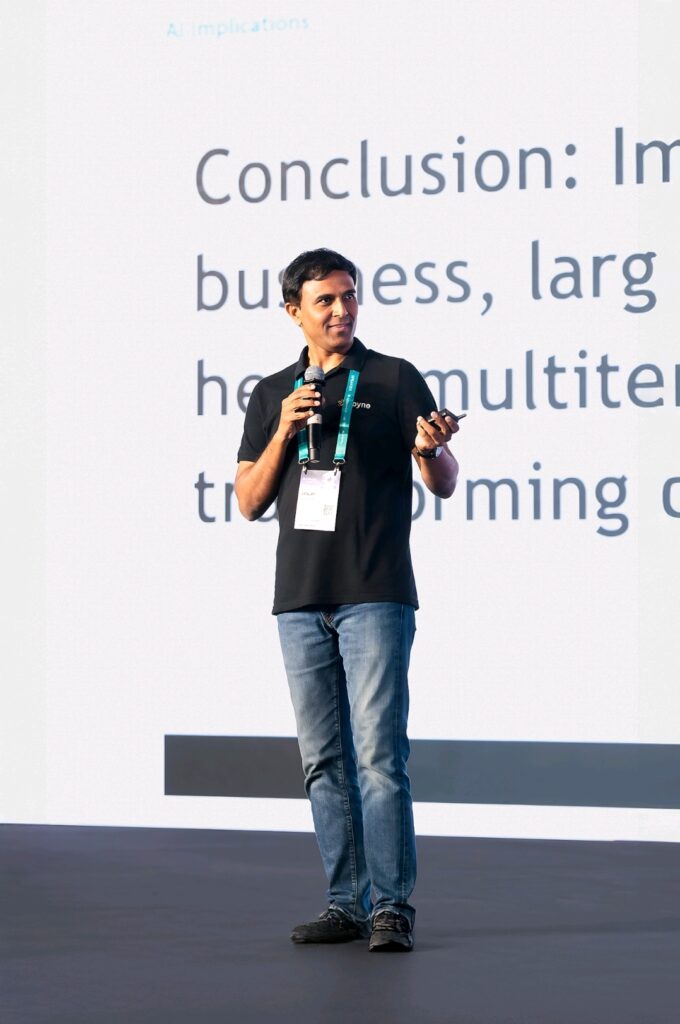
Speaking at AIBoomi Annual ’26 in Chennai on “Building Moats in an AI World,” Sanjay brings a practitioner’s perspective on how AI is moving beyond pilots into real execution environments. In this interview, we explore how CX leaders can rethink strategy, technology, and customer engagement in an AI-first era.
Market Context: The Rise of Vertical AI in Automotive CX
Automotive retail is undergoing a structural shift from generic digital tooling to vertically integrated AI systems.
Traditional CX stacks—CRMs, chat tools, listing platforms—operate in silos. Vertical AI, by contrast, integrates:
- Inventory presentation
- Lead engagement
- Qualification workflows
into a single, context-aware system.
This transition is being driven by one core reality:
Customer experience is now formed before human interaction begins
Dealerships that fail to operationalize this layer are not losing deals in negotiation—they are losing them before the conversation starts.
AI-driven Automotive Retail
Q1. How do you define customer experience in the context of AI-driven automotive retail?
SV: Customer experience in automotive has always been about trust. The problem is that trust used to be built entirely inside the showroom. That is no longer where buyers form their opinions.
Today, a buyer’s first impression of your dealership happens on a screen, often before they have spoken to anyone on your team. They are looking at your inventory, your images, and your responsiveness. And they are making judgments in seconds.
What AI changes is the ability to show up well at both of those moments consistently, not just when the right person happens to be available. At Spyne, that is the problem we went after first. How do you make sure a dealership’s first impression and first response are always strong, regardless of staffing, timing, or volume? That is the foundation of what we have built.
Customer-Centricity and Interactions
Q2. What does “customer-centricity” mean when interactions are increasingly handled by AI systems?
SV: I think customer-centricity gets misunderstood in the context of AI. People assume it means warmth or human touch. But if you ask most buyers what they actually want, it is something simpler. They want to feel like their time was respected.
Speed matters more than most dealerships realise. A lead that goes unanswered for even a few hours often goes cold. Not because the buyer lost interest, but because someone else responded first.
The shift AI enables is not replacing the human relationship. It is making sure the relationship gets a chance to start. Vini AI, our conversational AI agent, does exactly that. It picks up every inbound inquiry immediately, qualifies the intent, and keeps the conversation moving until a sales rep can take over with full context. The human interaction becomes more meaningful because it is not starting from zero.
CX Strategy in an AI-first World
Q3. How should automotive businesses rethink their CX strategy in an AI-first world?
SV: The honest answer is that most dealerships are still optimising for the wrong stage of the journey.
There is a lot of investment in closing. Training sales staff, incentive structures, floor management. But very little attention to what happens in the 48 hours before a buyer ever walks in.
That window is where most opportunities are won or lost. A buyer who does not get a response, or who sees inconsistent listings across platforms, simply moves to the next option. They do not complain. They just leave.
Rethinking CX in an AI-first world means mapping where that drop-off actually happens and building systems that hold the customer’s attention across the entire pre-visit journey. That is the strategic shift. The technology follows from that clarity.
Traditional CX Models to AI-driven Ones
Q4. What are the biggest barriers organizations face when transitioning from traditional CX models to AI-driven ones?
SV: The most persistent barrier is not technical. It is that people frame AI adoption as a tool decision when it is actually a process decision.
A dealership can deploy the best AI system available, but if the underlying workflow has not changed, the system ends up running alongside the old process rather than replacing it. You get duplication and confusion, not efficiency.
The second barrier is siloed thinking. Teams evaluate AI for engagement separately from how they think about inventory presentation or lead routing. But the customer does not experience these as separate things. They experience a single journey. If any part of that journey breaks down, the whole thing breaks down.
The organisations that move fastest are the ones that start with the journey and then ask where AI fits. Not the other way around.
Vertical AI vs Generic AI
Q5. Spyne focuses on vertical AI—how is this fundamentally different from generic AI solutions in CX?
SV: Generic AI is built to be broadly applicable. That is its strength and its limitation.
In automotive, the buyer journey has very specific characteristics. The consideration cycle is long. The purchase is high-value and emotionally charged. The decision often involves multiple touchpoints before any conversation happens with a dealer. A generic AI system can handle inquiries. It cannot navigate that context.
Vertical AI is built with that context already embedded. It understands what a question about fuel efficiency actually signals about where a buyer is in their journey. It knows when to provide information and when to move the conversation toward the next step.
That distinction matters enormously at scale. When you are handling hundreds of leads across a dealer group, the difference between contextually aware AI and generic response automation shows up very clearly in conversion rates.
Conversational AI Vini
Q6. How does conversational AI like Vini change the dynamics of lead engagement and follow-ups?
SV: The dynamic that changes most significantly is coverage.
In a traditional dealership setup, lead response quality is entirely dependent on who is available at that moment. Peak hours get attention. After-hours inquiries wait. High-volume days create backlogs. The result is an uneven experience that has nothing to do with how interested the buyer actually is.
Vini AI flattens that unevenness. Every lead gets an immediate, contextually appropriate response regardless of when it comes in. At Paragon Honda, hundreds of leads were handled in a single month with that kind of consistency, contributing to significant recovered revenue that would otherwise have slipped through gaps in coverage.
The follow-up dynamic also changes. Rather than sales reps manually tracking who to call back and when, Vini manages the cadence and hands off leads with full conversation history. The rep enters the conversation informed, not cold.
Role of Visual AI
Q7. What role does visual AI play in influencing customer decisions in automotive retail?
SV: There is a lot of focus in the industry on the bottom of the funnel. Conversion, negotiation, closing. But visual presentation is what determines whether a buyer enters the funnel at all.
Research consistently shows that listings with high-quality, consistent imagery generate significantly more engagement. Yet most dealerships still treat photography as an operational afterthought. Images go up whenever someone has time. Quality varies by vehicle, by lot, by day.
Studio AI addresses this at the process level, not just the output level. It automates the creation of showroom-quality visuals and pushes listings live across platforms without manual intervention. The result is that every vehicle gets the same quality of presentation the day it arrives on the lot.
When presentation quality is consistent, inventory moves faster. That is a straightforward relationship, and AI makes it operationally achievable at scale.
Working Alongside AI Systems
Q8. How do dealership teams adapt to working alongside AI systems without resistance?
SV: Resistance usually comes from a misframing of what the AI is there to do.
When teams hear “AI is handling customer conversations,” the instinct is to worry about relevance. What they actually experience, once it is running, is that the conversations they are now having are better. Higher intent. More context. Less time spent chasing leads that were never going to convert.
The shift happens naturally when the outcome is visible. A sales rep who used to start Monday morning with a backlog of unread weekend inquiries now walks into a queue of qualified appointments. That changes the perception quickly.
What matters is that leadership does not position AI adoption as a cost-cutting measure. The frame needs to be augmented. The team handles what requires human judgment. The AI handles what requires availability and consistency.
Integrating AI into CX Operations
Q9. What cultural shifts are necessary to successfully integrate AI into CX operations?
SV: The most important shift is from intuition-based to signal-based decision making.
Dealership culture has historically relied heavily on the instincts of experienced sales managers. That knowledge is genuinely valuable. But it does not scale, and it does not capture what is happening in the parts of the funnel that are not visible to the floor.
AI surfaces those signals. Response time by lead source. Engagement patterns by vehicle type. Drop-off points in the conversation before a booking is made. Once leadership starts making decisions based on that data, the conversation about AI changes entirely. It stops being a technology discussion and becomes a performance discussion.
The second shift is patience with the transition period. Integration takes time to calibrate. Teams that commit to a 90-day view rather than expecting immediate results consistently see better outcomes.
Measuring the Effectiveness
Q10. How do you measure the effectiveness of AI-driven CX interventions?
SV: The mistake most organisations make is measuring AI in isolation from the journey it is part of.
If you are measuring Vini AI only on response rate, you are missing the point. The relevant question is how many of those responses turned into qualified appointments. And behind that, how many of those appointments closed. The metric that matters is the one that connects AI activity to business outcome.
Similarly, measuring Studio AI on image quality scores is less useful than measuring listing velocity and engagement rates. How quickly does inventory go live? How does that affect inbound lead volume?
We anchor our measurement framework on the handoff points between stages. What leaves one stage and enters the next is where you see whether the system is actually working. Everything else is instrumentation.
Metrics to Capture Improvements
Q11. What metrics best capture improvements in responsiveness, engagement, and conversion?
SV: Each stage has a different failure mode, and the metric should reflect that.
For responsiveness, the number that matters is not average response time. It is the percentage of leads that receive a response within the first five minutes. Averages can look acceptable while a significant portion of high-intent leads are being missed entirely.
For engagement, it is not the click-through rate. It is time spent and return visits. A buyer who comes back to a listing twice before reaching out is a very different signal than a single click.
For conversion, the appointment-to-sale rate is more meaningful than raw appointment volume. It tells you whether the qualification happening upstream is actually working.
The connecting thread across all three is that the metric should tell you something actionable. If it does not change how you operate, it is not worth tracking.
Customer Experience Outcomes
Q12. Can you share a real-world example where Spyne’s AI significantly improved customer experience outcomes?
SV: Paragon Honda is the example I come back to most often, not because the numbers are impressive, which they are, but because of what the problem actually was.
They were not struggling with a lack of leads. They had inbound interest. The problem was that a meaningful portion of that interest was going unanswered, particularly during peak hours and after closing. The opportunity existed. The system to capture it did not.
With Vini AI handling coverage across all inbound channels, that gap closed. Hundreds of leads engaged in the first month, a strong appointment-to-sale rate, and more than $300,000 in recovered revenue. But the more important framing is that this was not a new demand created from scratch. It was existing demand that was finally being met.
That distinction matters because it tells you something about where the real leverage is in most dealerships.
Successful Operationalizing AI
Q13. What distinguishes organizations that successfully operationalize AI from those stuck in pilot mode?
SV: The organisations that move from pilot to operation have usually made one decision; the others have not. They have decided what success looks like before they start.
Pilots fail to scale not because the technology does not work, but because there is no agreed-upon definition of what “working” means. So the pilot runs, generates some data, and then sits in a review cycle indefinitely while stakeholders debate interpretation.
The organisations that operationalise quickly define two or three metrics upfront that will determine whether they proceed. They run the pilot against those metrics specifically. And they have a deployment plan ready before the pilot ends, not after.
The other differentiator is executive sponsorship with operational authority. A champion who can observe but not act is not sufficient. The decision to change workflows has to come from someone who can actually change them.
Future of Customer Experience
Q14. How do you see vertical AI shaping the future of customer experience across industries beyond automotive?
RV: Automotive is a useful proving ground because the stakes are high and the journey is complex. High-value purchase, long consideration cycle, multiple touchpoints, significant emotional investment. If AI can work well here, it is instructive for other industries.
The pattern that translates is this: every industry has a moment of first impression and a moment of first response. And in most industries, one or both of those moments are handled inconsistently. Either the presentation varies by circumstance, or the response depends on who is available.
Vertical AI creates consistency at both moments without requiring the organisation to scale headcount to do it. Real estate has the same inventory presentation problem that automotive does. Healthcare has the same response latency problem. Insurance has a qualification and routing problem.
The specifics differ. The structure of the problem does not. And that is where I think vertical AI has the most to contribute over the next several years.
CX Maturity Model: AI in Automotive Retail
- Level 1: Reactive CX
Manual responses, delayed engagement, inconsistent listings - Level 2: Tool-based Automation
Basic chatbots, fragmented systems, limited integration - Level 3: Orchestrated AI CX (Emerging Standard)
Integrated journey across listing → engagement → qualification - Level 4: Predictive CX Intelligence
Signal-driven, proactive engagement, dynamic personalization
Strategic Lens: Build vs Buy vs Partner
- Build
High control, but slow execution and heavy AI talent dependency - Buy (Vertical AI platforms)
Faster deployment, domain intelligence embedded, quicker ROI - Partner / Integrate
Flexible but operationally complex, requires orchestration maturity
Insight:
For most dealerships, speed-to-value outweighs customization, making vertical AI platforms the practical starting point.
Implementation Reality Check
- Complexity: Medium
- Time to Value: 30–90 days
Key Dependencies:
- CRM and lead source integration
- Inventory management systems
- Sales team onboarding and workflow redesign
Critical Insight:
AI success is less about deployment—and more about process redesign alignment.
Where AI Can Fail in CX (And What to Watch)
- Over-automation reducing perceived human trust
- Poor training leading to irrelevant or repetitive responses
- Fragmented system integration creating inconsistent journeys
- Misaligned KPIs (measuring activity instead of outcomes)
CX Leader Action Framework
1. Audit First Response Performance
- % of leads responded within 5 minutes
- Identify drop-offs in first interaction
2. Map the Pre-Visit Journey
- Focus on the 0–48 hour decision window
- Identify friction across listing → inquiry → follow-up
3. Redesign Before Deploying AI
- Fix workflows before layering automation
- Align teams around unified journey ownership
4. Measure What Moves Revenue
- Response → Appointment → Sale conversion chain
- Not isolated AI metrics
Key Takeaways
- The first 5 minutes—not the showroom—define CX success
- AI delivers maximum ROI in the pre-visit journey, not closing stage
- Vertical AI creates advantage by embedding context, not just automation
- CX transformation is fundamentally a process redesign challenge
- Organizations that win treat AI as operational infrastructure, not experimentation
