
1. The Inflection Point of AI Enterprise Value: AI Must Now Prove Its Worth
Enterprises have moved beyond experimentation. The question is no longer whether to adopt AI in customer experience—but whether those investments are generating measurable enterprise value.
Recent industry analyses (Forrester, McKinsey, Salesforce) converge on a critical gap: while a majority of CX organizations have launched AI pilots, only a fraction have successfully scaled them into production systems that drive ROI. This delta marks a structural failure—not of technology, but of strategy.
At the same time, customer tolerance has collapsed. Data from Salesforce’s State of the Connected Customer consistently shows that a single poor interaction can trigger brand switching for a majority of consumers. In parallel, PwC’s Global Consumer Insights Survey highlights a sharp rise in expectations for proactive, predictive engagement.
The implication is unambiguous:
AI in CX is no longer a capability advantage—it is a performance obligation to give Enterprise Value.
2. The Pressure Stack: Rising Expectations, Constrained Operations
CX leaders are navigating a dual pressure system:
Demand-side escalation
- Customers increasingly expect:
- Proactive issue resolution
- Hyper-personalized engagement
- Channel-agnostic continuity
These expectations are being shaped not by direct competitors, but by category leaders setting cross-industry benchmarks.
Supply-side strain
- Contact volumes have surged post-pandemic
- Agent attrition and burnout remain elevated
- Cost pressures are intensifying under macroeconomic uncertainty
Layered onto this is regulatory complexity. Frameworks such as the EU AI Act are redefining accountability in AI-driven decision-making—particularly in high-impact CX domains like hiring, lending, and grievance resolution.
Result: CX leaders are now accountable not just for experience quality—but for the economic justification of AI itself.
3. Why AI in CX Fails to Scale: A Structural Diagnosis
Despite strong intent, most AI initiatives stall at the pilot stage. The root causes are systemic:
1. Fragmented Data Architecture
Customer data remains siloed across CRM, contact centers, and digital platforms—preventing unified intelligence.
2. Misaligned Ownership
AI is often driven by IT or innovation teams, while CX owns outcomes—creating a disconnect between deployment and impact.
3. Weak KPI Linkage
AI success is measured in model accuracy or automation rates, rather than revenue, retention, or lifetime value.
4. Integration Debt
Legacy BPM and CRM systems cannot support real-time orchestration at scale.
5. Governance Bottlenecks
Concerns around bias, explainability, and compliance delay production deployment.
Conclusion: The failure is not technological—it is architectural and organizational.
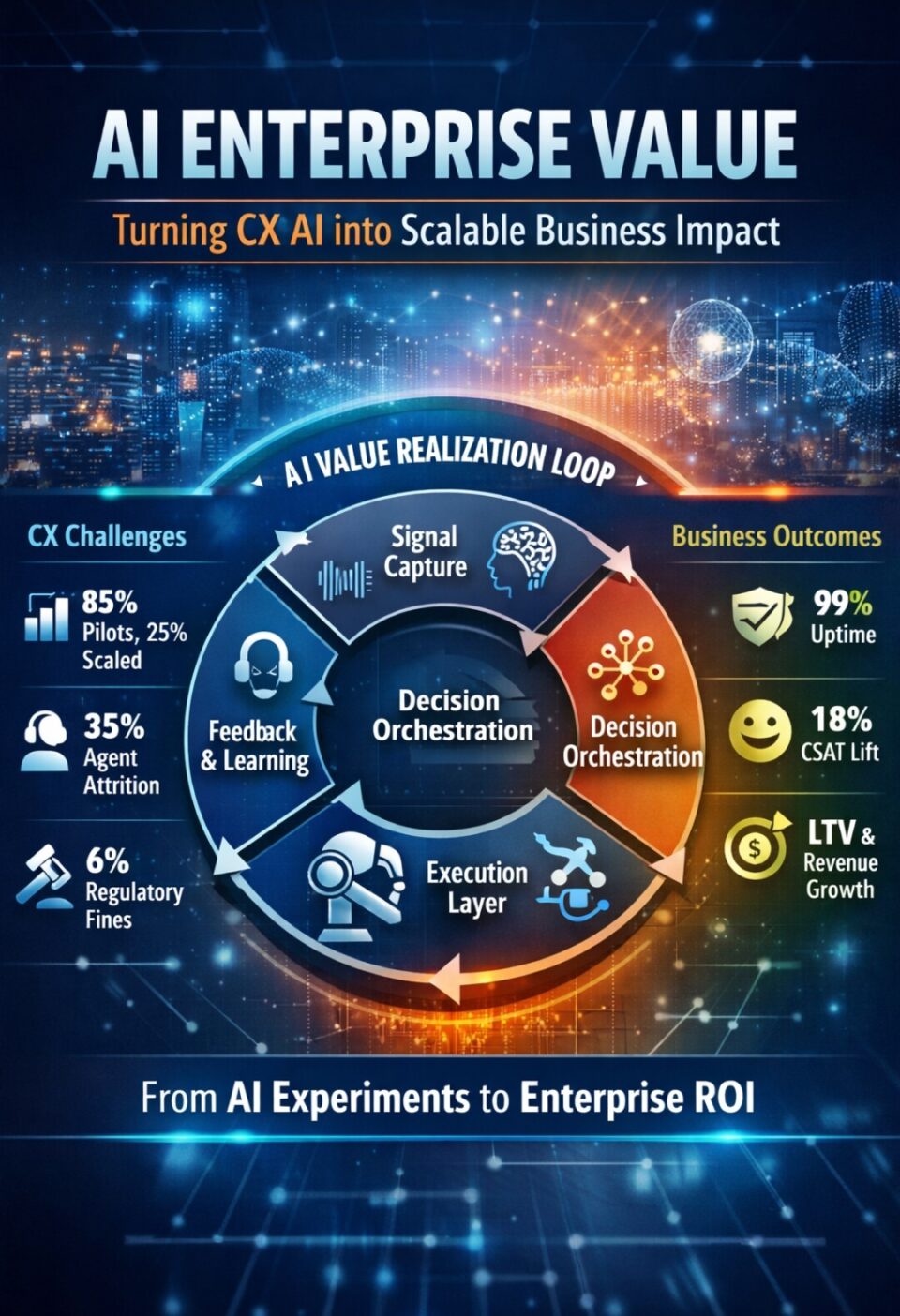
4. The AI Value Realization Loop for CX
To move from experimentation to impact, organizations must adopt a closed-loop value architecture:
1. Signal Capture
Ingest structured and unstructured data across touchpoints—voice, chat, app behavior, transactions.
2. Contextual Intelligence
Apply AI models augmented with retrieval mechanisms (RAG) to ground outputs in enterprise knowledge.
3. Decision Orchestration
Translate insights into real-time decisions—routing, recommendations, interventions.
4. Execution Layer
Deliver outcomes through a hybrid model:
- Autonomous agents (for high-volume, low-complexity tasks)
- Human agents augmented with AI copilots
5. Feedback & Learning
Continuously retrain models based on outcomes, closing the loop between experience and intelligence.
This loop transforms AI from a tool into a system of compounding value.
5. Technology Architecture: From Components to Systems
Modern CX AI stacks differ fundamentally from legacy automation systems.
Key architectural shifts:
From Rule-Based to Probabilistic Systems
Traditional BPM relied on deterministic workflows. AI introduces probabilistic decision-making—enabling adaptation at scale.
From Data Storage to Semantic Retrieval
Vector databases enable similarity search across unstructured data, allowing systems to “understand” intent rather than match keywords.
From Static Automation to Agentic Execution
Agentic AI systems can:
- Interpret multi-step requests
- Execute workflows across systems
- Adapt based on intermediate outcomes
From Training-Centric to Retrieval-Augmented Models
RAG reduces hallucination risk and ensures enterprise-grounded responses—critical for CX trust.
6. CX Impact: Engineering Anticipatory Journeys
When implemented effectively, AI transforms customer journeys across four dimensions:
1. Speed
Response times compress from minutes to seconds through intelligent routing and automation.
2. Resolution Quality
First-contact resolution improves via predictive triage and contextual recommendations.
3. Consistency
Unified customer profiles ensure continuity across channels.
4. Transparency
Explainable AI builds trust—customers understand why decisions are made.
Illustrative impact pathways:
- Predictive churn models → proactive retention offers → improved lifetime value
- Sentiment-aware routing → reduced escalations → lower cost-to-serve
- Real-time personalization → higher conversion rates → revenue uplift
Insight:
In high-volume CX environments, friction is rarely a UX problem—it is a systems orchestration failure.
7. Industry Applications: From Theory to Practice
Banking & Financial Services
AI-driven personalization engines identify deposit or investment opportunities based on behavioral signals—driving measurable growth in wallet share.
Telecom
Churn prediction models leverage call transcripts and usage data to trigger preemptive retention interventions.
E-commerce
Dynamic recommendation engines adapt in-session based on browsing behavior and intent signals.
Across sectors, the pattern is consistent:
AI creates value when it is embedded within decision flows—not layered on top of them.
8. Measuring What Matters: The CX AI Metrics Stack
To ensure accountability, AI initiatives must be tied to a structured measurement hierarchy:
Operational Metrics
- Average Handle Time (AHT)
- First Contact Resolution (FCR)
- Automation Rate
Experience Metrics
- Customer Satisfaction (CSAT)
- Net Promoter Score (NPS)
- Customer Effort Score (CES)
Financial Metrics
- Customer Lifetime Value (LTV)
- Retention Rate
- Revenue per Customer
Critical shift:
AI success must be evaluated not by what it does, but by what it delivers.
9. Strategic Implications: AI as Core Infrastructure
The evolution underway mirrors the shift to cloud computing:
- AI is becoming a utility layer, not a differentiator
- CX organizations are restructuring around AI-enabled operating models
- Vendor ecosystems are moving toward outcome-based pricing
- Partnerships with hyperscalers are deepening
Organizationally, this leads to:
- AI Centers of Excellence reporting to business leadership
- Tighter alignment between CX, data, and technology teams
- New roles focused on AI governance and ethics
10. The Road Ahead: Toward AI-Native CX
Looking forward, several trends will define the next phase:
1. Multimodal Intelligence
AI systems will integrate voice, text, and visual inputs for richer interactions.
2. Autonomous Service Models
Agentic AI will handle increasingly complex workflows with minimal human intervention.
3. Trust-Centric Design
Explainability, fairness, and compliance will become competitive differentiators.
4. Continuous Learning Systems
Static models will give way to adaptive systems that evolve with customer behavior.
By the end of this decade, CX will not “use” AI—
it will be fundamentally built on it.
Key Takeaways for CX Leaders
- Anchor AI initiatives to business KPIs, not technical metrics
- Invest in data unification as the foundation for intelligence
- Design for orchestration, not isolated automation
- Embed governance and explainability from the outset
- Build organizational capability in AI strategy, not just deployment
Closing Thought
The next competitive frontier in customer experience will not be defined by who adopts AI fastest—but by who converts it into sustained enterprise value.
