
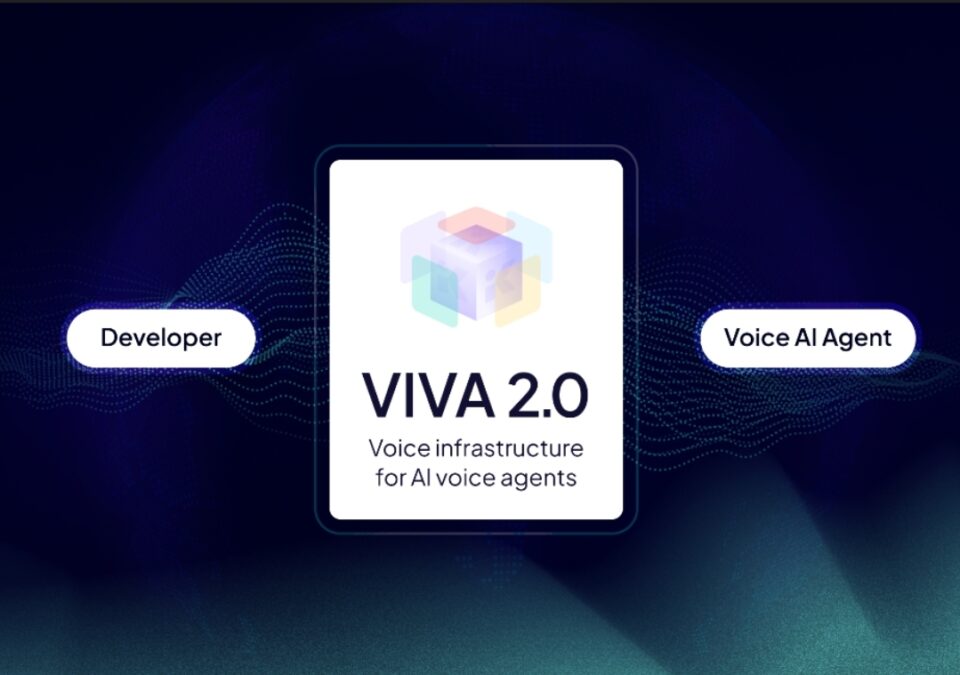
Krisp Launches VIVA 2.0 with predictive voice AI infrastructure designed to improve conversational reliability in real-world environments. The platform introduces multilingual turn prediction, interruption intent detection, and real-time audio intelligence models that help enterprise voice agents reduce latency, improve transcription accuracy, and deliver smoother customer experiences.
Krisp Launches VIVA 2.0 as Voice AI Infrastructure Moves Beyond the Demo Stage
The voice AI industry has spent years optimizing intelligence. Now it is being forced to optimize reality.
Krisp Launches VIVA 2.0 at a moment when conversational AI adoption is accelerating across contact centers, IVRs, enterprise automation systems, and customer engagement platforms. Yet despite the rapid growth of voice agents, production deployments continue to struggle with the same operational weaknesses: interruptions, noisy environments, accent variability, latency, and conversational instability.
The deeper issue is structural.
Most conversational AI systems were designed around a three-layer architecture:
- Speech-to-text
- Large language models
- Text-to-speech
But real-world conversation does not begin with language generation. It begins with messy audio.
This is where Krisp is attempting to reposition the market.
Krisp Launches VIVA 2.0 to Solve the Missing Audio Intelligence Layer
Krisp’s latest release introduces a collection of predictive audio intelligence models designed to operate before transcription systems engage.
Rather than relying exclusively on downstream AI interpretation, VIVA 2.0 processes live conversational signals directly inside enterprise audio pipelines.
This changes the operating logic of conversational AI systems.
Instead of waiting for transcription failures to occur, the infrastructure attempts to improve conversational understanding at the source.
“Voice is becoming the primary interface between humans and AI,” said Robert Schoenfield, EVP of Licensing and Partnerships at Krisp. “Those conversations don’t happen in clean environments. They happen in the real world, shaped by noise and subtle human cues. VIVA brings that layer into the system, so voice agents can operate the way people actually speak.”
The release includes:
- Turn Prediction v3
- Interrupt Prediction v1
- Voice Isolation v3
- TTS Detection
- Accent Detection
- Gender Detection
Each model addresses a different conversational failure point that traditional AI stacks often overlook.
This becomes critical when enterprises move from prototype demonstrations into scaled customer-facing deployments.
Why Conversational Reliability Is Becoming the New CX Battleground
From a CX standpoint, customers rarely care about model architecture.
They care whether the interaction feels smooth.
A delayed response, an interrupted sentence, or a failed recognition event instantly breaks conversational trust. Unlike graphical interfaces, conversational systems expose operational flaws in real time.
This is where the shift occurs.
The market is increasingly moving from “Can AI talk?” to “Can AI sustain natural conversation under unpredictable conditions?”
Krisp’s Turn Prediction v3 model attempts to answer that challenge by predicting conversational turn endings directly from audio signals rather than relying solely on transcription logic.
Operationally, this reduces:
- Premature interruptions
- Response lag
- Misinterpreted pauses
- Conversational overlap
Interrupt Prediction v1 extends this further by distinguishing actual interruption intent from passive backchannel acknowledgments such as “mhm” or “yes.”
At a structural level, this reflects a broader industry realization: human conversation depends as much on timing and perception as it does on language itself.
The Strategic Positioning Behind Krisp Launches VIVA 2.0
Strategically, Krisp is not competing directly against foundation model companies.
Instead, it is attempting to become the reliability layer sitting beneath them.
That positioning matters because enterprise conversational stacks are becoming increasingly modular.
Organizations may select:
- One vendor for telephony
- Another for STT
- Another for LLM orchestration
- Another for voice generation
Krisp wants to become the audio intelligence layer connecting them all.
Its existing ecosystem footprint supports that ambition. The company says VIVA already processes more than 12 billion minutes of voice AI traffic annually and is integrated into over 130 voice AI products including Daily, Vapi, LiveKit, Ultravox, and Telnyx.
“At scale, the biggest challenge in voice AI isn’t the model. It’s the quality of the signal going into it,” said David Casem, CEO of Telnyx. “Krisp addresses that at the source, which improves everything downstream from transcription to response.”
This becomes strategically important because infrastructure-adjacent platforms often achieve stronger long-term defensibility than application-layer vendors.
Once embedded deeply into enterprise audio pipelines, replacement costs rise significantly.
How the Technology Stack Actually Works
The architecture behind VIVA 2.0 is designed for low-latency deployment.
All models run on standard server CPUs and operate directly from audio input without requiring transcription analysis first.
That creates several operational advantages:
- Lower compute overhead
- Faster inference timing
- Easier deployment
- Edge-device compatibility
- Reduced conversational latency
Voice Isolation v3 continues Krisp’s historical focus on noise suppression and speech clarity. The company says the latest version improves downstream word error rate performance for transcription systems.
The new Signal Detectors add another layer of contextual awareness.
The Accent Detector routes speakers toward STT models optimized for their accent profile, potentially improving recognition quality. The TTS Detector identifies synthetic speech in real time, which could become increasingly valuable as AI systems begin interacting autonomously with other AI systems and IVRs.
The Gender Detector introduces another personalization layer, although it may also raise governance and bias considerations depending on deployment environments.
Operationally, the release signals a broader movement toward anticipatory conversational infrastructure.
The Enterprise CX Implications Are Larger Than Noise Reduction
The most important business implication may not be audio clarity itself.
It may be customer confidence.
Krisp says organizations using VIVA report:
- 3.5x improvement in turn-taking accuracy
- 50% fewer dropped calls
- 30% higher customer satisfaction
If sustained at scale, those improvements could significantly alter enterprise economics around conversational AI adoption.
From the customer perspective, smoother interaction flow reduces cognitive friction.
From the business perspective, improved conversational reliability can increase:
- Automation containment
- Customer retention
- Operational efficiency
- Agent productivity
- Multilingual scalability
The deeper implication is that conversational quality may become a measurable competitive differentiator across industries including banking, telecom, healthcare, logistics, and retail.
This is where voice AI transitions from novelty to infrastructure.
The CX Maturity Curve Is Shifting Toward Conversational Reliability
Krisp’s positioning reflects a mature understanding of real-world conversational failure modes rather than idealized AI interactions.
The platform addresses:
- Noise handling
- Interruption intent
- Accent routing
- Conversational timing
- Synthetic voice detection
These are advanced operational problems typically encountered only at production scale.
However, broader enterprise adoption still faces challenges around governance, integration complexity, multilingual calibration, and AI compliance requirements.
This becomes especially important as organizations attempt to standardize conversational experiences across global customer environments.
The trigger behind this infrastructure shift is clear: enterprise voice AI adoption is accelerating faster than conversational reliability standards.
That gap is creating a market opportunity for specialized conversational infrastructure vendors.
Build, Buy, or Partner? The Enterprise Decision Framework
Enterprises evaluating conversational AI infrastructure now face a strategic choice.
Should they:
- Build proprietary conversational reliability systems?
- Buy specialized infrastructure?
- Partner through ecosystem integrations?
Building internally remains highly complex due to the data requirements and edge-case variability involved in real-world conversational environments.
Buying reduces operational burden and accelerates deployment timelines but introduces dependency risks around infrastructure vendors.
Partnership models may become the most scalable option for communication platforms, contact center vendors, and AI orchestration ecosystems.
Operationally, VIVA’s integration approach lowers implementation complexity because it sits within the audio pipeline rather than replacing the full conversational stack.
However, enterprises still need:
- Audio routing redesign
- Latency optimization
- Monitoring frameworks
- Governance controls
From a strategic standpoint, conversational reliability is rapidly becoming an enterprise infrastructure decision rather than a simple feature evaluation.
What Happens Next for the Voice AI Ecosystem
Krisp Launches VIVA 2.0 into a market entering its operational maturity phase.
The industry’s first wave focused on proving AI could converse.
The next phase will focus on whether those conversations can scale reliably across unpredictable real-world environments.
That transition changes enterprise buying behavior.
Organizations are increasingly evaluating:
- Latency resilience
- Interruption handling
- Accent adaptability
- Conversational continuity
- Audio infrastructure reliability
The future conversational stack may increasingly resemble cloud infrastructure ecosystems where specialized middleware providers become strategically indispensable.
Krisp is positioning itself for that future.
Whether competitors internalize similar capabilities or partner with infrastructure specialists remains an open question. But one trend is becoming increasingly clear:
the success of voice AI may depend less on how intelligently systems speak and more on how well they listen.
Key Takeaways
- Krisp Launches VIVA 2.0 as a production-focused conversational infrastructure platform.
- The company is repositioning audio intelligence as a foundational AI layer rather than an enhancement feature.
- Conversational reliability is emerging as the next major CX battleground in enterprise AI.
- Predictive audio models may become strategically as important as LLM orchestration.
- Enterprises are increasingly evaluating voice AI systems based on conversational continuity, latency resilience, and interruption handling rather than raw intelligence alone.
