
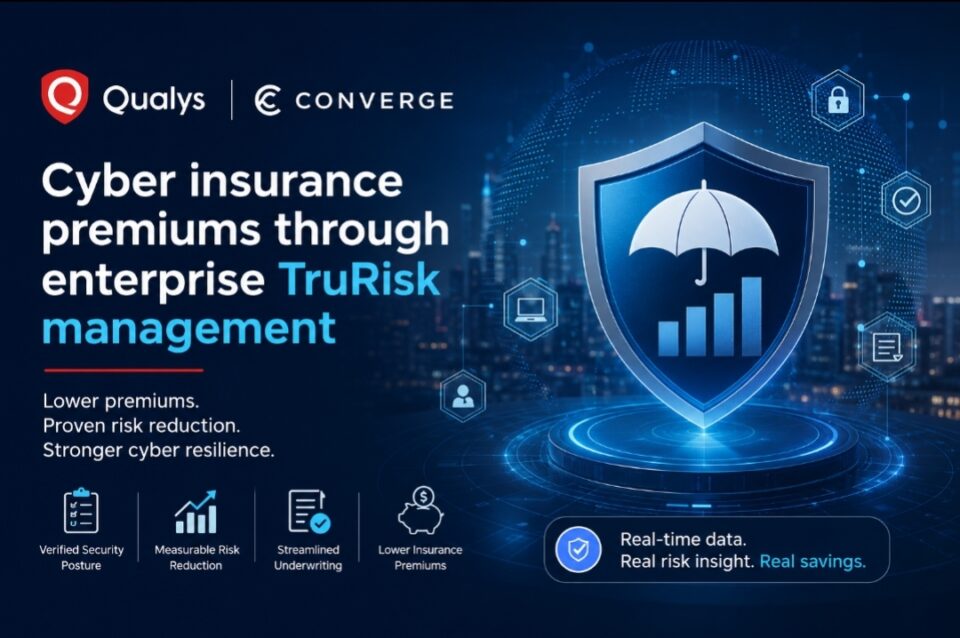
Cyber insurance economics are entering a new phase as Qualys and Converge introduce a joint initiative designed to connect live cybersecurity posture with insurance pricing. The collaboration marks an important shift because Cyber insurance premiums through enterprise TruRisk management moves underwriting away from static questionnaires toward continuously validated operational security intelligence.
The initiative allows Qualys customers using Enterprise TruRisk Management (ETM) to potentially qualify for lower cyber insurance premiums through Converge. More importantly, the model attempts to solve a longstanding challenge in cyber insurance: the gap between claimed cybersecurity maturity and actual operational resilience.
As ransomware attacks, supply chain compromises, and enterprise data breaches continue disrupting digital operations globally, insurers increasingly struggle to price cyber risk accurately. Consequently, the Qualys-Converge partnership represents more than a product integration. It signals a broader restructuring of how enterprises may eventually prove cyber trustworthiness.
Cyber insurance premiums through enterprise TruRisk management changes underwriting dynamics
Traditional cyber insurance applications rely heavily on manual questionnaires and self-reported controls. However, those models often fail to capture rapidly changing operational realities. Security posture can deteriorate quickly between policy renewals, while inaccurate self-reporting introduces additional underwriting uncertainty.
The Qualys Converge Connect Insurance Report (CCIR) addresses that problem by using live ETM telemetry to validate cybersecurity controls. The report evaluates factors such as vulnerability management, patching performance, endpoint detection capabilities, remediation velocity, compliance maturity, and asset coverage.
Notably, the report remains valid for 30 days, which creates a more current and operationally relevant assessment framework.
“Cyber risk has historically been priced on snapshots and self-reported answers, leaving real exposure invisible between renewals,” said Tom Kang, CEO of Converge.
“With verified data, we will be able to underwrite to a company’s live security posture and provide policyholders who do the hard work of reducing risk to see the benefits.”
That statement highlights a growing industry concern: insurers increasingly need continuous visibility rather than periodic declarations.
Editorial Pull-Quote
“Cyber insurance increasingly depends on operational truth rather than compliance paperwork.”
Why cybersecurity now directly affects customer experience
Cybersecurity failures no longer remain isolated technical events. They directly impact customer trust, service continuity, procurement confidence, and long-term brand credibility.
When ransomware attacks interrupt digital services, customers experience delays, outages, payment failures, or data exposure concerns. Consequently, cybersecurity posture now shapes customer experience as much as application performance or support responsiveness.
Therefore, the Qualys-Converge initiative carries broader CX implications. Organizations that maintain stronger cyber hygiene can potentially reduce insurance costs while simultaneously improving resilience against customer-facing disruptions.
Moreover, automated evidence-based reporting reduces operational friction for enterprise security teams. Instead of repeatedly generating manual compliance documentation, organizations can present validated telemetry through standardized reporting frameworks.
Editorial Pull-Quote
“The future of customer trust may depend as much on cyber resilience as on product quality.”
Cyber insurance premiums through enterprise TruRisk management aligns security with business outcomes
The collaboration also reflects a strategic evolution in cybersecurity platform positioning. Security vendors increasingly compete on business outcome enablement rather than purely technical capability.
Qualys appears to recognize that enterprise buyers now expect measurable financial impact from cybersecurity investments. By linking ETM performance with potential insurance savings, the company strengthens its business-value narrative.
“Cyber insurance is key to the overall risk management strategy, but there has to be an easier way to correlate the strength of an organization’s cyber posture with what they should pay in insurance,” said Sumedh Thakar, president and CEO of Qualys.
“That’s why we created ETM to provide stakeholders with an accurate picture of their true risk, enabling better business outcomes like cyber insurance savings, and a greater incentive to reduce their cyber risk.”
Importantly, this strategy moves cybersecurity discussions closer to CFOs, risk officers, procurement leaders, and boards.
Instead of framing cyber investments purely around threat prevention, organizations can increasingly connect them to financial efficiency, insurance optimization, and operational continuity.
Editorial Pull-Quote
“Cybersecurity platforms are evolving into financial trust infrastructure.”
Operational telemetry becomes a competitive enterprise asset
The broader cybersecurity industry may experience significant changes if telemetry-based underwriting gains traction.
Historically, organizations often treated cyber insurance as a secondary risk-transfer mechanism. However, insurers now seek deeper operational insight because cyberattack frequency and severity continue increasing globally.
As a result, live security telemetry could become a competitive enterprise asset.
Organizations that demonstrate faster remediation cycles, broader endpoint visibility, stronger patch management, and continuous compliance monitoring may secure more favorable underwriting terms. Meanwhile, enterprises with fragmented visibility or inconsistent security controls could face increased premiums.
That dynamic creates stronger incentives for continuous operational discipline.
The Qualys CCIR reportedly incorporates telemetry from several solutions across the Qualys portfolio, including ETM, Vulnerability Management, Detection and Response (VMDR), TruRisk Eliminate, and Endpoint Detection and Response (EDR).
Consequently, the initiative reinforces the growing market preference for integrated security platforms rather than isolated point tools.
Editorial Pull-Quote
“Cyber resilience metrics may soon influence insurance costs as directly as claims history.”
Enterprise trust strategies increasingly require measurable resilience
The partnership also reflects a larger shift in enterprise trust architecture.
Customers, regulators, investors, and partners increasingly expect organizations to prove resilience rather than simply claim compliance. Therefore, measurable operational security maturity becomes strategically important beyond IT departments.
Enterprises now operate in highly interconnected digital ecosystems where third-party vulnerabilities can quickly cascade into customer-facing crises. In that environment, verified cybersecurity telemetry supports stronger governance credibility.
Meanwhile, insurers benefit from more accurate underwriting visibility. Instead of relying on broad industry averages, they can evaluate continuously updated operational data tied to real enterprise environments.
That approach could eventually improve underwriting precision across the cyber insurance industry.
Editorial Pull-Quote
“Validated cyber posture is becoming a boardroom-level trust signal.”
A broader transformation in cyber risk economics
The Qualys-Converge collaboration ultimately reflects a structural shift in how enterprises measure, communicate, and monetize cybersecurity maturity.
Cybersecurity increasingly influences operational resilience, customer trust, procurement decisions, and financial performance simultaneously. Therefore, initiatives like Cyber insurance premiums through enterprise TruRisk management demonstrate how cybersecurity platforms are expanding into broader enterprise risk orchestration ecosystems.
Moreover, the partnership reinforces a growing industry reality: organizations can no longer separate cybersecurity from customer experience strategy.
As enterprises continue digitizing operations, operational trust will increasingly depend on measurable cyber resilience. Consequently, underwriting models based on live telemetry may eventually become standard practice across the cyber insurance industry.
