
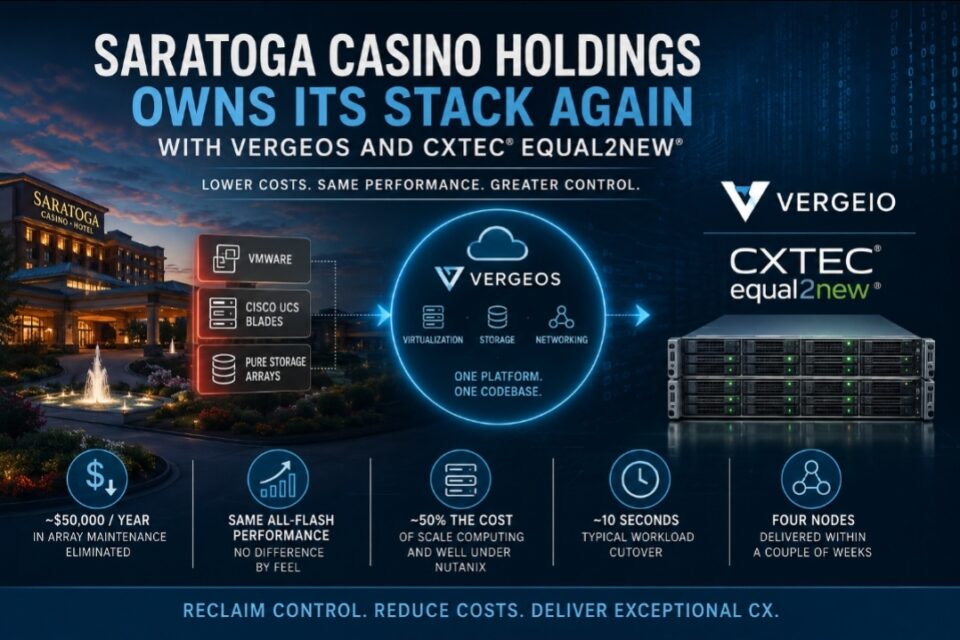
Enterprise infrastructure decisions have traditionally been viewed as technical exercises focused on hardware refresh cycles, software licensing, and operational efficiency. Today, however, they are increasingly influencing customer experience, business agility, and financial resilience. Saratoga Casino Holdings Owns Its Stack Again with VergeOS and CXTEC® equal2new® illustrates this shift by showing how a gaming operator transformed an infrastructure modernization project into a strategic initiative that restored technology ownership while reducing operational costs.
For organizations evaluating alternatives to VMware following industry-wide licensing changes, the announcement from VergeIO, CXTEC, and Saratoga Casino Holdings offers more than another migration success story. It highlights an emerging enterprise trend: organizations are seeking greater control over their infrastructure rather than remaining dependent on tightly integrated proprietary ecosystems.
At a structural level, the announcement reflects how IT leaders are redefining modernization—not simply by replacing legacy platforms but by reclaiming decision-making authority over infrastructure investments.
Infrastructure Modernization Is No Longer Just About Cost
Digital experiences in industries such as gaming rely heavily on uninterrupted infrastructure. When a casino guest inserts a loyalty card into a gaming machine, every wager, reward point, promotional offer, and transaction must be processed accurately and immediately. Behind that seamless experience lies a highly available technology platform supporting multiple mission-critical applications.
Saratoga Casino Holdings operates four gaming properties across the United States through a centralized IT organization responsible for maintaining consistent performance across geographically distributed locations. Such environments leave little tolerance for downtime or infrastructure complexity.
This becomes particularly significant as many enterprises continue reassessing their virtualization strategies following changes in enterprise licensing models. Rising software costs, aging hardware platforms, and increasing maintenance expenditures have forced organizations to reconsider long-established technology standards.
The deeper implication is that infrastructure modernization is increasingly becoming a business continuity strategy rather than simply an IT upgrade.
Instead of asking which virtualization platform delivers the most features, executives are beginning to ask a more strategic question:
Who controls the technology decisions that shape future customer experiences?
Reclaiming Technology Ownership
The central narrative behind Saratoga Casino Holdings Owns Its Stack Again with VergeOS and CXTEC® equal2new® is not virtualization alone.
It is ownership.
Scott Bargis, Corporate Director of IT at Saratoga Casino Holdings, inherited an infrastructure architecture selected by an external business partner. That environment included VMware virtualization, Cisco UCS blade servers, and mirrored Pure Storage arrays.
Over time, the assumptions supporting that architecture changed dramatically.
Hardware reached replacement age.
Licensing economics evolved.
Maintenance costs increased.
Vendor flexibility declined.
Rather than accepting those conditions as inevitable, Saratoga initiated a structured evaluation of available alternatives.
Several strategic observations emerge from that evaluation.
First, technology decisions increasingly extend beyond software functionality into commercial flexibility.
Second, infrastructure independence has become a competitive advantage.
Third, enterprises increasingly value architectural freedom alongside performance.
Unlike several hyperconverged platforms that prescribe hardware compatibility or require proprietary appliances, VergeOS allows deployment on customer-selected commodity x86 infrastructure.
From a CX standpoint, this flexibility translates into faster procurement, easier lifecycle management, and improved alignment between business priorities and technology investments.
That distinction becomes particularly meaningful for organizations operating multiple locations where infrastructure scalability directly influences operational consistency.
Cost Reduction Without Sacrificing Experience
Digital transformation initiatives frequently promise lower operating costs but often require organizations to compromise elsewhere—performance, resilience, flexibility, or implementation complexity.
One of the most compelling aspects of this deployment is that Saratoga reports avoiding that trade-off.
According to the published deployment figures:
- Approximately $50,000 in annual Pure Storage maintenance was eliminated.
- VergeOS was reportedly priced at roughly half the cost of the evaluated Scale Computing proposal.
- The solution also remained substantially below competing Nutanix pricing.
- Four production nodes were delivered within weeks.
- Typical workload cutovers completed in approximately 10 seconds after synchronization.
From an enterprise strategy perspective, these figures matter because infrastructure modernization projects frequently struggle to demonstrate measurable return on investment beyond license savings.
Here, multiple financial benefits appear simultaneously:
- Lower software expenditure
- Reduced hardware maintenance
- Greater hardware purchasing flexibility
- Simplified future expansion
- Operational continuity throughout migration
This is where the shift occurs.
Instead of viewing infrastructure purely as a cost center, Saratoga positioned technology modernization as an enabler of long-term operational sustainability.
“This is the best compromise between the Scale Computing hypervisor and VMware that I have seen yet. It does everything we need it to do, and I haven’t found one thing it can’t.”
— Scott Bargis, Corporate Director of IT, Saratoga Casino Holdings
The quote is notable because it emphasizes operational capability rather than marketing differentiation. Rather than claiming superiority over every competing platform, it positions VergeOS as delivering the practical functionality required for enterprise production workloads.
Customer Experience Begins Long Before Customers Notice
Many CX discussions focus on customer interfaces—mobile applications, websites, AI assistants, or omnichannel engagement.
However, infrastructure remains one of the least visible yet most influential layers of customer experience.
A player tracking platform that fails during peak casino hours directly impacts customer trust.
Database latency influences loyalty systems.
Storage performance affects transaction processing.
Recovery speed determines service continuity during outages.
Operationally, this translates to an important principle:
Infrastructure resilience is customer experience resilience.
Saratoga validated this principle by maintaining replicated databases across both environments during migration, allowing direct performance comparison between legacy infrastructure and VergeOS.
Scott Bargis summarized that comparison succinctly:
“If you blindfolded me, I wouldn’t be able to tell. It is no different other than my checkbook has a little more money in it.”
— Scott Bargis, Corporate Director of IT, Saratoga Casino Holdings
Rather than emphasizing benchmark statistics, the statement reinforces something far more valuable for enterprise decision makers:
The customer experience remained unchanged while operational economics improved significantly.
Competition Is Shifting from Features to Freedom
The infrastructure market has entered a new competitive phase. For years, enterprise virtualization was dominated by feature comparisons—high availability, live migration, disaster recovery, and centralized management. Today, purchasing decisions increasingly hinge on flexibility, licensing predictability, and infrastructure independence.
In Saratoga Casino Holdings’ evaluation, VMware represented the incumbent platform, while Scale Computing and Nutanix were assessed as potential alternatives. According to the deployment details, smaller hyperconverged platforms did not meet Saratoga’s capacity and performance requirements for workloads spanning 30–40 TB. Nutanix, meanwhile, was priced close enough to VMware that it offered limited financial differentiation.
This is where VergeOS and CXTEC equal2new positioned themselves differently. Rather than requiring proprietary hardware or a restricted compatibility list, the solution allowed Saratoga to deploy on customer-selected x86 servers supplied through CXTEC’s refurbished, warrantied hardware program.
Strategically, the differentiation was not simply lower cost—it was greater architectural choice. As enterprises seek to reduce vendor lock-in, platforms that preserve flexibility without compromising operational performance are likely to gain greater attention.
A Technology Stack Designed Around Integration
From a technology standpoint, the deployment illustrates a move toward platform consolidation.
Instead of managing separate virtualization, storage, and networking layers, VergeOS combines these capabilities into a unified operating environment. This reduces the number of infrastructure components that IT teams must deploy, monitor, and maintain.
CXTEC complemented this approach by supplying equal2new enterprise hardware, enabling Saratoga to modernize its infrastructure without investing in brand-new OEM systems. The combination of integrated software and tested, warrantied hardware created a solution that balanced performance with cost efficiency.
An important aspect of the project was its measured implementation strategy. Before migrating production workloads, the IT team validated VergeOS on a small proof-of-concept system using a micro PC with 16 GB RAM and approximately 1 TB of SSD storage. Installation, recovery, hardware compatibility, and day-to-day administration were verified before broader deployment.
The migration itself followed a staged process:
- Replicate workloads from VMware.
- Synchronize data.
- Shut down the source workload.
- Perform a final sync.
- Restart services on VergeOS in roughly 10 seconds.
This phased approach minimized operational disruption while reducing migration risk.
The CX Impact Extends Beyond the Data Center
From a customer experience perspective, infrastructure modernization is often invisible when it succeeds—and painfully visible when it fails.
For a gaming operator, every second of downtime can affect player confidence, loyalty tracking, and transaction integrity. Reliable infrastructure therefore supports not only IT operations but also the trust that customers place in the business.
The Saratoga deployment demonstrates three layers of CX value:
Customer impact: Consistent uptime and application responsiveness help ensure uninterrupted gaming experiences.
Business impact: Eliminating approximately $50,000 in annual storage maintenance frees budget that can be redirected toward innovation, guest services, or digital initiatives.
System impact: A scalable node-based architecture simplifies future expansion, allowing capacity to grow incrementally rather than through disruptive hardware replacements.
This becomes critical when organizations seek to align technology investments with long-term business outcomes. Infrastructure decisions increasingly influence the quality, consistency, and resilience of customer-facing services.
CX Maturity: Moving Toward Strategic Infrastructure Management
From a CX maturity perspective, Saratoga Casino Holdings appears to be operating at an Optimized level.
The organization did not simply replace aging technology; it reassessed its infrastructure strategy based on business objectives, operational flexibility, and total cost of ownership.
Several characteristics support this assessment:
- Technology choices were evaluated against business requirements rather than vendor familiarity.
- Proof-of-concept testing reduced implementation risk.
- Migration was executed in controlled stages to maintain service continuity.
- Financial savings were achieved without sacrificing user experience or performance.
The remaining opportunity lies in extending this infrastructure flexibility into broader cloud, automation, and AI-driven operational initiatives. As enterprise environments become increasingly hybrid, governance and orchestration across multiple platforms will become the next maturity milestone.
Decision Intelligence for Enterprise Leaders
For CIOs and infrastructure decision-makers, the case offers broader lessons than a single migration success.
Build: Developing an in-house virtualization platform is impractical for most enterprises due to the expertise, engineering effort, and long-term maintenance required.
Buy: Purchasing integrated infrastructure software remains the fastest route to modernization, provided organizations carefully evaluate licensing models, hardware flexibility, and vendor roadmaps.
Partner: Collaborating with providers such as VergeIO and CXTEC illustrates how software and hardware partnerships can reduce implementation complexity while preserving customer choice.
Risk Assessment
The principal risks include migration planning, application compatibility, staff training, and operational change management. Saratoga mitigated these risks through proof-of-concept validation, phased migration, and workload replication before cutover.
Implementation Complexity
Compared with large-scale infrastructure transformations, this deployment demonstrates a relatively manageable migration model. Incremental workload movement, node-based scalability, and staged synchronization reduced operational disruption while maintaining business continuity.
Industry Implications: Infrastructure Choice Is Becoming a Competitive Differentiator
The significance of Saratoga Casino Holdings Owns Its Stack Again with VergeOS and CXTEC® equal2new® extends beyond a single gaming operator. It reflects a broader shift occurring across enterprise IT, where organizations are reassessing long-standing assumptions about virtualization, infrastructure procurement, and vendor dependence.
For IT leaders, the announcement reinforces that infrastructure modernization is no longer judged solely by technical specifications. Total cost of ownership, licensing flexibility, deployment speed, and architectural freedom are becoming equally important evaluation criteria.
For technology vendors, the competitive landscape is also changing. Winning enterprise workloads increasingly requires demonstrating measurable business outcomes rather than simply adding product features. Customers are demanding transparent licensing, predictable operating costs, and the flexibility to choose hardware that aligns with their procurement strategies.
For the broader ecosystem—including system integrators, channel partners, and managed service providers—the opportunity lies in helping enterprises design modernization roadmaps that balance innovation with financial discipline. Organizations that can simplify migration while minimizing operational risk are likely to become trusted strategic partners rather than transactional suppliers.
This becomes particularly relevant as enterprises continue to modernize data centers while preparing for hybrid cloud, AI-enabled workloads, and increasingly distributed operations.
Looking Ahead: The Future of Enterprise Infrastructure
The next phase of enterprise infrastructure will likely be defined less by proprietary technology stacks and more by interoperability, automation, and customer control.
Organizations are expected to prioritize platforms that:
- Reduce vendor lock-in.
- Support commodity hardware.
- Simplify operations through integrated software.
- Scale incrementally without major architectural redesign.
- Align infrastructure investments with business resilience and customer experience goals.
From a CX standpoint, infrastructure will remain largely invisible to end users—but its influence on service quality will continue to grow. As digital interactions become the primary interface between organizations and customers, reliable infrastructure will increasingly determine whether businesses can deliver consistent, always-on experiences.
For gaming and hospitality organizations in particular, where uptime directly affects revenue and customer trust, infrastructure decisions are becoming board-level business decisions rather than purely technical considerations.
Key Takeaways
Several strategic lessons emerge from this deployment:
- Technology ownership is becoming a competitive capability. Enterprises increasingly want the freedom to choose their infrastructure rather than inherit restrictive technology ecosystems.
- Customer experience begins with operational resilience. Reliable infrastructure enables seamless digital interactions that customers often take for granted.
- Cost optimization should not require performance compromises. Saratoga’s reported experience suggests that organizations can reduce operating expenses while maintaining enterprise-class performance when solutions are carefully evaluated.
- Infrastructure flexibility supports long-term innovation. Hardware-agnostic platforms provide greater adaptability as business requirements evolve.
- Modernization is ultimately a business transformation initiative. The most successful projects combine financial discipline, technical excellence, and customer-centric thinking.
Conclusion
Saratoga Casino Holdings Owns Its Stack Again with VergeOS and CXTEC® equal2new® is more than a migration announcement. It illustrates a broader transformation in enterprise infrastructure strategy, where ownership, flexibility, and operational efficiency are becoming as important as raw technical capability.
From a CX perspective, the story demonstrates that infrastructure decisions directly influence the consistency and reliability of customer experiences. By replacing legacy virtualization and storage components with an integrated platform running on customer-selected hardware, Saratoga Casino Holdings sought to reduce operational costs while preserving the performance required for mission-critical gaming applications.
The deeper implication is that enterprises are moving away from infrastructure decisions driven primarily by vendor ecosystems toward strategies centered on business outcomes. Organizations evaluating virtualization alternatives will increasingly measure success not only by lower licensing costs, but also by the ability to maintain service continuity, simplify operations, and retain control over future technology choices.
Ultimately, this case is less about replacing one virtualization platform with another and more about reclaiming strategic control over the technology foundation that supports customer experience, operational resilience, and sustainable business growth.
