

Regal AI Agents Hit 500m Calls Milestone as Voice AI Moves from Automation to Customer Growth
Featured Snippet
Regal AI Agents Hit 500m Calls Milestone marks more than a usage benchmark. The announcement signals how enterprise Voice AI is evolving from experimental automation into a customer engagement channel capable of generating revenue, improving service quality, and reducing operating costs at scale.
When Scale Becomes Strategy
Regal AI Agents Hit 500m Calls Milestone at a time when enterprises are reassessing how customer interactions are delivered. Regal says its AI-powered voice agents have now participated in more than 500 million conversations while contributing to $9 billion in revenue generation and helping organizations reduce cost-to-serve by up to 80%.
On the surface, the announcement appears to be a scale story. Yet the deeper significance lies elsewhere. The milestone reflects a broader industry transition from AI pilots toward AI operations.
For years, organizations experimented with chatbots and conversational systems in isolated use cases. Many deployments produced efficiency gains but struggled to create meaningful customer value. Today, enterprises are increasingly demanding outcomes rather than experimentation.
This becomes critical when customer expectations continue rising while operating budgets remain constrained. Business leaders are under pressure to deliver faster service, greater personalization, and measurable returns without proportionally increasing headcount.
The significance of 500 million conversations is not simply the volume. It represents accumulated operational learning. Every interaction contributes data, behavioral patterns, workflow insights, and customer preferences that can be used to improve future engagements.
As AI adoption matures, scale itself becomes a strategic asset.
Regal AI Agents Hit 500m Calls Milestone and Challenge an Old Assumption
For decades, contact center leaders operated under a familiar assumption: organizations could either deliver high-quality service or achieve large-scale efficiency, but rarely both.
Scaling customer support traditionally required hiring additional agents, expanding facilities, increasing training investments, and managing growing operational complexity. Cost reduction initiatives often resulted in longer wait times, reduced personalization, and declining customer satisfaction.
Voice AI is beginning to challenge that equation.
Regal highlights deployments supporting healthcare patient intake, roadside assistance, and insurance enrollment. These are not simple transactional interactions. They are often emotionally charged, time-sensitive, and outcome-dependent conversations where the quality of engagement directly affects customer success.
From a CX standpoint, this represents an important shift. AI is no longer being evaluated solely on automation rates or call deflection metrics. Instead, enterprises are increasingly measuring whether AI can successfully complete customer journeys and create business value.
The old question was whether AI could answer customer questions.
The new question is whether AI can achieve customer outcomes.
That distinction fundamentally changes how organizations evaluate customer experience technologies.
The Competitive Race Is Moving Beyond AI Pilots
The Voice AI industry has entered a new phase of maturity.
Early adopters differentiated themselves by launching pilots and demonstrating technical feasibility. Today, the competitive landscape is shifting toward operational excellence.
This is where the shift occurs.
Organizations are discovering that sustainable competitive advantage comes from continuously improving AI systems rather than merely deploying them.
Many enterprises have already proven that AI can conduct conversations. The challenge now is improving conversation quality, increasing resolution rates, enhancing customer trust, and integrating AI more deeply into business workflows.
The businesses generating the greatest returns from AI are not necessarily those that moved first. They are the organizations that continuously refine prompts, optimize workflows, monitor outcomes, and incorporate new capabilities as they emerge.
Regal’s announcement emphasizes this reality. The company argues that success is driven less by pilot deployment and more by ongoing iteration and improvement.
Strategically, this signals a broader market transition from experimentation to operationalization.
The winners in the next phase of Voice AI adoption will likely be determined by execution rather than innovation alone.
Building the Infrastructure Behind Modern Voice AI
Behind every successful AI-powered conversation is a sophisticated technology stack.
Modern Voice AI platforms combine automatic speech recognition, natural language understanding, large language models, orchestration layers, workflow engines, analytics systems, CRM integrations, and speech synthesis technologies.
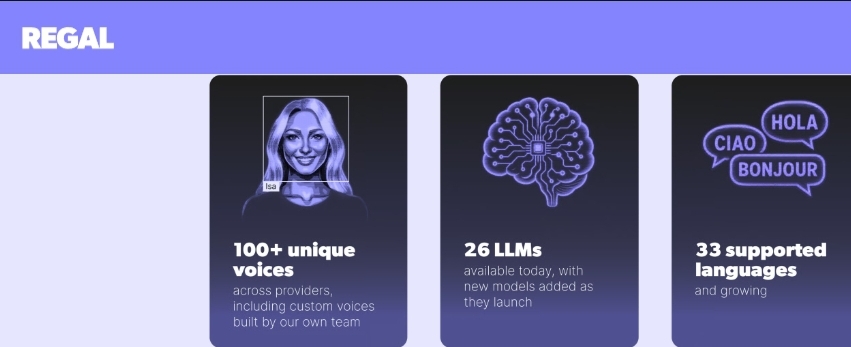
Regal reports support for more than 100 unique voices, 26 large language models, and 33 languages. These capabilities suggest an architecture designed for flexibility rather than dependence on any single AI provider.
At a structural level, this reflects a broader industry trend toward model-agnostic AI environments.
Organizations increasingly want the freedom to select different models based on cost, latency, accuracy, compliance requirements, or specific use cases. As new models enter the market, enterprises expect platforms to integrate them quickly.
However, models alone do not create value.
The real challenge lies in orchestration.
Successful AI deployments must maintain context, retrieve customer information, execute business processes, integrate with enterprise systems, and complete tasks while maintaining a natural conversational flow.
Operationally, this translates to a fundamental reality: AI conversations are only valuable when they result in meaningful actions.
The technology itself is becoming a utility. The ability to orchestrate customer outcomes is becoming the differentiator.
What 500 Million Conversations Reveal About Customer Behavior
One of the most intriguing observations from Regal’s announcement concerns customer engagement.
Many industry observers initially assumed customers would provide fewer details to AI systems than to human representatives. The expectation was that customers would keep conversations short, reserve nuanced discussions for human agents, and limit engagement with automated systems.
The reported data suggests something different.
Customers increasingly appear willing to clarify information, provide additional context, and expand on their intent during interactions with AI agents.
This finding carries important implications.
Customer experience quality depends heavily on understanding intent. The more context a system receives, the more effectively it can personalize interactions, resolve issues, and guide customers toward successful outcomes.
From a business perspective, richer conversations generate richer data.
Organizations gain deeper insight into customer needs, preferences, frustrations, and behaviors. These insights can be used to improve products, optimize customer journeys, and identify emerging trends.
From a systems perspective, every conversation becomes a learning opportunity.
The result is a feedback loop where customer interactions continuously improve future interactions.
This may ultimately prove to be one of the most significant advantages of AI-powered engagement models.
AI Maturity Is Becoming an Organizational Capability
The broader lesson from the Regal AI Agents Hit 500m Calls Milestone announcement is that AI maturity is becoming a core enterprise competency.
Many organizations still view AI as a technology project. Increasingly, however, AI success depends on operational disciplines rather than technology deployment alone.
Enterprises require governance frameworks, quality assurance processes, compliance monitoring systems, performance management structures, and optimization programs.
In practical terms, AI agents are beginning to resemble digital employees.
Like human employees, they require onboarding, supervision, training, evaluation, and continuous improvement.
Organizations that develop these capabilities early may establish durable competitive advantages.
Conversely, businesses that deploy AI without operational discipline may struggle to achieve meaningful returns despite significant investments.
The next phase of enterprise AI adoption will likely be defined less by technological breakthroughs and more by management excellence.
That transition could become one of the defining characteristics of customer experience leadership in the coming decade.
Decision Intelligence for Enterprise Leaders
For executives evaluating Voice AI initiatives, technology selection represents only one component of the decision.
Leaders typically face three strategic paths: build, buy, or partner.
Building provides maximum control and customization but requires significant investment, technical expertise, and ongoing maintenance.
Buying accelerates deployment and reduces operational complexity but may limit flexibility.
Partnering offers a middle path by combining external expertise with internal business knowledge.
The optimal choice depends on organizational maturity, available resources, regulatory requirements, and long-term objectives.
However, the larger strategic consideration extends beyond implementation.
Executives must determine whether AI is being deployed merely to reduce costs or to transform customer engagement.
Organizations that focus exclusively on efficiency may achieve short-term savings.
Organizations that leverage AI to improve customer outcomes may unlock far greater long-term value.
This distinction increasingly separates tactical deployments from strategic transformations.
Looking Beyond the Numbers
The true significance of Regal AI Agents Hit 500m Calls Milestone is not the number itself.
Rather, it reflects a broader evolution in how enterprises engage customers, operate service organizations, and create business value.
Voice AI is steadily moving from the periphery of customer operations toward the center of enterprise engagement strategies.
The reported outcomes—including revenue generation, operational efficiency, multilingual support, and expanded customer engagement—suggest that organizations are beginning to view AI agents as business assets rather than automation tools.
At a structural level, customer engagement is becoming increasingly software-defined, data-driven, and continuously optimized.
From a CX standpoint, this means organizations may soon be able to deliver highly personalized experiences at a scale previously considered impossible.
Strategically, it indicates that future competitive advantage may depend less on workforce size and more on conversational intelligence.
For customer experience leaders, the message is becoming increasingly clear.
The next generation of customer engagement will not be defined by replacing human interactions. It will be defined by extending them through intelligent, scalable, and continuously improving AI systems.
And that may ultimately be the most important lesson behind the Regal AI Agents Hit 500m Calls Milestone announcement.
