

How enterprises are moving from fragmented data to decision-grade intelligence—and why Enterprise Intelligence CX is becoming the core driver of real-time performance, resilience, and growth.
INTRODUCTION
A global supply chain disruption hits unexpectedly. Costs surge, compliance risks multiply, and leadership teams scramble—not for lack of data, but for lack of clarity. In today’s environment, enterprises don’t suffer from data scarcity; they suffer from fragmented intelligence.
This is where Enterprise Intelligence CX becomes mission-critical. Organizations need systems that can connect operational signals with financial outcomes, enabling real-time, decision-grade clarity across complexity.
In this conversation, we speak with Vivek Shankaranarayanan, Co-Founder of Impactree.ai and architect of enterprise intelligence platforms that bridge physical and financial worlds. With deep experience spanning sustainability, enterprise systems, and large-scale industrial transformation, Vivek offers a unique lens into how Enterprise Intelligence CX is reshaping how organizations think about resilience, performance, and long-term value creation.
ENTERPRISE INTELLIGENCE FOUNDATIONS
Q1. How do you define customer experience in the context of enterprise intelligence and complex decision systems?
VS: For me, customer experience is fundamentally about reducing friction in decision-making.
Today, most enterprises are not short of data – they are overwhelmed by it. The real problem is not access, but clarity. Teams struggle to separate correlation from causation, signal from noise, and as a result, decision-making becomes slower and less confident.
My belief is simple: the ideal CX is when the right information reaches the right person at the right time -without them having to search for it.
But in an AI-driven world, generic, web-trained insights are not enough. Enterprise decisions require deep context – about the business, the customer, the environment, and the moment.
That’s where Enterprise Intelligence changes the equation. The vision is to move toward systems that are almost sentient in how they operate—present everywhere, yet invisible. Systems that understand intent, anticipate needs, and surface the right insight even before a question is fully formed.
At that point, CX is no longer reactive—it becomes predictive, and eventually, instinctive.
Enterprise Intelligence CX at a Philosophical Level
Q2. What does Enterprise Intelligence CX mean to you at a philosophical level?
VS: For me, Enterprise Intelligence CX comes from a very practical frustration I’ve seen repeatedly—both in my own experience and in conversations with other CEOs.
Most enterprises today are not short of data or systems. But when it comes to actual decision-making, especially in critical moments, leaders are still relying on fragmented information, delayed reports, or instinct. There is always a gap between what the systems know and what the business actually does.
I’ve seen this across functions – whether it’s customer experience, operations, or even sustainability. The systems are there, but they don’t really “talk” to each other in a way that helps you act with confidence and speed.
So for me, Enterprise Intelligence CX is about closing that gap. It’s about building systems that don’t just capture information, but help people make better decisions in real time.
And CX is where this becomes most visible – because that’s where decisions directly impact outcomes. The shift is not just about AI, but about creating a working model where human judgment and machine intelligence operate together, continuously learning and improving.
Core Business Strategy
Q3. How should organizations embed Enterprise Intelligence CX into their core business strategy rather than treating it as a support function?
VS: Most organizations still treat CX as a reporting function—measured through NPS and optimized for cost efficiency. That is the core problem.
If Enterprise Intelligence CX is embedded correctly, it stops being a support layer and becomes a driver of growth. The shift starts by moving beyond dashboards and reports. For years, companies have been measuring experience; very few have been improving decision-making.
In many cases, even AI is being used to reduce service costs, not to create better customer outcomes. That mindset needs to change.
Enterprise Intelligence CX should be built around a simple principle: move from cost optimization to opportunity creation.
This means using customer journey data to predict and prevent churn, connecting CX signals directly to sales and marketing to improve conversion, and enabling teams to act on insights in real time – not just report them.
When done right, CX is no longer a lagging indicator. It becomes a system that actively drives revenue, retention, and long-term growth.
Data-rich to Intelligence-driven Organizations
Q4. What are the biggest barriers enterprises face when transitioning from data-rich to intelligence-driven organizations?
VS: The biggest barrier is not lack of data – it’s the way enterprises think about data.
Most organizations today are constantly collecting more information, assuming that more data will automatically lead to better decisions. In reality, it often creates the opposite effect – noise, confusion, and slower decision-making.
The second challenge is the inability to connect variables to outcomes. Companies track hundreds of metrics, but very few can clearly explain what is actually driving customer behavior or business performance. There is a persistent gap between correlation and causation.
The third, and more subtle issue, is misattribution. When growth happens, organizations tend to credit multiple initiatives without really understanding what worked. That makes it difficult to replicate success or scale it.
As a result, enterprises remain data-rich but intelligence-poor.
Moving to an intelligence-driven model also requires a mindset shift. It means being willing to drop your own assumptions and biases, and accepting that you don’t fully understand all the variables at play. Only then can organizations build systems that learn, adapt, and make better decisions over time.
AI, BUSINESS LANGUAGE MODELS & DECISION SYSTEMS
Q5. How are AI and Business Language Models transforming the way enterprises interpret customer and operational data?
VS: AI is changing how enterprises process data, but Business Language Models (BLMs) are changing how they understand it.
Most conventional AI models are trained on generic, public data. They are useful, but they lack the context needed to make enterprise-grade decisions. Every company operates within its own reality it- s own processes, constraints, and industry dynamics. That’s where BLMs come in.
BLMs are built on company-specific and sector-specific data, which allows AI to interpret information in the right context. If I were to use a simple analogy – LLMs are like players with general skills, but BLMs are the rules of the game. They define the boundaries, conditions, and logic within which decisions should be made.
This shift is already visible. For example, in an agrochemical company, AI models combined with domain context can use weather patterns to predict raw material output and price movements. That directly informs production planning, sales strategy, and cash flow management. Earlier, each of these functions operated on separate ERP systems, and the impact was only visible on profitability and cash flows after a full operating cycle.
Now, intelligence connects these decisions in real time.
So the real transformation is this: AI moves from generating insights to enabling context-aware, cross-functional decisions that directly impact business outcomes.
Structured and Unstructured Data Sources
Q6. Can you explain how Impactree’s platforms enable Enterprise Intelligence CX across structured and unstructured data sources?
VS: Most systems are built either for structured data like ERP transactions, or unstructured data like documents, images, and conversations. But real decisions require both, in context.
At Impactree, we approached this as a systems problem. At the foundation, we’ve built capabilities around data ingestion, data management, and insight generation—designed to work seamlessly across both structured and unstructured data. This includes integrating clean ERP data with manual inputs, documents, and even vision-based signals. For example, using computer vision to interpret on-ground conditions, and combining that with operational data to build predictive models that guide decisions.
On top of this, our product suite solves specific business problems. For a CEO, this means a 360-degree view of performance. For a banker, it means tracking risk across operations, financial sustainability, and physical and transition risks.
Our focus has always been to sit at the pipeline of information – so every stakeholder can move from fragmented data to system-level intelligence and better decisions.
Real-time Intelligence
Q7. What role does real-time intelligence play in improving both customer outcomes and financial performance?
VS: Real-time intelligence is often misunderstood as speed. In reality, it’s about relevance—having the right insight at the moment a decision needs to be made.
Most enterprises operate across multiple timelines. Customer interactions happen in seconds, operations in days, and financial reporting in months. The problem is that these timelines are rarely reconciled, which leads to fragmented and delayed decision-making.
The real value of intelligence comes from normalizing these into a single decision layer—where signals from across the organization are aligned to the same moment of action.
When that happens, customer outcomes improve because responses become timely and context-aware, often predictive rather than reactive.
From a financial perspective, this is where the real shift happens. By linking structured data like sales and operations with unstructured signals such as customer behavior, field inputs, and external factors, companies can start identifying patterns that actually drive revenue and performance. Over time, this allows them to move from reactive reporting to building models that consistently predict outcomes—whether it’s demand, churn, or pricing.
This creates a more stable and predictable growth engine, where decisions are not based on hindsight, but on continuously validated intelligence.
In that sense, real-time intelligence is not about moving faster – it’s about making better decisions at the right time, with a clear line to financial outcomes.
OPERATIONALIZATION & ORGANIZATIONAL ALIGNMENT
Q8. How do you align internal teams—data scientists, business leaders, and operators—around a unified intelligence framework?
VS: Data scientists, business leaders, and operators often work with different objectives and timelines. Data teams focus on models, business leaders on outcomes, and operators on execution. Without a shared layer, alignment depends on constant coordination—and usually breaks down.
The way to solve this is by creating a unified intelligence framework where data, decisions, and outcomes are connected.
We’ve seen this clearly in our work with financial institutions. Traditionally, sustainability was treated as a reporting requirement. Today, leading institutions are embedding it directly into credit decisioning. Sustainability teams now work closely with credit teams to identify non-financial risks—whether operational, environmental, or transition-related—and actively factor them into lending decisions.
This works because everyone is aligned around a single, well-defined objective: better risk assessment and more resilient portfolios.
When teams operate on a shared intelligence layer with a common goal, alignment is no longer forced – it becomes a natural outcome of how decisions are made.
Cultural Shifts
Q9. What cultural shifts are required to operationalize Enterprise Intelligence CX effectively?
VS: Cultural shift is often treated as a top-down initiative, but in reality, it’s a byproduct of how decisions are made within the organization.
Leadership plays an important role in setting direction and intent. But real change happens when teams on the ground start seeing how their inputs – data, actions, decisions – directly impact outcomes.
In most organizations today, there is a disconnect. People generate data, but they rarely see how it influences business performance. That’s why intelligence systems fail to scale – they don’t change behavior.
Operationalizing Enterprise Intelligence CX requires a shift from reporting to accountability, from intuition-driven decisions to evidence-based ones, and from siloed ownership to shared outcomes.
This only works when systems create clear feedback loops—where decisions are visible, outcomes are measurable, and learning is continuous.
When operators see that better data leads to better decisions, and better decisions lead to better results, adoption becomes natural.
In that sense, culture doesn’t change through mandate—it evolves when systems make impact visible.
METRICS, ROI & PERFORMANCE INTELLIGENCE
Q10. How should enterprises measure the ROI of Enterprise Intelligence CX initiatives?
VS: The conventional approach to measuring CX is becoming increasingly irrelevant. Metrics like NPS and CSAT are useful, but they are fundamentally lagging indicators—they tell you what happened, not whether you made the right decisions.
In an AI-driven world, where systems are continuously influencing actions, this is not enough. Enterprises need to move beyond measuring experience to measuring decision quality.
The real question is not “Was the customer satisfied?” but “Did we take the right action at the right time, and what was the outcome?”
This requires a new set of indicators. For example, how quickly can an organization move from insight to action? How accurately can it predict outcomes like churn or demand? And most importantly, can it clearly link decisions to business results such as revenue growth, cost efficiency, or risk reduction?
Over time, this also reflects in more stable performance and better access to capital, as predictability improves.
In that sense, the ROI of Enterprise Intelligence CX is not just better experience—it is more consistent, measurable, and scalable business performance.
Traditional CX KPIs
Q11. What metrics go beyond traditional CX KPIs to reflect true enterprise performance and resilience?
VS: As enterprises move beyond traditional CX, the focus is shifting from measuring experience to measuring system performance and resilience.
Leading organizations are starting to adopt a new set of metrics that go deeper than NPS or satisfaction scores.
First, there is a focus on decision quality—metrics like decision latency (how quickly insights translate into action) and prediction accuracy (how well the system anticipates outcomes like demand or churn).
Second, companies are tracking outcome linkage—the ability to directly connect decisions to business results. This includes metrics such as revenue per interaction, conversion improvements driven by insights, or cost reductions linked to specific actions.
Third, resilience is becoming critical. Organizations are measuring how quickly they can detect and respond to risks, as well as the stability of performance—such as reduced volatility in revenues or cash flows.
Finally, there is increasing emphasis on learning velocity—how quickly systems improve based on feedback.
What we’re seeing globally is a clear shift: from static CX dashboards to dynamic systems that measure how effectively the enterprise senses, decides, and adapts.
That’s what truly reflects performance in an intelligence-driven organization.
REAL-WORLD IMPACT & TRANSFORMATION
Q12. Can you share an example where integrated intelligence significantly improved decision-making or customer outcomes?
VS: One example that stands out is our work with a large construction and operations & maintenance (O&M) company in the Middle East, where integrated intelligence fundamentally changed how decisions were made.
Before our engagement, the organization was operating in silos. Maintenance was reactive, based on fixed schedules, and different systems didn’t provide a unified view of asset performance or cost drivers. This led to high operational costs, inefficiencies, and margin pressure.
We approached this by combining AI, systems engineering, and a risk-based framework into a single intelligence layer. By integrating data from internal systems and applying predictive models, we shifted the organization from calendar-based maintenance to condition-based, risk-driven decision-making.
This allowed the company to anticipate failures, optimize scheduling, and align operations directly with cost and performance outcomes in real time.
The impact was significant—delivering savings to the tune of ~$10 million, along with over 46% reduction in O&M time and major improvements in operational efficiency.
More importantly, this shift strengthened their competitive positioning. With lower costs, better reliability, and data-backed performance, they were able to win new contracts, expand their pipeline, and improve renewal rates with existing clients.
It wasn’t just an efficiency gain—it was a shift to a new operating model where intelligence directly drove both profitability and growth.
Large-scale Sustainability Initiatives
Q13. How does your experience in large-scale sustainability initiatives influence your approach to enterprise CX today?
VS: My experience with large-scale sustainability initiatives has fundamentally changed how I think about enterprise systems and CX.
One of the biggest lessons we learned—sometimes the hard way—is that scale does not mean uniformity. Even within large organizations, data systems can vary significantly in maturity, structure, and reliability. Assuming consistency across the enterprise is often where implementations fail.
This has made our approach much more grounded and disciplined. Today, we invest heavily in the pre-planning stage—understanding data quality, identifying gaps, and mapping how information actually flows across the organization.
We’ve also built a much stronger data ingestion and validation pipeline, because intelligence is only as good as the data it is built on. Before any implementation, we actively look for friction points—where data is incomplete, inconsistent, or disconnected.
This directly influences how we approach Enterprise Intelligence CX. If the underlying data layer is not reliable, no amount of AI can create meaningful outcomes.
In that sense, intelligence doesn’t start with models—it starts with understanding the reality of your data.
Climate Risk and Geopolitical Shifts
Q14. How do you see Enterprise Intelligence CX evolving over the next 5–10 years in a world shaped by climate risk and geopolitical shifts?
VS: Over the next 5–10 years, Enterprise Intelligence CX will be shaped by a world that is far more volatile and interconnected—driven by climate risk and geopolitical shifts.
What this means in practice is that many of the variables that were earlier treated as qualitative—like climate exposure, regulatory risk, or supply chain dependencies—will become increasingly quantified. We’re already seeing this shift, where data that was once captured through scorecards or subjective assessments is now being modeled with far greater precision.
At the same time, enterprises will have access to far more region-specific and industry-specific datasets, which will significantly improve how context is built into decision-making.
As a result, Enterprise Intelligence will no longer be limited to internal data. It will continuously integrate external signals—climate, sovereign, and market dynamics—into everyday decisions.
What this leads to is a convergence. Sustainability and enterprise intelligence will no longer be separate functions—they will come together as a unified system that manages both risk and performance.
In that sense, enterprise systems will evolve into something far more adaptive—almost like a sentient layer within the organization, continuously sensing, learning, and guiding decisions.
Potential of Enterprise Intelligence CX
Q15. As enterprises navigate uncertainty, what is the one mindset shift leaders must adopt to truly unlock the potential of Enterprise Intelligence CX?
VS: The single biggest mindset shift leaders need to make is moving from believing they have the answers to building systems that continuously learn.
Most enterprises are still designed around certainty—fixed plans, static models, and decisions driven by past experience. But in a world shaped by constant change, that approach breaks down very quickly.
Enterprise Intelligence CX requires a different way of thinking. It’s not about having perfect data or making one right decision—it’s about creating systems that can adapt as new information comes in.
This also means letting go of some level of control. Leaders have to be comfortable with the idea that they don’t fully understand all the variables, and that intelligence comes from the system, not just individual judgment.
In the end, the advantage will not come from who knows more—but from who can learn and adapt faster.
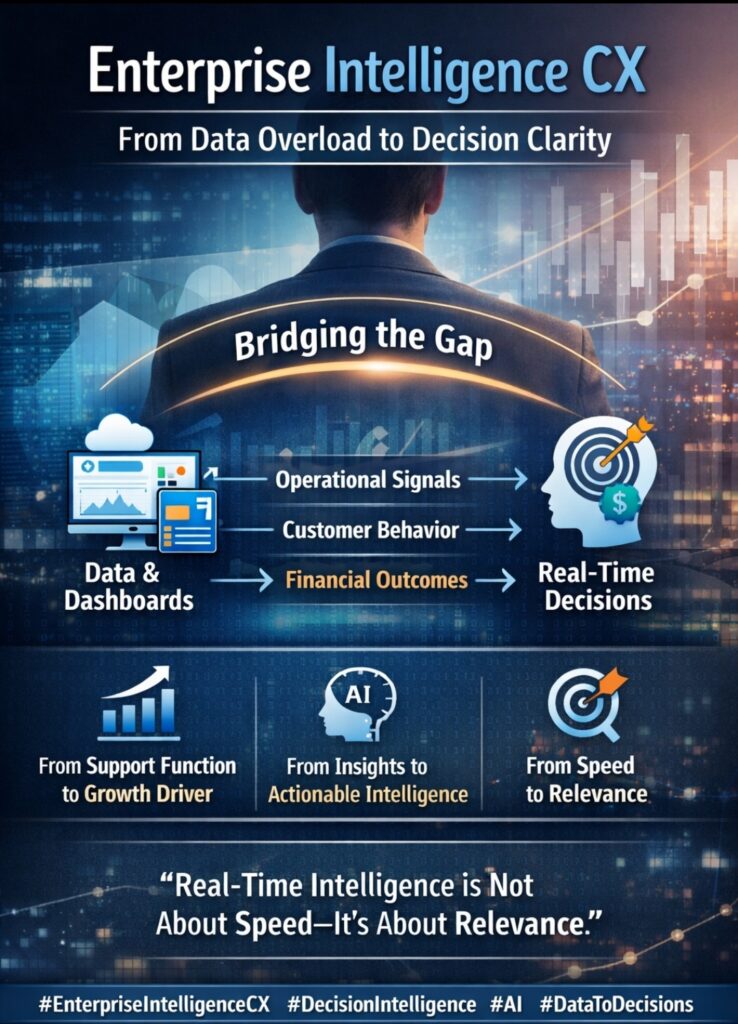
QUOTES (EDITORIAL HIGHLIGHTS)
“Enterprises are not data-poor—they are clarity-poor.”
“The real shift is from measuring experience to measuring decision quality.”
“Real-time intelligence is not about speed—it’s about relevance.”
“CX is no longer a support function—it becomes a driver of growth.”
“Business Language Models define the rules within which enterprise decisions should be made.”
KEY INSIGHTS
- Enterprise Intelligence CX shifts the focus from data availability to decision clarity
- CX is evolving from a cost center to a revenue and growth engine
- Business Language Models (BLMs) introduce context-aware enterprise intelligence
- Real-time intelligence is about decision relevance, not just speed
- Organizations must move from reporting systems to decision systems
- ROI in CX is increasingly measured through decision quality and outcome linkage
- Integrated intelligence enables predictive, cross-functional decision-making
CXQUEST STRATEGIC PERSPECTIVE
Enterprise Intelligence CX represents a structural shift in how organizations operate in an AI-driven world.
For decades, enterprises invested heavily in systems of record—ERP, CRM, and analytics platforms designed to capture and report data. However, these systems were never designed to support real-time, cross-functional decision-making. The result is what we see today: data-rich enterprises that remain decision-constrained.
What emerges from this conversation is a new architectural layer—the Enterprise Intelligence Layer—that sits above traditional systems and connects signals, context, and outcomes into a unified decision framework.
Three strategic shifts stand out:
1. From Data to Decision Intelligence
The competitive advantage is no longer who has more data, but who can translate data into actionable, timely decisions.
2. From CX Measurement to CX Activation
Traditional CX metrics are retrospective. Enterprise Intelligence CX transforms CX into a forward-looking system that actively drives revenue, retention, and risk management.
3. From AI Models to Contextual Intelligence Systems
Generic AI is insufficient for enterprise complexity. The rise of Business Language Models signals a move toward domain-specific, context-aware intelligence.
This positions Enterprise Intelligence CX not as an incremental improvement—but as a foundational capability for resilience, adaptability, and long-term value creation.
CONCLUSION
As enterprises navigate increasing complexity, volatility, and interconnected risks, the ability to make clear, timely, and context-aware decisions becomes a defining capability.
Enterprise Intelligence CX is not just about enhancing customer experience—it is about transforming how organizations think, operate, and grow. By connecting data, decisions, and outcomes into a unified intelligence layer, enterprises can move beyond reactive strategies toward predictive and adaptive systems.
In this new paradigm, the winners will not be those with the most data—but those with the clearest intelligence.
