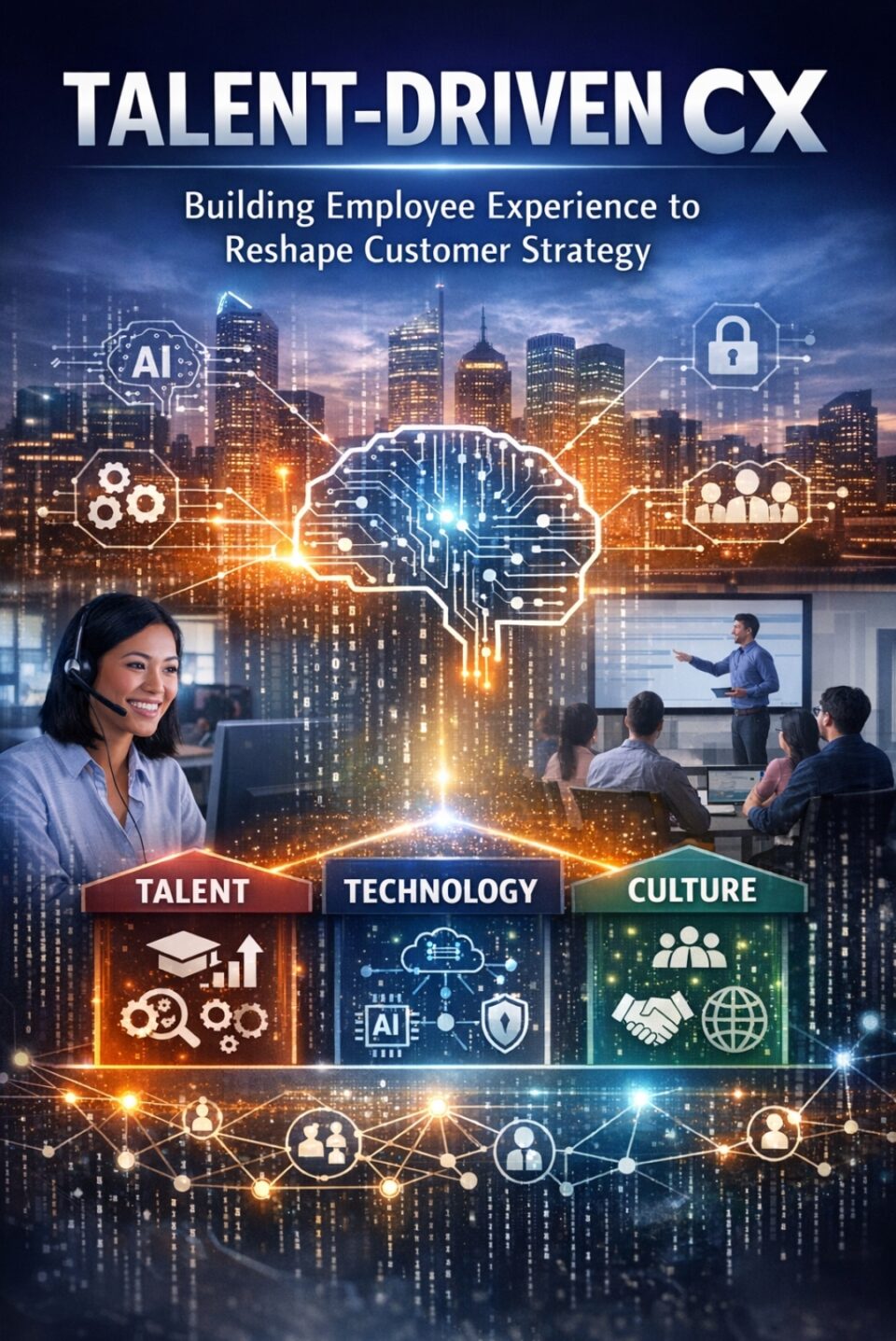
Talent-driven CX is emerging as the new foundation of customer experience. This analysis explores how employee experience, talent strategy, and AI-driven skills are reshaping CX transformation.
Talent-driven CX: The Hidden Contradiction in Modern CX
Organizations today are scaling customer experience through AI, automation, and digital platforms at an unprecedented pace. Yet, despite these investments, customer satisfaction remains uneven, inconsistent, and in many cases, declining.
This is the central contradiction shaping modern CX.
On one side, enterprises are optimizing for speed, efficiency, and scale. On the other, customers continue to report fragmented journeys, impersonal interactions, and a lack of trust.
The issue is not technological limitation.
It is organizational misalignment.
“Customer experience doesn’t fail at the interface—it fails in the organization behind it.”
A fundamental shift is now emerging—one that reframes CX transformation not as a technology-first initiative, but as a capability-driven system rooted in people, skills, and culture.
At the center of this shift is a defining idea:
Employee experience is no longer a support function for CX—it is its foundation.
Customer Expectations Are Outpacing Organizational Capability
Customer expectations have structurally evolved.
Personalization is now assumed. Real-time responsiveness is expected. Consistency across channels is non-negotiable.
Studies consistently show that:
- A majority of customers expect tailored experiences
- A single poor interaction can trigger brand switching
- Trust is increasingly tied to experience quality, not just product
At the same time, organizations face a different kind of pressure:
- Acute shortages in AI, data, and cybersecurity talent
- Increasing complexity in managing omnichannel ecosystems
- Rapid scaling across geographies and customer segments
This creates a widening execution gap:
Technology capability is accelerating faster than human capability.
The implications are significant.
Tools are being deployed faster than teams can absorb them. Systems are becoming more intelligent, but execution remains inconsistent. Automation is scaling, but empathy is not.
“The limiting factor in CX is no longer technology—it is organizational capability.”
For CX leaders, this marks a transition from managing tools to managing capability systems.
From Technology-Led CX to Talent-Driven CX
This shift represents a deeper strategic evolution.
For years, CX transformation has been driven by technology investments—CRM systems, AI platforms, analytics engines, and automation layers.
But leading organizations are now moving:
From: Technology-led transformation
To: Talent-driven CX ecosystems
This evolution is grounded in three structural realizations.
1. Employee Experience Is a CX Multiplier
Employees are the execution layer of CX. Their ability to interpret data, respond to customers, and navigate systems directly shapes experience quality.
An empowered employee creates a seamless experience. A constrained employee creates friction—regardless of the technology in place.
2. Talent Strategy Is Core CX Infrastructure
Hiring, training, and upskilling are no longer HR priorities alone. They are central to CX scalability.
Without the right skills in AI, data, and decision-making, organizations cannot fully leverage their CX technology stack.
3. Leadership Alignment Drives Experience Consistency
Customer experience is inherently cross-functional. Misaligned leadership leads to fragmented journeys, inconsistent messaging, and broken accountability.
“You cannot scale customer experience without scaling organizational alignment.”
This is where competitive differentiation is emerging.
- Leaders are integrating HR, CX, and technology strategies
- Challengers are accelerating skill development and agile operating models
- Laggards remain tool-centric, seeing diminishing returns on CX investments
Reframing Technology: From Replacement to Augmentation
Technology remains critical—but its role is changing.
The focus is shifting from replacing human effort to augmenting human capability.
Three system layers are enabling this transformation:
AI-Augmented Workflows
AI is increasingly acting as a co-pilot—supporting employees with real-time insights, recommendations, and decision support. This reduces cognitive load and improves consistency.
Continuous Skill Development Systems
Organizations are investing in learning platforms that enable ongoing upskilling in AI, cybersecurity, and data literacy. Skills are becoming dynamic assets rather than static qualifications.
Experience Orchestration Platforms
These systems align employee actions with customer journeys, ensuring that every interaction is context-aware and consistent across channels.
The New CX Architecture
- Frontend (CX Layer): Customer interactions and touchpoints
- Middleware: Workflow orchestration and experience management
- Backend: AI models, data platforms, and skill intelligence systems
“The future of CX architecture is not just systems integration—it is human-system integration.”
Where CX Transformation Becomes Visible
The real impact of this shift is seen in execution.
Before:
- Employees operate across fragmented tools
- Service quality varies significantly
- Customer interactions are reactive and inconsistent
After:
- AI-assisted decision-making improves response quality
- Context-aware systems enable personalization
- Experiences become proactive and predictive
Impact Across CX Dimensions
- Speed: Faster resolution through guided workflows
- Reliability: Reduced variability in outcomes
- Transparency: Greater visibility into customer journeys
- Consistency: Standardized experiences across channels
- Personalization: Context-driven engagement at scale
Cause → Effect in Action
- Skill development → Better decisions → Higher first-contact resolution → Improved satisfaction
- AI augmentation → Faster workflows → Reduced handling time → Lower operational costs
- Culture alignment → Consistent behavior → Stronger customer trust
Translating to Business Impact
| CX Lever | Operational Change | Business Outcome |
|---|---|---|
| AI augmentation | Faster decisions | Lower costs, higher CSAT |
| Skill development | Improved capability | Higher NPS, better retention |
| Culture alignment | Consistent delivery | Reduced churn, stronger trust |
The Operating Model Is Being Rewritten
This transformation is not incremental—it is structural.
Organizations are shifting:
- From siloed functions → to cross-functional CX teams
- From static roles → to dynamic, skill-based roles
- From centralized control → to distributed decision-making
“Organizations are moving from role-based execution to capability-based execution.”
Employee experience, talent strategy, and CX are converging into a unified operating model.
Industry Implications: A Structural Reset
This shift signals a broader redefinition of CX itself.
Customer experience is no longer just about journeys or touchpoints. It is about organizational capability.
Short-Term (0–2 Years)
- Increased investment in employee experience platforms
- Rapid upskilling initiatives in AI and data
- Early adoption of AI-assisted workflows
Mid-Term (3–5 Years)
- Full integration of EX and CX strategies
- Emergence of talent ecosystems over static workforce models
- Deep collaboration between industry and academia
What Changes Structurally
- HR evolves into a strategic CX function
- Learning becomes continuous, not episodic
- Culture becomes measurable and actively managed
“The future CX leader will need to understand talent strategy as deeply as customer journeys.”
The Rise of Capability-Led Enterprises
The next generation of CX leaders will not be defined by the technologies they deploy, but by the capabilities they build.
Three defining characteristics will separate leaders from the rest:
1. Talent-First Strategy
Organizations prioritize skill development as a competitive advantage.
2. AI-Augmented Workforce
Human decision-making is enhanced—not replaced—by intelligent systems.
3. Aligned Leadership and Culture
Consistency in experience is driven by alignment at the top.
Enterprise Decision Lens
Build vs Buy vs Partner
- Build: Internal capability for long-term differentiation
- Buy: Platforms for speed and scale
- Partner: Academia and ecosystems for sustained talent pipelines
Adoption Readiness
- Requires moderate to high data maturity
- Depends heavily on leadership alignment
- Demands strong change management
Risk Assessment
- Execution Risk: High due to organizational complexity
- Integration Risk: Moderate across systems and teams
- CX Risk: High if talent gaps remain unaddressed
Implementation Complexity
High — This is a cross-functional transformation, not a tool deployment
CX Maturity Signal
- Early-stage organizations may struggle
- Mid-stage organizations can selectively adopt
- Advanced organizations are best positioned for full transformation
Competitive Playbook
- Market Leaders: Integrate EX, CX, and technology into unified strategies
- Challengers: Accelerate workforce capability and agility
- New Entrants: Build talent-first models from inception
Final Insight: CX Will Be Won in the Workforce, Not the Interface
The narrative around CX is changing.
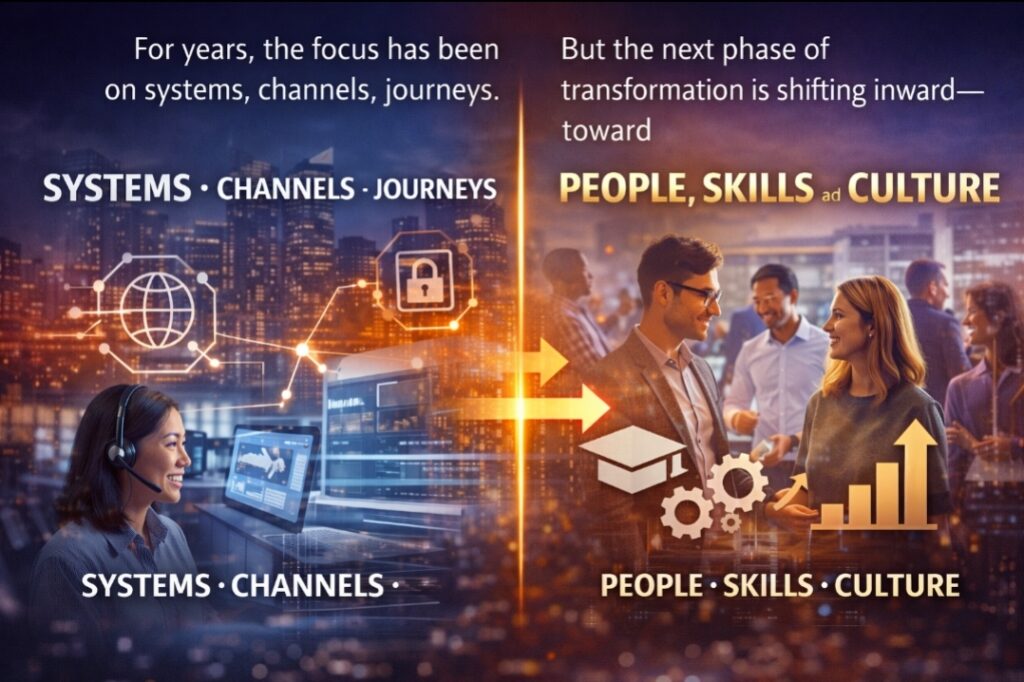
For years, the focus has been on systems, channels, and journeys. But the next phase of transformation is shifting inward—toward people, skills, and culture.
“Efficiency without capability creates fragile CX. Capability with alignment creates durable CX.”
The organizations that will lead in customer experience are not those with the most advanced tools.
They are the ones with the most capable, aligned, and empowered workforce.
Because in the end:
Customer experience is not delivered by systems. It is delivered by people—enabled by systems.
