
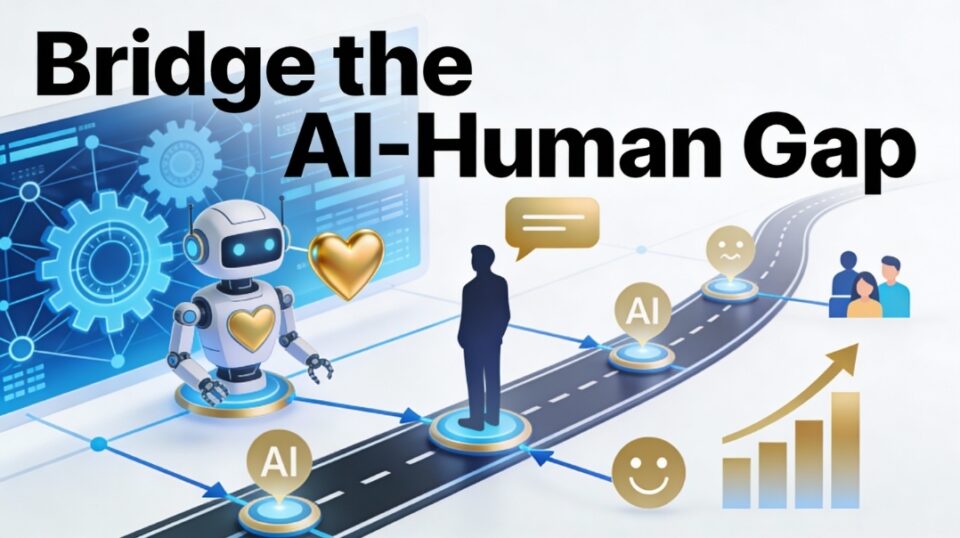
Bridging the AI-Human Gap: Empowering CX Leaders in the Agentic Era
Picture CX leader Priya at 3 AM. Her dashboard blinks red. Siloed teams flood Slack with alerts. AI chatbots mishandle a viral complaint. Customers churn. She wonders: Can AI fix this alone? No. Humans bridge the gap.
What Is the AI-Human Gap and Why Does It Plague CX Teams?
The AI-human gap describes AI’s limits in empathy, context, and adaptation despite speed and scale. CX teams need it addressed now. Fragmented journeys and siloed data amplify failures. 82% of leaders misread customers without hybrid models. Agentic AI evolves agents into proactive orchestrators, yet humans guide nuance.
Recent surveys show AI handles 70% of routine queries effectively. Humans excel in 90% of emotional escalations. Together, they cut resolution times by 40%. Vodafone deployed agentic AI for password resets. Results? Agents focused on high-value tasks, boosting satisfaction 25%.
Why Do Siloed Teams and AI Gaps Fragment Customer Journeys?
Silos trap data in CRM, ERP, and service tools. AI amplifies this chaos without human oversight. Journeys break at handoffs. Customers face 60% more touchpoints in fragmented systems. Agentic AI unifies via dynamic APIs, but humans set intent.
Consider a telecom giant. Marketing AI personalized offers. Service AI ignored context. Churn spiked 15%. Human-led governance fixed it. They created cross-functional squads. Now, unified graphs deliver seamless experiences. Journey completion rates rose 35%.
Expert Matthias Goehler notes AI shifts from reactive to anticipatory. Humans ensure ethical alignment. Without this, AI hallucinations erode trust. CXQuest hubs like “AI in Silos is a Dead End” warn: Fragmentation kills loyalty.
How Does Agentic AI Differ from Traditional AI Agents in CX?
Agentic AI reasons, plans, and adapts autonomously across tools. Traditional agents execute fixed tasks like chat responses. Agentic systems cut costs 40% via self-optimizing workflows. CX leaders gain orchestration power.
AI agents react to queries. Agentic AI predicts churn, triages alerts, and escalates smartly. NICE Ltd. embedded agentic tools in contact centers. Agents resolved issues twice as fast. Humans reviewed edge cases, preserving empathy.
Key Differences Table
| Aspect | AI Agents | Agentic AI |
|---|---|---|
| Scope | Single-task, rule-based | Multi-agent, goal-driven |
| Autonomy | Parameter-limited | Adaptive, self-improving |
| CX Impact | Routine automation | End-to-end journey governance |
| Human Role | Full oversight | Strategic guidance |
This evolution suits CXQuest readers tackling 2026 trends.
What Real-World Frameworks Bridge the AI-Human Gap Effectively?
Human-in-the-Loop (HITL) frameworks embed agents in AI lifecycles. Start with audits, then govern, train, and iterate. Readiness scores improve 50% in adopting firms. CX leaders prioritize empathy zones.
Phased rollout works best. Vodafone’s workshops identified pain points. They prototyped with LangChain. Governance boards set escalation thresholds. CSAT jumped 28%. Reports highlight personalization gains.
HITL Implementation Checklist
- Audit skills gaps across teams.
- Map journeys before tool selection.
- Define confidence thresholds for escalations.
- Train on AI copilots weekly.
- Monitor biases quarterly.
Key Insights from CX Pioneers
Agentic AI empowers, not replaces. Matt Price predicts AI will outperform average agents by 2026 in efficiency. Humans win empathy. Exelon pilots AI summaries for calls—agents handle nuance better.
Zendesk’s CTO sees anticipation over automation. Loris.ai blends predictive troubleshooting with human reviews. Efficiency rises 63%. Salesforce data: 69% of pros gain productivity.
Common Pitfalls
- Over-automation: AI without humans spikes errors 20%.
- Siloed rollout: Department tools fragment data.
- Skill neglect: 70% of teams lack AI governance.
- Bias ignore: Unguided AI erodes trust fast.
CXQuest integrates these in thought leadership. Leaders unify via journey governance.
How Can CX Leaders Implement Hybrid Models Today?
Start small. Pilot one journey like onboarding. Use agentic platforms for triage. Humans refine outputs. Response times drop 30%. Iterative testing ensures long-term success.
Hybrid Workflow Example
- AI triages inbound queries.
- Agentic layer predicts needs.
- Humans intervene on sentiment flags.
- Feedback loops optimize daily.
Energy firms assign journey owners. Boards review metrics weekly. Conversion lifts 25%. Enterprises investing in upskilling close capability gaps.
FAQ
What exactly causes the AI-human gap in customer experience?
AI excels at data but misses empathy and context. Humans provide judgment. Silos worsen this, fragmenting journeys. Hybrid models resolve most issues.
How does agentic AI fix siloed teams in CX?
Agentic AI maps data across CRM and ERP dynamically. It creates unified fabrics. Humans oversee accuracy. Teams see faster insights.
What are proven case studies of AI-human collaboration in CX?
Vodafone automated resets, freeing agents—CSAT rose 25%. NICE tools doubled resolutions. Exelon summarized calls, easing workloads.
Why do CX leaders need human oversight for agentic AI?
Oversight prevents hallucinations and biases. It ensures ethics. Regulations like the AI Act demand it. Outcomes improve measurably.
How to start bridging AI gaps on fragmented journeys?
Audit silos first. Form cross-functional squads. Pilot HITL frameworks. Measure journey KPIs weekly. Scale what works.
What 2026 trends will widen or close the AI-human gap?
Agentic mainstreaming anticipates needs. Upskilling closes skill voids. Governance boards unify teams. Empathy-first hybrids dominate.
Actionable Takeaways
- Audit current silos: Map data flows across tools in one workshop. Identify top three friction points.
- Define hybrid roles: Assign AI for volume, humans for empathy. Set clear escalation rules.
- Pilot agentic triage: Test on one journey like support. Measure resolution speed weekly.
- Build governance boards: Meet biweekly. Review CSAT, churn, and biases. Adjust prompts live.
- Upskill teams now: Run AI copilot training. Focus on sentiment and ethics modules.
- Unify data fabrics: Deploy agentic ETL for CRM-ERP links. Humans validate schemas.
- Iterate with feedback: Collect agent logs daily. Refine models for efficiency gains.
- Track journey KPIs: Monitor completion rates, not just NPS. Aim for uplift quarterly.
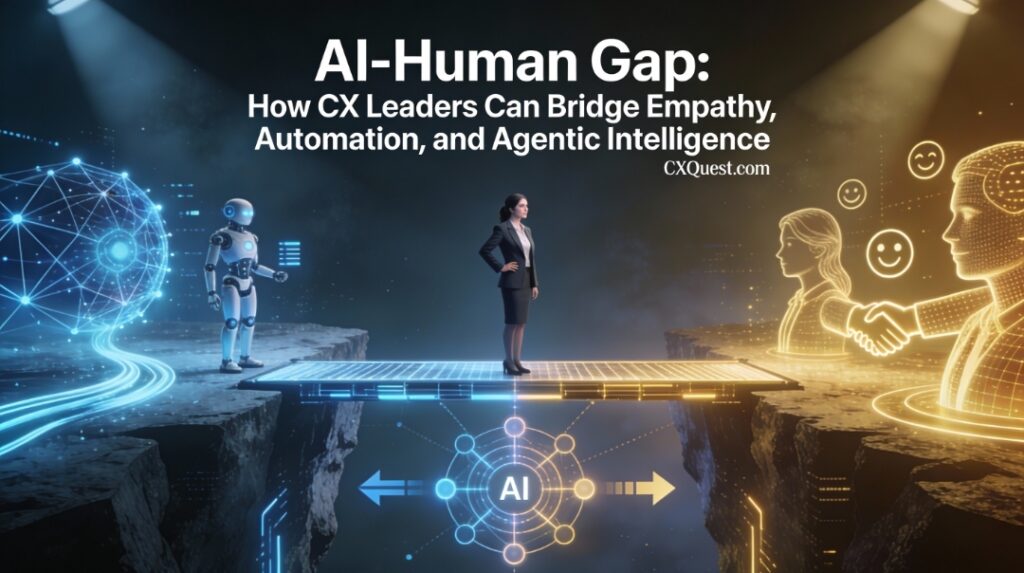
CX leaders, embrace this gap as opportunity. Agentic AI scales. Humans inspire. United, they’ll transform journeys on CXQuest.com.
