
AI Infrastructure and Customer Experience: The Hidden Layer Redefining CX
When we talk about customer experience (CX), the conversation usually revolves around interfaces—apps, chatbots, personalization engines, and service design. But a more fundamental transformation is underway.
AI infrastructure and customer experience are now deeply interconnected.
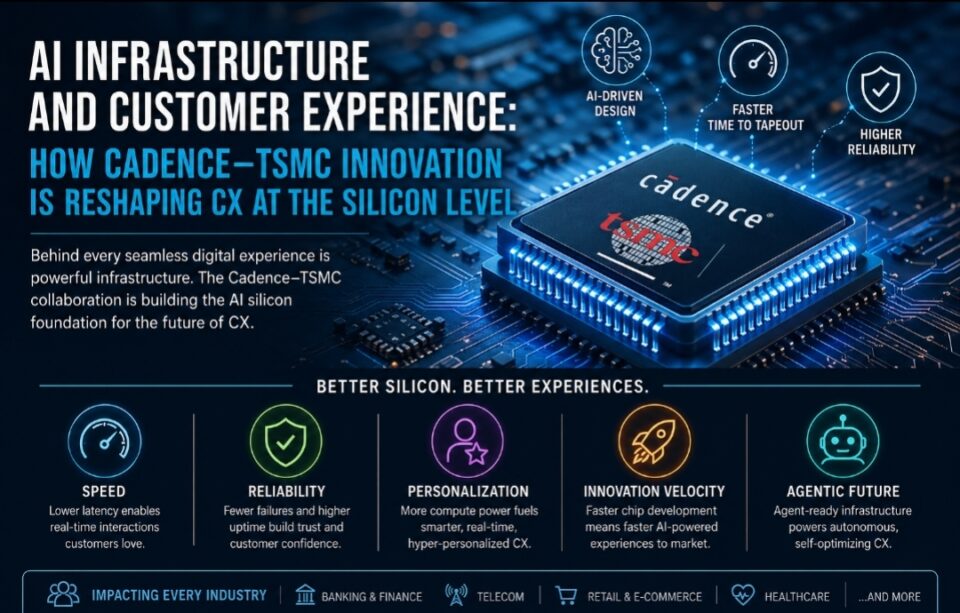
A recent collaboration between Cadence Design Systems and TSMC highlights a critical shift: customer experience is increasingly being shaped at the silicon level—long before any user interaction occurs.
From Frontend CX to Foundational CX
The expansion of Cadence–TSMC’s partnership focuses on:
- Advanced AI chip design (3nm, 2nm, and beyond)
- AI-driven electronic design automation (EDA)
- Faster, more reliable semiconductor development cycles
At first glance, this seems far removed from CX. But in reality, it represents the foundation layer of modern experience ecosystems.
Every digital interaction—whether:
- A banking app detecting fraud in milliseconds
- A streaming platform recommending content in real time
- A chatbot resolving queries instantly
—is powered by underlying compute infrastructure.
And that infrastructure is now being optimized for AI at unprecedented levels.
Why AI Infrastructure and Customer Experience Are Converging
1. Speed Is Experience
Latency is no longer a technical metric—it is a customer perception driver.
Advanced semiconductor nodes enable:
- Faster AI inference
- Real-time decision-making
- Reduced lag in digital interactions
For customers, this translates into:
- Instant recommendations
- Seamless transactions
- Frictionless digital journeys
In CX terms: speed becomes satisfaction.
2. Reliability Builds Trust
Cadence emphasizes “signoff-ready” design flows that reduce errors and improve predictability in chip design.
This has a direct CX implication:
- Fewer system failures
- Higher uptime
- More consistent digital services
In industries like banking and healthcare, reliability is not just operational—it is trust-defining.
Trust is built not just through communication, but through system performance.
3. Personalization at Scale Requires Better Silicon
Modern CX depends heavily on AI-driven personalization:
- Recommendation engines
- Predictive analytics
- Behavioral targeting
These systems require:
- High compute efficiency
- Low power consumption
- Scalable processing capabilities
The Cadence–TSMC collaboration enables precisely this—supporting advanced AI workloads that power hyper-personalized experiences.
4. Time-to-Market = CX Competitiveness
One of the most overlooked aspects of CX is innovation velocity.
By reducing design iterations and accelerating “time to tapeout,” semiconductor advancements enable:
- Faster rollout of AI-enabled products
- Quicker feature updates
- Shorter innovation cycles
For CX leaders, this means:
- Staying ahead of customer expectations
- Rapidly adapting to behavioral shifts
Faster chips → faster innovation → better CX outcomes
The Rise of “Agentic CX”
A notable element in this development is the shift toward agentic AI—systems that can:
- Set goals
- Optimize outcomes
- Execute decisions autonomously
Cadence’s “agent-ready” infrastructure signals a future where:
- AI doesn’t just support CX
- It actively orchestrates it
Imagine:
- Self-optimizing customer journeys
- Autonomous service recovery systems
- AI-driven experience design in real time
This is not incremental CX improvement—it is a paradigm shift.
Industry Impact: Where This Will Be Felt First
Banking & Financial Services
- Real-time fraud detection
- Instant credit decisioning
- Personalized financial advisory
Telecom
- Network optimization for seamless connectivity
- AI-driven customer support
Retail & E-commerce
- Hyper-personalized recommendations
- Dynamic pricing and inventory intelligence
Healthcare
- AI-assisted diagnostics
- Real-time patient monitoring
In each case, the visible experience is powered by invisible infrastructure.
The CX Blind Spot: Ignoring the Infrastructure Layer
Most CX strategies today focus on:
- UI/UX design
- Customer journeys
- Engagement channels
But this misses a critical reality:
You cannot deliver next-generation CX on legacy infrastructure.
Organizations that fail to align their CX strategy with AI infrastructure investments risk:
- Slower experiences
- Lower reliability
- Reduced personalization capabilities
A Strategic Shift for CX Leaders
The Cadence–TSMC collaboration is not just a semiconductor story—it is a signal for CX leaders.
It suggests a necessary shift:
From:
- Channel-centric CX
- Interface-level optimization
To:
- Infrastructure-aware CX strategy
- Full-stack experience engineering
This means CX leaders must increasingly collaborate with:
- CTOs
- Infrastructure teams
- AI engineering units
Because the future of CX will be determined as much by compute capability as by design thinking.
Conclusion: CX Is Now Engineered, Not Just Designed
The evolution of AI infrastructure and customer experience marks a fundamental shift in how organizations must think about delivering value.
The partnership between Cadence Design Systems and TSMC illustrates a powerful truth:
Customer experience is no longer just designed at the interface—it is engineered at the silicon level.
For forward-looking organizations, this creates both:
- A competitive advantage
- And a strategic imperative
Because in the AI era, the quality of your customer experience will increasingly depend on the intelligence—and performance—of the systems beneath it.
