
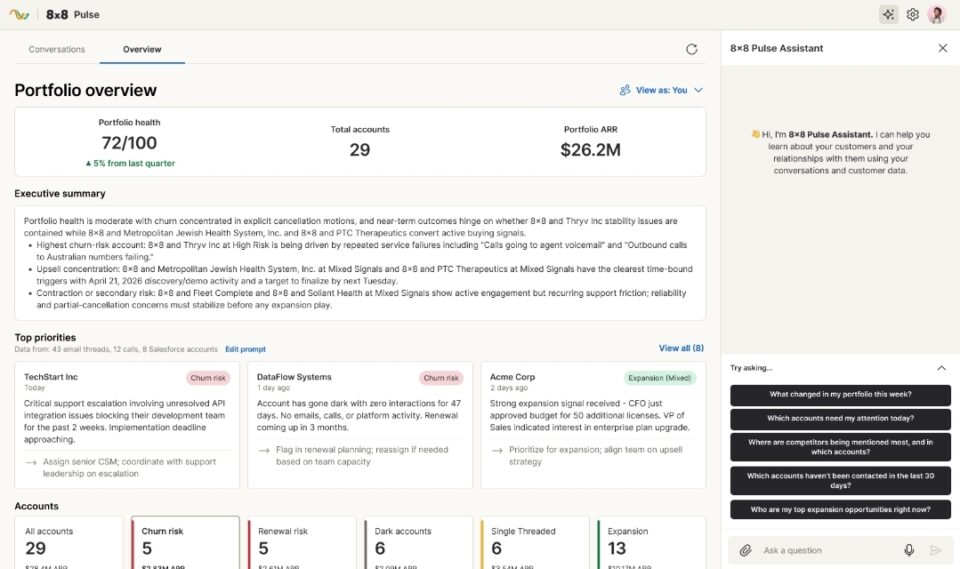
Enterprise communication platforms increasingly compete on context, reliability, and execution speed. Against that backdrop, 8×8 introduced two products that expand its ambitions beyond traditional communications software. The launches place conversational intelligence and workforce communications at the center of customer experience operations by targeting two persistent enterprise gaps: fragmented conversation data and disconnected frontline employees.
Rather than introducing isolated tools, 8×8 appears to be building toward a model where communication channels become operational systems of record. That distinction matters because customer experience failures often begin with missing context or delayed action.
Why conversational intelligence and workforce communications matters now
Organizations generate enormous volumes of customer and operational data through meetings, support interactions, internal chats, sales calls, and service tickets. However, much of that information remains trapped inside disconnected systems.
8×8 Pulse attempts to address this challenge through a conversational intelligence layer built upon communication data captured natively inside enterprise workflows.
Hunter Middleton, Chief Product Officer at 8×8, Inc., said:
“You don’t search your own memory, the right thing just surfaces when you need it. Companies never had that. They had recordings nobody replays and knowledge that might walk out the door. 8×8 Pulse gives organizations a more human kind of memory: shared, in context, and traceable to the source.”

The strategy reflects growing enterprise demand for fewer integrations and more embedded intelligence.
“Customer context loses value when organizations cannot operationalize it quickly.”
Industry analysts increasingly argue that architectural simplicity matters because intelligence delayed often becomes intelligence wasted.
Beth Schultz, VP of Research and Principal Analyst at Metrigy, said:
“CX leaders have more data than ever and less ability to act on it than they need. Complex layered architecture is a problem. With every additional intelligence layer comes integration lag, and by the time the signal surfaces, the conversation is often over.”
How conversational intelligence and workforce communications changes enterprise workflows
Pulse focuses heavily on contextualization.
The platform captures communication data across meetings, support interactions, chats, emails, and customer conversations while combining those signals with operational systems. Users can reportedly query information naturally while tracing answers back to source interactions.
That architectural choice creates three strategic advantages.
First, it reduces dependence on employee documentation habits.
Second, it preserves institutional knowledge.
Third, it potentially improves consistency across customer-facing teams.
“Enterprise memory increasingly determines customer consistency.”
The company also positioned Pulse across multiple workflow environments including browsers, CRM environments, and collaboration tools. Consequently, intelligence becomes embedded inside existing workflows rather than forcing workflow changes.
Deskless workforce gaps create operational risk
The second launch addresses a very different problem.
Millions of employees remain difficult to reach during disruptions because traditional enterprise tools prioritize desk workers. Resolve focuses on notification, escalation, acknowledgment tracking, and incident orchestration for frontline and distributed teams.
This capability matters because operational failures frequently become customer failures.
The platform supports multi-channel delivery across SMS, voice, messaging applications, and mobile workflows while escalating communications automatically until recipients acknowledge them.
Dave Michels, Principal Analyst and Founder at TalkingPointz, said:
“We’ve spent decades over-tooling the C-suite while leaving the frontline to rot in a mess of manual call trees and ignored emails. In a world of infinite noise, messaging is one of the most effective things that actually moves the needle.”
The emphasis on deskless employees reflects changing workforce realities across healthcare, retail, logistics, manufacturing, and utilities.
“Frontline communication failures often become customer experience failures.”
CX implications extend beyond contact centers
The strongest connection between both launches lies in reliability.
Pulse targets decision quality.
Resolve targets operational execution.
Together, they reinforce a broader principle: customer experience increasingly depends upon internal information flows.
Organizations frequently invest heavily in customer-facing technology while underinvesting in employee communication infrastructure. However, fragmented internal systems create delays that customers ultimately experience through slower support, inconsistent service, or failed recovery processes.
Hunter Middleton emphasized this operational focus:
“Too many critical events still end with someone asking who got the message and who didn’t. 8×8 Resolve answers that question before it’s asked.”
“Trust grows when organizations reduce communication latency.”
Moreover, governance appears central to both launches. Audit trails, traceability, and structured data controls support compliance requirements while also increasing organizational trust in AI-generated outputs.
What enterprises should watch next
The launches signal expanding competition around operational intelligence.
Organizations evaluating conversational intelligence and workforce communications capabilities will likely examine several factors closely:
- Native versus layered architectures
- Governance and explainability
- Frontline workforce coverage
- Integration complexity
- Operational resilience
Importantly, these categories increasingly overlap.
Communication platforms no longer compete solely on call quality or messaging capabilities. Instead, they compete on how effectively they convert interactions into decisions and actions.
As enterprises simplify technology stacks and pursue measurable experience outcomes, conversational intelligence and workforce communications may evolve from emerging categories into foundational infrastructure.
“Experience leaders increasingly buy outcomes, not communication channels.”
