
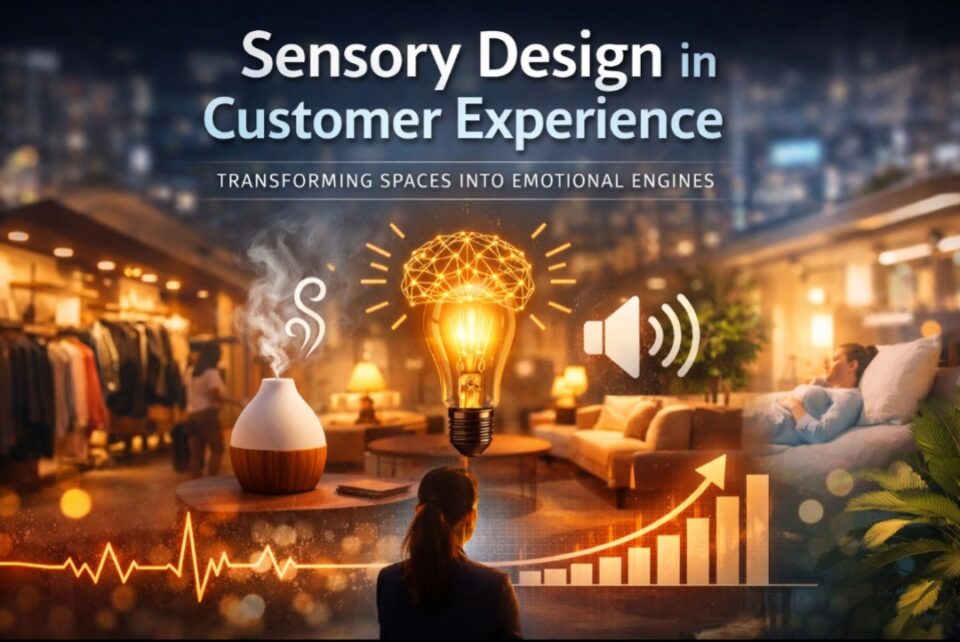
There is an emerging frontier of sensory design in customer experience. You don’t notice it at first.
You walk into a store, a hotel lobby, a workspace—and something feels right. Unknowingly, you stay a little longer. And, you browse more. You feel calmer, or more energized, or more open to buying.
Nothing explicitly told you to feel that way.
But something did.
This is the emerging frontier of customer experience: sensory design as an emotional engine. What was once ambient—lighting, scent, sound, spatial flow—is now being intentionally orchestrated to influence customer behavior, memory, and decision-making.
For CX leaders, this is no longer aesthetic design. It is behavioral infrastructure.
Experience is shifting from functional delivery to emotional orchestration
For years, customer experience has been optimized around efficiency:
- Faster checkouts
- Frictionless interfaces
- Seamless journeys
But as these become standardized, they stop differentiating.
The new battleground is not speed or convenience—it is how an experience makes the customer feel.
This is where sensory design becomes strategic.
Because emotion is not a byproduct of experience anymore.
It is the product.
Forward-looking organizations are recognizing that:
- A neutral experience is forgettable
- A positive emotional experience is memorable
- A designed emotional experience is monetizable
This is a fundamental shift—from managing journeys to engineering perception.
Why sensory design in customer experience are the fastest lever in customer behavior
From a cognitive standpoint, sensory inputs bypass rational filtering.
- Scent connects directly to memory and emotion
- Sound influences pace and mood
- Lighting affects energy and attention
- Spatial design shapes movement and interaction
Unlike messaging or branding, which require interpretation, sensory cues operate subconsciously and instantly.
This makes them one of the most efficient levers in CX design.
Consider the implications:
- A subtle fragrance can increase dwell time in retail
- Ambient sound can influence perceived waiting time
- Lighting can alter product perception and perceived quality
These are not marginal gains.
They compound across the entire customer journey.
For CX leaders, the question is no longer whether sensory design works.
It is whether you are deliberately using it—or leaving it to chance.
The rise of “emotional infrastructure” across industries
What we are witnessing is the emergence of emotional infrastructure—designed environments that actively shape customer states.
This is already visible across sectors:
Retail
Stores are evolving into immersive environments where scent, music, and layout drive exploration and purchase behavior. The goal is no longer just conversion—it is emotional imprinting.
Hospitality
Hotels are investing in signature sensory identities—distinct scents, soundscapes, and tactile elements—to create memory-linked experiences that drive repeat visits and brand recall.
Healthcare
Clinics and hospitals are redesigning environments to reduce anxiety through calming sensory inputs, improving both patient satisfaction and perceived quality of care.
Workspaces
Organizations are using environmental design to influence focus, collaboration, and employee well-being—directly impacting productivity and retention.
Across these industries, the pattern is clear:
Experience design is moving from visible interfaces to invisible influences.
Mapping sensory design to measurable CX outcomes
For CXQuest readers, the critical question is: how does this translate into metrics?
Sensory design impacts multiple layers of business performance:
1. Dwell Time
Well-designed environments increase how long customers stay—directly correlating with higher spend.
2. Conversion Rate
Emotionally aligned environments reduce friction in decision-making, improving purchase likelihood.
3. Average Transaction Value (ATV)
Positive emotional states increase openness to premium products and upselling.
4. Customer Satisfaction (CSAT) & NPS
Memorable sensory experiences enhance perception, even when core service remains unchanged.
5. Brand Recall
Multi-sensory experiences create stronger memory encoding than visual-only interactions.
In other words, sensory design is not “soft.”
It is quantifiable experience leverage.
The strategic risk: when emotional design becomes commoditized
However, there is a critical contrarian layer CX leaders must consider.
If every brand begins to engineer emotional experiences, differentiation erodes.
- If every retail store smells pleasant, scent loses impact
- If every hotel feels calming, calm becomes baseline
- If every workspace optimizes mood, mood optimization becomes expected
This leads to emotional commoditization.
When that happens, two risks emerge:
1. Diminishing returns
Incremental sensory improvements yield less differentiation over time.
2. Escalation pressure
Brands are forced to continuously intensify experiences to stand out—raising cost without proportional ROI.
The implication is clear:
Sensory design is a powerful lever—but not a permanent moat.
The hidden dependency problem in customer experience design
There is a deeper behavioral risk that is often overlooked.
As environments become better at regulating emotional states, customers may become dependent on external cues.
This has two implications:
For customers:
Reduced tolerance for neutral or unoptimized environments.
For brands:
Increased pressure to maintain high-sensory environments consistently across touchpoints.
In CX terms, this creates a new expectation baseline:
Customers no longer evaluate just the service—they evaluate how the environment makes them feel.
Failure to meet that expectation can result in disproportionate dissatisfaction.
A decision framework for CX leaders: when to invest in sensory design
Not every organization needs to heavily invest in sensory design. The decision should be strategic, not trend-driven.
Use this framework:
1. Experience Sensitivity
Does your category depend on emotion-driven decisions (e.g., retail, hospitality, wellness)?
→ If yes, sensory design is high impact.
2. Differentiation Pressure
Are your functional advantages easily replicable?
→ If yes, emotional differentiation becomes critical.
3. Customer Journey Length
Do customers spend meaningful time in your environment?
→ Longer dwell time increases ROI on sensory investments.
4. Brand Positioning
Are you competing on price or experience?
→ Premium positioning requires emotional depth.
5. Scalability Constraints
Can sensory elements be standardized across locations?
→ Consistency is key to maintaining impact.
This moves sensory design from experimentation to strategic deployment.
From passive environments to programmable experiences
The future of customer experience lies in programmable environments.
Advancements in IoT, AI, and adaptive systems will enable:
- Dynamic lighting based on time or customer profile
- Personalized scent diffusion
- Context-aware soundscapes
- Real-time environmental adjustments
This transforms spaces into responsive systems—capable of adapting to customer needs in real time.
For CX leaders, this opens a new frontier:
Experience is no longer static. It is adaptive, contextual, and continuously optimized.
The competitive advantage will not be design—but restraint
Here is the paradox.
As sensory design capabilities expand, the winning strategy may not be doing more—but doing it with precision.
Because over-designed environments can feel:
- Artificial
- Manipulative
- Overstimulating
The brands that win will be those that:
- Use sensory cues subtly
- Align them with brand identity
- Avoid over-engineering emotional responses
In other words, the advantage shifts from capability to calibration.
What CX leaders should do next
- Audit your current environments
Identify unintentional sensory signals—good or bad. - Map sensory touchpoints across the journey
Where can emotion be influenced meaningfully? - Run controlled experiments
Test impact on dwell time, conversion, and satisfaction. - Align with brand strategy
Ensure sensory elements reinforce—not contradict—brand identity. - Avoid over-optimization
Design for authenticity, not manipulation.
The bottom line: experience is becoming emotional infrastructure
Customer experience is no longer just about journeys, interfaces, or service quality.
It is becoming something deeper:
A system that shapes how customers feel—often without them realizing it.
This is the power of sensory design.
But it also comes with responsibility.
Because when you design environments that influence emotion, you are not just shaping experiences.
You are shaping behavior.
And in the long run, the brands that understand this balance—between influence and authenticity—will define the next era of customer experience.
