
When IT Talks Like Humans: Why Conversational AI in Endpoint Management Is a CX Game-Changer
Ever watched a frontline employee stare helplessly at a frozen screen while customers wait, queues grow, and trust quietly erodes?
The IT team knows the fix exists. The data exists. The device insights exist.
But they’re buried under dashboards, filters, scripts, and tickets.
That moment—small, invisible, and painfully common—is where employee experience collapses first.
And when EX breaks, CX always follows.
Hexnode’s latest upgrade to Genie AI, announced in February 2026, signals a deeper shift underway. Endpoint management is no longer just an IT efficiency problem. It is becoming a conversational, experience-led capability—one that directly shapes how fast employees can serve customers.
This is not about shiny AI.
It is about reducing friction at the exact point where work happens.
What Is Conversational Endpoint Management, and Why Should CX Leaders Care?
Conversational endpoint management allows IT teams to query, diagnose, and fix devices using natural language instead of complex dashboards or scripts.
For CX and EX leaders, this matters because device friction is one of the most under-measured drivers of customer dissatisfaction.
Every delay compounds:
- Slower employee response times
- Longer customer wait cycles
- Higher escalation volumes
- Lower frontline confidence
Hexnode Genie AI embeds conversational intelligence directly inside its Unified Endpoint Management (UEM) console, allowing IT teams to ask instead of hunt.
That subtle change has outsized CX implications.
Why Traditional Endpoint Management Quietly Breaks Experience
Most enterprises still manage devices through fragmented interfaces:
- One dashboard for inventory
- Another for compliance
- A third for scripts
- A fourth for troubleshooting
During a live incident, this fragmentation creates dashboard fatigue.
Admins spend more time searching than solving.
Frontline employees wait.
Customers feel the lag.
From a CX lens, this creates three systemic failures:
1. Time-to-Resolution Expands
Every extra click delays recovery during critical moments.
2. Cognitive Load Increases
IT teams operate under pressure, not clarity.
3. Experience Ownership Fractures
No single interface sees the full context.
Hexnode’s Genie AI addresses all three by collapsing insight, action, and remediation into a single conversational layer.
How Does Hexnode Genie AI Actually Change the Game?
Genie AI allows IT administrators to interact with their entire device ecosystem using natural language commands inside the UEM console.
Instead of navigating menus, admins can:
- Ask for real-time device insights
- Execute management actions
- Diagnose failures
- Apply remediation steps instantly
This is not a chatbot bolted onto reports.
It is context-aware operational intelligence, tied directly to live device inventory.
The result is faster decisions and fewer handoffs—two things CX operations desperately need.
From Dashboard Fatigue to Decision Velocity
One of the most under-discussed EX issues is decision latency.
Admins often know what they need.
They just cannot reach it fast enough.
Genie AI replaces:
- Manual filtering
- Cross-dashboard navigation
- Script hunting
With:
- Conversational queries
- Immediate, relevant responses
- Actionable next steps
This shift reduces mean time to insight, not just mean time to resolution.
For CX leaders, that distinction matters. Faster insight prevents incidents from becoming customer-impacting failures.
Why “Fix It with Genie” Matters for Real-World CX
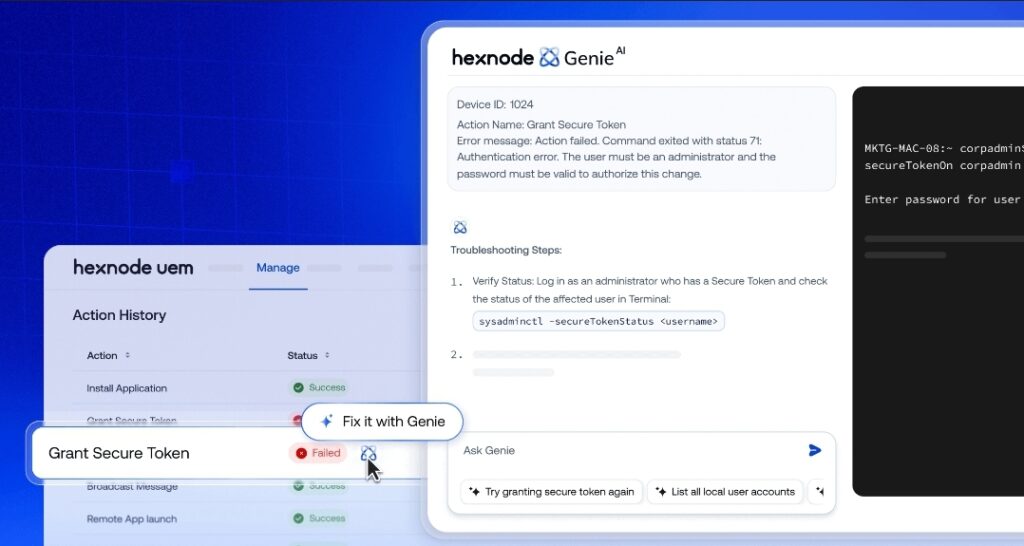
Genie AI does not stop at insight—it enables action.
Admins can instruct Genie to:
- Restart services
- Push configurations
- Apply compliance fixes
- Trigger automated remediation
When actions fail, Genie identifies root causes and presents clear remediation guidance, which can be executed immediately from the same interface.
This is critical in customer-facing environments:
- Retail POS systems
- Healthcare devices
- Call center endpoints
- Logistics scanners
Every minute saved is a customer saved.
Scripting Without the Silo: A Quiet Breakthrough
Hexnode’s introduction of a dedicated scripting terminal inside Genie AI is a deceptively powerful move.
Admins can now execute custom scripts across:
- Windows
- macOS
- Linux
All from a conversational interface.
This eliminates a long-standing gap between:
- Power users who script
- Operations teams who execute
For CX operations, this means:
- Fewer escalations
- Faster cross-team collaboration
- Reduced dependency on specialists
It also lowers the risk of knowledge silos—a chronic enterprise problem.
What Makes This a CX Story, Not Just an IT Upgrade?
CX does not fail at strategy.
It fails at execution under pressure.
Hexnode Genie AI directly impacts:
- Employee confidence during incidents
- Consistency of frontline performance
- Speed of customer recovery
When employees trust that IT systems will respond quickly, they serve customers more confidently. That emotional safety translates into better interactions.
This is where EX becomes CX.
How This Fits the Broader AI-in-CX Trend
Across CXQuest’s research and industry analysis, one pattern is clear: AI that removes friction beats AI that adds features.
Genie AI aligns with three emerging CX tech principles:
1. AI as an Interface, Not a Tool
Users interact with outcomes, not systems.
2. Context Over Automation
Automation without understanding increases risk.
3. Experience-Led Operations
Operational tools must serve human workflows.
Hexnode’s roadmap to extend Genie AI into its XDR platform reinforces this direction—bringing conversational intelligence into security and threat response, where speed is existential.
Common Pitfalls CX Leaders Should Watch For
Conversational AI is powerful—but only when deployed thoughtfully.
Over-automation without governance
Unchecked actions can introduce compliance risk.
Treating IT AI as “back-office only”
CX leaders must stay involved.
Ignoring training and change management
Natural language still needs shared norms.
Measuring efficiency instead of experience
Speed is useless if trust erodes.
The leaders who win will treat Genie AI-like tools as experience infrastructure, not just IT upgrades.
A Practical Framework: The CX-EX-IT Alignment Loop
Use this four-step loop to operationalize conversational endpoint AI:
| Step | Focus | Outcome |
|---|---|---|
| Observe | Identify recurring device friction points | Experience clarity |
| Converse | Enable natural language diagnostics | Faster insight |
| Act | Trigger remediation from one interface | Reduced downtime |
| Learn | Feed incidents into CX metrics | Continuous improvement |
This loop ensures IT actions translate into measurable CX gains.
Key Insights for CX and EX Leaders
- Device friction is customer friction
- Conversational AI reduces cognitive load
- Speed without context creates risk
- EX tools shape emotional confidence
- Integrated interfaces outperform layered dashboards
These are not technical insights. They are experience truths.
Frequently Asked Questions (FAQ)
How does conversational endpoint management impact customer experience?
By reducing device downtime and employee frustration, it improves response speed and interaction quality.
Is Genie AI meant for IT teams only?
Primarily yes, but its outcomes directly influence EX and CX metrics.
Does conversational AI replace IT expertise?
No. It amplifies expertise by reducing manual effort and search time.
What environments benefit most from this approach?
Retail, healthcare, logistics, call centers, and any device-heavy operation.
How should CX leaders measure success?
Track downtime reduction, incident resolution time, and frontline confidence scores.
Conversational AI in Endpoint Management : Actionable Takeaways for CX Professionals
- Map device failures to customer pain points, not IT metrics.
- Include CX leaders in endpoint AI rollout discussions.
- Prioritize tools that reduce cognitive load, not just automate tasks.
- Demand conversational access to insights, not more dashboards.
- Align IT remediation metrics with CX recovery metrics.
- Train teams on intent-based commands, not rigid workflows.
- Audit where EX friction silently leaks into CX.
- Treat endpoint intelligence as experience infrastructure.
Conversational AI in Endpoint Management : The Bottom Line
When IT systems start understanding humans, work starts flowing again.
And when work flows, customers feel it.
Hexnode Genie AI is not just strengthening endpoint management in India.
It is quietly redefining how experience resilience is built—one conversation at a time.
For CX leaders, that conversation is no longer optional.
