

What happens when AI answers fast—but still gets it wrong?
Contextual Intelligence: The CX Strategy Redefining AI-Led Customer Experience in 2026
A customer reaches out at midnight.
They’ve already explained their issue twice.
The chatbot responds instantly.
But it asks the same question again.
Speed exists. Intelligence does not.
This is the quiet crisis facing customer experience in 2026.
AI is everywhere in CX. Yet satisfaction is not.
According to global research spanning more than 11,000 consumers and CX leaders across 22 countries, expectations have outpaced execution. 83% of consumers believe customer experience should be far better than it is today, even in an era of automation, personalisation, and always-on support.
The gap is no longer about technology access.
It is about context.
The Zendesk CX Trends 2026 report calls this shift contextual intelligence—the ability of AI systems to understand not just what a customer says, but who they are, what happened before, why it matters now, and what should happen next.
This article unpacks all five CX trends for 2026, connects them to real-world CX challenges, and translates them into practical frameworks CX and EX leaders can apply immediately.
What Is Contextual Intelligence—and Why Does CX Now Depend on It?
Short answer: Contextual intelligence is AI that understands history, intent, emotion, and policy—not just prompts.
Contextual intelligence goes beyond automation. It combines:
- Persistent memory across interactions
- Unified knowledge across teams
- Real-time signals and policies
- Reasoning that explains decisions
This is what enables agentic AI—systems that can act, decide, and resolve issues autonomously, while still aligning with brand values and rules.
According to the research, 87% of CX leaders believe agentic AI can now dramatically improve interaction quality. But only organisations that unify data, workflows, and governance actually see results.
Without context, AI scales frustration.
With context, it scales trust.
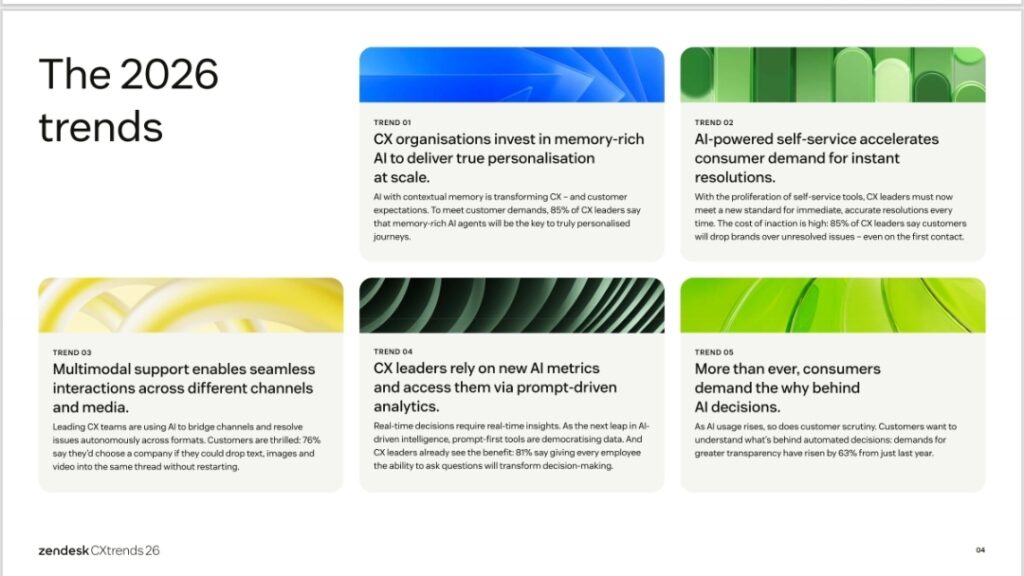
Trend 01: Why Is Memory-Rich AI Becoming the Foundation of Personalised CX?
Short answer: Memory-rich AI enables continuous conversations instead of disconnected interactions.
What is memory-rich AI?
Memory-rich AI retains and applies relevant details from every prior interaction, across channels and time. It remembers preferences, past issues, outcomes, and emotional signals.
This transforms CX from transactional to relational.
Consumers already expect this shift. 67% believe brands should offer more personalised service now that AI can analyse interactions, and 74% find repeating themselves deeply frustrating.
Why memory matters more than speed
Personalisation fails when it resets every session.
Customers do not think in channels.
They think in stories.
Memory-rich AI enables:
- Seamless channel switching without loss of context
- Faster resolution without repetitive questions
- Explanations grounded in past experiences
Case in point: WeRoad
WeRoad, a tech-driven travel company, uses AI agents to resolve 30% of tickets autonomously. Their AI agent checks bookings, discounts, and policies without human escalation.
The result is not just efficiency.
It is continuity.
Agents also benefit. 73% say having historical interactions in one place helps them perform better, reducing cognitive load and decision fatigue.
CX maturity matters
High-maturity organisations are 1.6× more likely to deploy memory-rich AI and 2× more likely to report CSAT improvements.
They treat AI as a team member, not a bolt-on.
Trend 02: Why Are Instant, Accurate Resolutions Now the Minimum Standard?
Short answer: Customers now expect problems solved immediately—not just acknowledged quickly.
Speed alone is no longer impressive.
Resolution is.
The new baseline
- 74% of consumers expect 24/7 service availability
- 85% of CX leaders say unresolved issues cost customers—even on first contact
- 86% say fast and accurate resolutions influence purchase decisions
AI has reshaped expectations across industries. What feels instant in one experience becomes expected everywhere else.
The danger of partial automation
Self-service without resolution creates churn.
Agentic AI changes the equation by:
- Making decisions autonomously
- Processing refunds or returns instantly
- Resolving multi-step issues without handoffs
Case in point: END.
END., a premium streetwear retailer, increased zero-touch ticket resolution by 96% by scaling AI automation. First-reply and full-resolution times dropped significantly.
Almost 87% of leaders agree AI materially accelerates resolution speed—but only when it is embedded into workflows, not layered on top.
The adoption gap
- 96% of high-maturity organisations report faster resolutions with AI
- Only 60% of low-maturity organisations say the same
The difference is not tools.
It is training, change management, and trust.
Trend 03: What Is Multimodal Support—and Why Text-Only CX Is Fading?
Short answer: Multimodal support lets customers use text, images, voice, and video in a single interaction.
Omnichannel meant consistency across channels.
Multimodal means fluidity within one conversation.
Why customers want multimodal CX
Customers already communicate this way in daily life. They send photos, share screens, and switch formats naturally.
In CX:
- 79% say sharing media makes support easier
- 76% would choose brands allowing text, images, and video in one thread
Video is rising fast for:
- Return verification
- Technical troubleshooting
- Product assembly
Voice remains critical for emotionally charged or complex issues, especially when tone matters.
Case in point: Leboncoin
Leboncoin Mobility Pro expanded from voice-only support to include video and screen sharing. Their CSAT reached 80%, supported by AI summarisation and tone-aware drafting.
The multimodal maturity divide
- 93% of high-maturity organisations use AI across at least one non-text medium
- Only 54% of low-maturity organisations do
Multimodal CX is not about adding channels.
It is about preserving context while switching formats.
Trend 04: Why Are Promptable Analytics Rewriting CX Measurement?
Short answer: Prompt-driven analytics democratise insights and redefine CX success metrics.
Traditional dashboards answer yesterday’s questions.
Promptable analytics answer today’s.
What are promptable analytics?
They combine natural-language querying with AI performance metrics, enabling real-time, contextual analysis.
Instead of waiting weeks for reports, CX leaders ask:
“Show country-wise inquiry spikes.”
“Which issues fail first-contact resolution?”
“Where does automation break down?”
And get answers instantly.
Why metrics are changing
AI introduces new performance dimensions:
- Automation containment
- Bot satisfaction
- Cost per contact
Yet 84% of leaders still see CSAT as the North Star, reinforcing that AI metrics complement—not replace—human-centric outcomes.
Case in point: SeatGeek
SeatGeek resolves over half of support conversations using AI agents. Their AI agent CSAT rose from 34% to 70%, doubling satisfaction.
The coming shift
- 44% of organisations use promptable analytics today
- 86% will within a year
High-maturity organisations track AI metrics at three times the rate of low-maturity peers.
The cost of delay is strategic blindness.
Trend 05: Why Do Customers Now Demand the “Why” Behind AI Decisions?
Short answer: Transparency builds trust when outcomes are automated.
AI decisions affect refunds, pricing, access, and security. Customers want explanations, not system messages.
The transparency expectation
- 95% of consumers want to know why AI made a decision
- Transparency demands rose 63% year-over-year
- 80% of CX leaders say transparency is non-negotiable
Yet only 37% of organisations currently provide decision rationale.
What transparency looks like
Not technical logic.
Plain-language reasoning.
“This refund was denied because the return window closed.”
Not: “System decision applied.”
Case in point: Playtomic
Playtomic integrated refund logic directly into CX workflows. 80% of refund enquiries are resolved by AI, with 77% customer satisfaction.
Transparency reduced agent workload and increased trust.
Why leaders hesitate
Many organisations still see CX as a cost centre. Efficiency dominates AI roadmaps. Explainability gets deprioritised.
This is a strategic error.
Transparency is becoming a differentiator.
Common Pitfalls CX Leaders Must Avoid in 2026
- Automating without memory, creating fast but forgetful experiences
- Scaling self-service without resolution authority
- Adding channels without preserving context
- Measuring AI only on cost reduction
- Hiding AI logic instead of explaining it
Each pitfall erodes trust quietly.
Together, they drive churn.
A Practical Framework: The Contextual Intelligence CX Stack
To operationalise these trends, CXQuest recommends a five-layer model:
- Memory Layer – Persistent customer and interaction history
- Knowledge Layer – Unified policies, products, and processes
- Action Layer – Agentic AI with decision rights
- Insight Layer – Promptable analytics and resolution metrics
- Trust Layer – Explainability, governance, and transparency
Weakness in any layer breaks the experience.
FAQ: CX Trends 2026
How is agentic AI different from chatbots?
Agentic AI can reason, decide, and act autonomously within defined policies.
Does contextual intelligence require replacing existing systems?
No. It requires integrating them into a unified knowledge and memory framework.
Are customers comfortable with AI-led service?
Yes, if it is accurate, fast, and transparent.
What KPIs matter most in AI-driven CX?
Resolution quality, customer effort, CSAT, and explainability—not just speed.
Can small CX teams adopt these trends?
Yes. Start with memory, then scale autonomy and analytics gradually.
Actionable Takeaways for CX Leaders
- Audit repetition across journeys. Eliminate questions customers already answered.
- Implement persistent memory across channels before adding new automations.
- Empower AI with decision rights for low-risk resolutions like refunds.
- Adopt promptable analytics to move from reports to real-time decisions.
- Track resolution-based KPIs, not just response times.
- Design explainability scripts for AI decisions in sensitive moments.
- Train agents to work with AI, not around it.
- Treat trust as a CX metric, not a legal afterthought.
Final Thought
In 2026, the CX leaders who win will not be the fastest adopters of AI.
They will be the best integrators of context.
Because customers do not remember automation.
They remember how understood they felt.
