
Agentic AI in CX Strategy: Why Ramco Systems’ Chia Signals a Turning Point for Enterprise Experience
Ever watched a customer repeat the same issue three times—chatbot, email, agent—only to abandon the journey in frustration?
That moment is not a tooling failure.
It is a design failure.
CX leaders know this scene too well. AI answers questions. Humans fix problems. Journeys fall through the cracks in between. What breaks is not intent—but execution across systems, teams, and policies.
This is where agentic AI enters the conversation—not as hype, but as a structural shift.
With the launch of Chia, an enterprise-grade conversational AI agent platform, is making a deliberate move into that gap. Not to replace humans. But to redesign how work flows through CX.
This article explores what agentic AI really means for CX, why it matters now, and how platforms like Chia are changing the economics and architecture of experience delivery.
What Is Agentic AI and Why CX Teams Need It Now?
Agentic AI refers to systems that can reason, decide, and act across workflows—not just respond to prompts.
Unlike traditional chatbots, agentic systems execute multi-step tasks across enterprise tools, within defined guardrails, and escalate only when exceptions arise.
For CX leaders, this matters because most customer pain does not live in questions.
It lives in unfinished work.
Refunds that stall.
Bookings that fail validation.
Policies that require interpretation, not retrieval.
Agentic AI addresses that operational middle ground.
Why Traditional Conversational AI Breaks at Scale
Conventional CX automation fails when journeys cross system boundaries.
Most bots excel at intent detection and FAQ deflection. They struggle when resolution requires orchestration—CRM updates, ERP actions, policy checks, and compliance logging.
This creates three systemic CX problems:
- Fragmented accountability across tools and teams
- Over-escalation to humans, driving costs up
- Inconsistent outcomes, eroding trust
CX teams then compensate with more scripts, more handoffs, and more agents.
Agentic AI flips this model by embedding decision logic into the workflow itself.
How Chia Reframes Enterprise CX Automation
Chia is designed to act, not just converse.
Positioned as part of Ramco’s AI-driven task automation suite, rTask, Chia enables enterprises to deploy production-grade AI agents that execute end-to-end workflows across systems.
What differentiates Chia is not conversation quality—but operational depth.
Key capabilities include:
- Natural Language Workflow (NLW) logic defined in plain English
- Multi-step workflow orchestration across enterprise systems
- Omnichannel presence across chat, email, and messaging
- Real-time integrations with CRM, ERP, ITSM, and HRIS platforms
- Explainability and workflow logs for audit and compliance
For CX leaders, this shifts automation from deflection metrics to resolution integrity.
Why No-Code Agent Design Changes CX Governance
Chia’s no-code AI Agent Foundry enables CX teams to design agents without engineering bottlenecks.
This matters more than it sounds.
In most enterprises, CX logic lives in documents, not systems. Policy teams define rules. Ops teams interpret them. Engineers encode them—often months later.
Chia collapses this cycle.
Using natural language instructions, non-technical teams can define logic like:
- Refund eligibility
- Booking validation
- Policy enforcement
The platform converts this into deterministic behavior, reducing hallucination risks and accelerating deployment timelines.
The result is not faster bots—but faster CX governance.
What “Human-in-the-Loop” Becomes in an Agentic Model
Agentic CX does not remove humans. It repositions them.
Instead of humans handling every interaction, they intervene only when:
- Policies conflict
- Exceptions arise
- Emotional escalation occurs
This is a shift from human-in-the-loop to human-on-exception.
According to , this reflects a broader transformation:
“The future of enterprise software is agentic by design—autonomous, adaptive, and continuously evolving.”
For CX leaders, this reframes workforce strategy. Agents focus on judgment, empathy, and complexity—not repetition.
Which Industries Stand to Gain the Most?
Agentic CX delivers the highest value where volume, variability, and compliance intersect.
Chia is positioned for industries where journeys are both frequent and fragile:
- E-commerce: Orders, returns, refunds at peak scale
- Travel and Hospitality: Booking changes and seasonal spikes
- Financial Services: High-volume queries with regulatory constraints
- Technology and SaaS: Onboarding and lifecycle support
- Telecom: Billing, service, and technical orchestration
In these environments, speed without accuracy destroys trust.
Accuracy without speed destroys loyalty.
Agentic AI balances both.
How Agentic AI Solves the CX Silo Problem
Silos persist because systems don’t share accountability.
CX leaders often inherit disconnected stacks—CRM for context, ERP for action, ITSM for tickets, analytics elsewhere.
Agentic AI introduces a control layer that sits above systems, not inside them.
This enables:
- Unified decision logic
- Cross-system task execution
- Centralized audit trails
Instead of stitching journeys together post-failure, CX teams design resolution paths upfront.
Common Pitfalls CX Leaders Must Avoid
Agentic AI fails when treated as a chatbot upgrade.
Based on early enterprise deployments, three mistakes recur:
- Automating broken processes without redesign
- Overloading agents with ambiguous policies
- Ignoring explainability and compliance logs
Agentic systems amplify design quality. Poor governance scales faster than good intent.
CX leaders must lead with clarity, not capability.
Key Insights for CX Strategy Leaders
- Conversation is not resolution
- Automation without action is noise
- Governance defines trust at scale
- Agentic AI is an operating model shift, not a feature
As notes:
“Customers expect accuracy, speed, and seamless support across every touchpoint.”
Agentic AI aligns CX delivery with that expectation.
How CX Teams Should Evaluate Agentic AI Platforms
Before adopting any agentic solution, CX leaders should ask:
- Can it execute across systems, not just respond?
- Does it support deterministic workflows?
- Is logic auditable and explainable?
- Can CX teams own change without engineering delays?
If the answer is no, automation debt will follow.
Frequently Asked Questions
How is agentic AI different from chatbots in CX?
Agentic AI executes tasks across systems, not just conversations. It resolves issues end-to-end.
Is agentic AI safe for regulated industries?
Yes, when designed with deterministic workflows, audit logs, and role-based controls.
How long does enterprise deployment typically take?
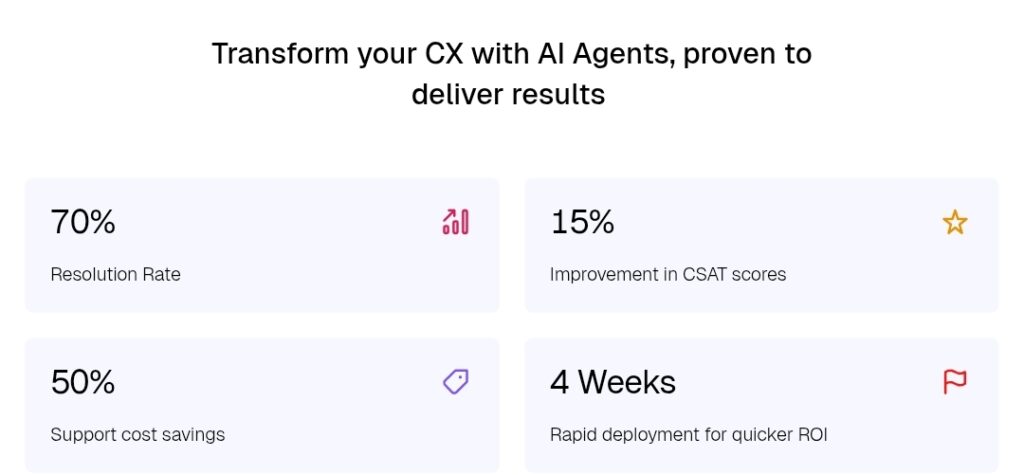
Platforms like Chia aim for weeks, not months, by eliminating heavy coding cycles.
Does agentic AI replace CX agents?
No. It reduces repetitive workload and escalates exceptions to humans with full context.
What CX metrics improve most with agentic AI?
First-contact resolution, average handling time, and operational cost efficiency.
Actionable Takeaways for CX Leaders
- Map journeys by resolution, not channels
- Identify tasks that require system-to-system execution
- Define CX policies in plain language first
- Design exception paths before automation
- Demand explainability from every AI action
- Shift agents toward judgment-heavy interactions
- Pilot in high-volume, rule-based workflows
- Treat agentic AI as a CX operating layer
Final Thought
The future of CX is not more empathetic scripts or smarter prompts.
It is systems that finish the work customers start.
Agentic AI platforms like Chia signal that CX is moving from conversation design to outcome architecture.
For leaders ready to make that shift, the opportunity is not incremental—it is structural.
