
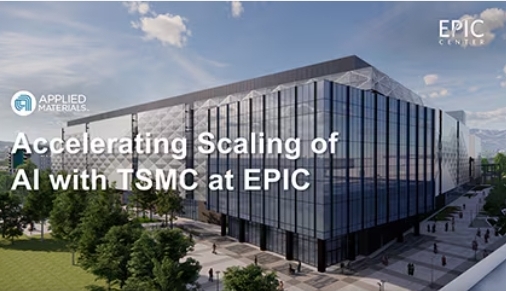
Applied Materials partners with TSMC to Accelerate AI Scaling Through EPIC Center Collaboration
The semiconductor industry is entering an era where AI growth is no longer constrained purely by software innovation. Infrastructure complexity, manufacturing precision, energy efficiency, and commercialization speed are becoming equally critical. That is why the announcement that Applied Materials partners with TSMC at the EPIC Center in Silicon Valley represents far more than another semiconductor collaboration.
At its core, the partnership signals a structural shift in how next-generation AI infrastructure will be designed, validated, and scaled.
Applied Materials and TSMC are expanding a relationship that has existed for more than three decades. But the nature of that relationship is changing. Instead of operating through traditional supplier-foundry boundaries, the companies are moving toward integrated co-innovation designed specifically for AI-era semiconductor complexity.
Gary Dickerson, President and CEO of Applied Materials, described the initiative as a way to “accelerate the development of technologies to address the unprecedented complexity driving the chipmaking roadmap.”
That complexity is rapidly becoming the defining challenge of the global AI economy.
Why Applied Materials partners with TSMC matters beyond semiconductor manufacturing
For years, semiconductor innovation operated through relatively linear development cycles. Equipment suppliers developed tools, foundries optimized manufacturing processes, and chip designers built architectures around predictable scaling improvements.
AI has fundamentally disrupted that operating model.
Modern AI infrastructure demands exponentially higher transistor density, lower energy consumption, faster interconnect speeds, and improved thermal efficiency. The deeper implication is that innovation can no longer occur in isolated stages.
This becomes critical when hyperscalers, enterprises, and AI platform providers require infrastructure capable of supporting massive inference workloads while maintaining economic viability.
From a CX standpoint, semiconductor scaling directly shapes:
- AI responsiveness
- Cloud performance
- Edge computing intelligence
- Latency reduction
- Enterprise automation experiences
Operationally, this translates into enormous pressure on semiconductor ecosystems to reduce the time between research breakthroughs and production deployment.
That is precisely where the EPIC Center becomes strategically important.
Applied Materials’ planned $5 billion investment into the EPIC Center is designed to shorten commercialization timelines by enabling collaborative engineering between semiconductor ecosystem players. Rather than waiting for sequential validation cycles, process integration, materials experimentation, and equipment optimization can occur simultaneously.
Dr. Y.J. Mii, Executive Vice President and Co-Chief Operating Officer at TSMC, emphasized this collaborative necessity:
“Meeting the challenges of AI at a global scale requires industry-wide collaboration.”
The statement reflects a broader reality across the semiconductor industry: future leadership may depend less on isolated technological breakthroughs and more on ecosystem synchronization capability.
The new competitive battleground is innovation velocity
The partnership also reshapes semiconductor competition itself.
Historically, competitive positioning focused heavily on node leadership and transistor scaling metrics. Those factors remain important, but AI-era manufacturing introduces a new variable: coordinated innovation speed.
This is where the shift occurs.
Applied Materials is effectively repositioning itself from a semiconductor equipment vendor into a strategic innovation orchestration partner. By embedding co-development directly into the EPIC Center model, the company gains deeper visibility into future manufacturing requirements while accelerating product validation cycles.
Meanwhile, TSMC gains earlier access to next-generation manufacturing capabilities and process experimentation environments.
This creates a reinforcing advantage loop:
- Faster experimentation
- Earlier validation
- Reduced commercialization delays
- Higher manufacturing predictability
- Faster AI infrastructure deployment
Competitors such as ASML, Lam Research, Samsung Electronics, and Intel Foundry are also investing aggressively in ecosystem-level innovation strategies.
However, the EPIC Center introduces a more integrated operational model where process engineering and manufacturing readiness evolve together rather than independently.
Strategically, this indicates that semiconductor competition is shifting from manufacturing scale toward orchestration efficiency.
How Applied Materials partners with TSMC to address AI-era semiconductor complexity
The technical foundation of the partnership centers around advanced materials engineering, process integration, and equipment innovation.
At a structural level, AI semiconductor architectures are becoming significantly more difficult to manufacture because transistor structures are evolving into increasingly dense 3D configurations.
This creates several engineering challenges:
- Thermal management complexity
- Variability control
- Reliability optimization
- Yield management
- Interconnect scaling limitations
Traditional semiconductor scaling approaches are becoming insufficient.
The companies specifically highlighted work involving:
- Advanced logic scaling
- Next-generation manufacturing equipment
- Vertically stacked architectures
- 3D transistor structures
- Advanced interconnect technologies
Dr. Prabu Raja, President of the Semiconductor Products Group at Applied Materials, stated:
“As a founding partner of the EPIC Center, TSMC gains earlier access to Applied’s innovation teams and next-generation equipment.”
Operationally, this translates into faster process refinement cycles and earlier production readiness.
The deeper implication is that semiconductor manufacturing is evolving into a systems orchestration discipline where materials science, process integration, and equipment engineering must function as a synchronized innovation stack.
From infrastructure optimization to customer experience impact
Although semiconductor manufacturing operates far below the consumer interface layer, its CX implications are substantial.
When AI systems experience latency issues, power inefficiencies, or compute bottlenecks, the root cause often originates at the infrastructure layer.
That means semiconductor innovation increasingly shapes:
- AI responsiveness
- Enterprise automation reliability
- Cloud scalability
- Device intelligence
- Real-time analytics performance
From a customer perspective, users may never directly encounter the EPIC Center or understand process integration technologies. But they will experience the downstream effects through faster AI systems, more capable edge devices, and more energy-efficient digital platforms.
This is where semiconductor engineering becomes a customer experience issue rather than simply a manufacturing issue.
At a business level, the implications are equally significant. AI infrastructure costs are rising sharply due to compute intensity and energy requirements. More efficient semiconductor architectures help enterprises reduce:
- Infrastructure spending
- Energy consumption
- Compute inefficiencies
- Deployment delays
Strategically, this indicates that semiconductor manufacturing capability is becoming a foundational competitive advantage for AI-native enterprises.

The EPIC Center model could redefine semiconductor collaboration
The announcement that Applied Materials partners with TSMC ultimately reflects a broader transformation occurring across advanced technology industries.
As AI complexity increases, isolated innovation models are becoming less effective. The future likely belongs to ecosystems capable of synchronizing:
- R&D
- Manufacturing
- Process integration
- Commercialization
- Infrastructure deployment
That transition carries implications for talent, investment models, supply chains, and global semiconductor policy.
The EPIC Center itself may become a blueprint for future semiconductor innovation hubs where collaborative engineering replaces fragmented development cycles.
Gary Dickerson noted that the initiative is designed to strengthen the innovation pipeline and accelerate the transition of breakthrough technologies from research into high-volume manufacturing. That objective becomes increasingly important as enterprises race to operationalize AI at scale.
The broader industry lesson is increasingly clear: in the AI era, innovation speed may matter as much as innovation itself.
Key Takeaways
- Applied Materials and TSMC are moving toward ecosystem-based semiconductor innovation.
- AI scaling pressures are forcing tighter integration between materials science and manufacturing execution.
- The EPIC Center model aims to reduce commercialization timelines structurally.
- Semiconductor competition is shifting toward innovation orchestration capability.
- Infrastructure-level optimization is increasingly shaping downstream customer experience quality.
- The announcement that Applied Materials partners with TSMC signals how AI-era manufacturing will likely evolve through collaborative ecosystems rather than isolated innovation silos.
