

Glenmorangie unveils Signature Serve Ritual as Luxury Whisky Consumption Evolves Beyond the Bottle
Luxury whisky consumption is entering a new experiential era, and Glenmorangie unveils Signature Serve Ritual at precisely the moment premium consumers are redefining what sophistication means.
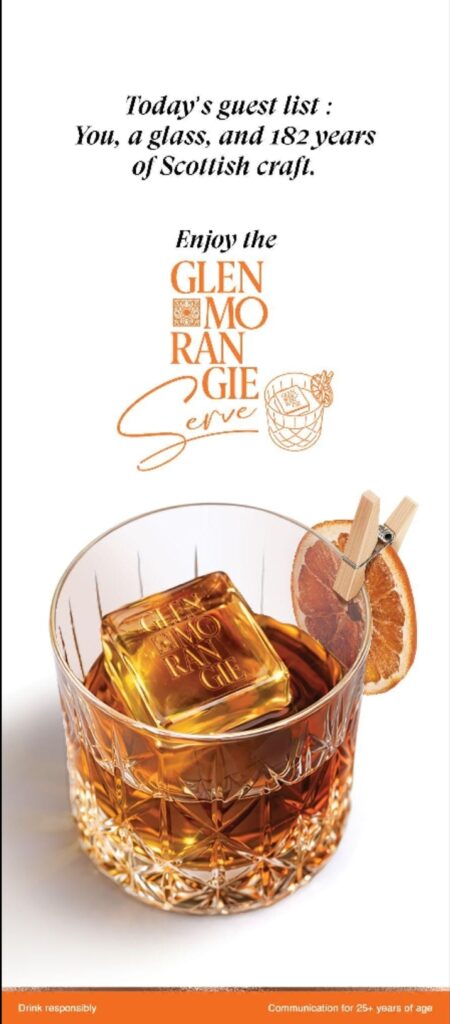
The Highland single malt Scotch whisky brand, under Moët Hennessy India, has introduced a carefully designed ritual experience for the newly evolved Glenmorangie Original 12 Years Old. At one level, the move appears simple: a bespoke Glenmorangie-inscribed ice cube paired with a dehydrated orange garnish intended to enhance the whisky’s citrus-forward profile.
But strategically, the launch signals something far larger.
The premium spirits industry is increasingly moving from product differentiation toward experience orchestration. In that environment, the glass, garnish, presentation, pacing, and emotional resonance surrounding consumption become nearly as important as the liquid itself.
That is where Glenmorangie’s latest move becomes significant.
Glenmorangie unveils Signature Serve Ritual as Experience Becomes the New Luxury Currency
For decades, whisky brands competed primarily through age statements, rarity, and distillation heritage. Those dimensions still matter, but customer expectations are evolving.
Today’s premium consumer increasingly values immersive engagement over passive ownership. This shift is particularly visible in India’s urban luxury market, where experiential dining, curated hospitality, and design-led consumption are rapidly reshaping lifestyle expectations.
From a CX standpoint, the consumption moment itself is becoming the battleground.
The Signature Serve Ritual is designed to translate Glenmorangie’s tasting notes into a physical experience. The slow-melting engraved ice cube protects flavour structure from aggressive dilution. The dehydrated orange slice amplifies citrus aromatics without destabilizing the serve.
Operationally, this transforms abstract craftsmanship into visible sensory interaction.
Smriti Sekhsaria, Marketing Director, Moët Hennessy India, summarized the shift directly:
“Today’s consumer seeks experience over routine. The modern whisky drinker is more curious, more experimental, and increasingly drawn to moments that feel both premium and personal.” — Smriti Sekhsaria, Marketing Director, Moët Hennessy India
This becomes critical because luxury consumption is increasingly judged through memory creation rather than product ownership alone.
The Strategic Shift From Whisky Product to Whisky Experience Platform
At a structural level, Glenmorangie is attempting to own the “serve layer” of whisky consumption.
That distinction matters.
Historically, brands controlled production while hospitality venues controlled presentation. The new model merges the two. Glenmorangie is effectively codifying how the product should be experienced.
The deeper implication is that experiential consistency becomes scalable.
A ritualized serving framework allows premium bars, hotels, and lounges to replicate a recognizable Glenmorangie moment regardless of geography. This improves brand continuity while simultaneously increasing premium positioning.
The timing is equally strategic.
The Signature Serve Ritual arrives alongside the evolution of Glenmorangie Original from 10 to 12 years of ageing, a move intended to deepen complexity, creaminess, and balance. The expression has already received a Gold Medal at the World Whiskies Awards 2024.
This combination of product refinement and experiential refinement creates layered differentiation.
The whisky evolves.
The experience evolves with it.
That synchronization is increasingly important in premium categories where storytelling without tangible experience risks losing relevance.
Why Ritual Engineering Is Becoming a Competitive Capability
When Glenmorangie unveils Signature Serve Ritual, it also highlights an emerging competitive trend across luxury beverages: ritual engineering.
This is not merely aesthetics.
Ritualized consumption improves:
- Emotional engagement
- Social amplification
- Recall value
- Premium perception
- Hospitality differentiation
Customers are no longer just consuming whisky. They are participating in a designed experience.
This is where the shift occurs from transactional service to emotional choreography.
For hospitality operators, that creates measurable value:
- Higher premium upselling potential
- Stronger customer engagement
- Increased visual differentiation
- Better experiential consistency
For brands, ritualization creates intellectual property around the consumption process itself.
That may become increasingly important as premium whisky categories become more crowded and difficult to differentiate through liquid characteristics alone.
The Hidden Systems Thinking Behind the Signature Serve Ritual
At first glance, the ritual appears artisanal and minimalistic. Underneath, it reflects structured sensory engineering.
The engraved ice cube is not merely decorative. Larger-format ice reduces rapid dilution, preserving flavour clarity over a longer consumption window. That helps maintain consistency across customer experiences.
Similarly, dehydrated citrus introduces controlled aromatic delivery without excess moisture variability associated with fresh garnishes.
From a systems perspective, Glenmorangie is operationalizing sensory precision.
This matters because premium hospitality increasingly depends on repeatability. Customers expect luxury experiences to feel intentional every time, regardless of venue.
That creates new operational demands around:
- Staff training
- Ritual consistency
- Presentation choreography
- Sensory balance
- Premium service standards
Strategically, the serve becomes part of the product architecture itself.
A Broader Cultural Shift in India’s Premium Consumption Landscape
India’s luxury consumer ecosystem is changing rapidly.
A younger affluent audience is increasingly comfortable experimenting with premium formats, curated experiences, and globally aligned consumption rituals. This evolution extends beyond whisky into dining, travel, wellness, and hospitality.
Glenmorangie’s move aligns closely with this transformation.
Rather than asking consumers to abandon tradition, the brand reframes tradition through modern experiential design. That balance between authenticity and contemporary relevance may prove especially powerful in India’s premium beverage market.
The deeper implication is that the future of luxury spirits may depend less on what is poured and more on how the moment is constructed.
As Glenmorangie states in its broader positioning, the objective is not simply to create whisky, but to create “delicious and wonderful” experiences around it.
That philosophy now appears increasingly operational rather than merely aspirational.
The Future of Premium Whisky May Be Designed, Not Just Distilled
The whisky industry has historically celebrated craftsmanship inside the barrel.
But the next competitive frontier may exist outside it.
As premium consumers seek immersion, participation, and memorable experiences, brands will likely invest more heavily in orchestrated rituals, hospitality integration, and sensory storytelling.
That makes Glenmorangie’s latest move strategically important beyond its immediate launch.
It represents a broader industry signal: Luxury consumption is becoming performative, experiential, and emotionally engineered.
And as Glenmorangie unveils Signature Serve Ritual, it demonstrates that the future of premium whisky may increasingly depend not only on how it is made, but on how it is experienced.
