
Scale vs Trust: Why Risk Management Governance Is Becoming the New CX Backbone
In digital commerce, scale has traditionally been the ultimate competitive weapon. More users, more sellers, more transactions—growth has been the dominant narrative. But scale comes with an inherent contradiction: the larger the system, the harder it becomes to control it.
This is the tension defining modern customer experience—efficiency vs trust.
Flipkart’s alignment with ISO 31000:2018, independently validated by British Standards Institution, must be viewed through this lens. This is not a compliance story. It is a signal of a deeper structural shift: risk management governance is becoming a core CX capability.
At a time when digital ecosystems are expanding in complexity—spanning logistics networks, payment systems, seller ecosystems, and AI-driven operations—customer experience is no longer just about interface design or service quality. It is about system reliability under pressure.
“Customer trust is no longer a byproduct of service—it is an engineered outcome.”
Flipkart’s move reflects a growing realization across the industry: trust must be architected, monitored, and governed—just like any other enterprise system.
Risk Management Governance: From Experience Optimization to Experience Assurance
The digital commerce industry is undergoing a critical transition. For years, the focus was on optimizing customer journeys—faster checkouts, better recommendations, smoother interfaces. But today, the emphasis is shifting toward ensuring those journeys don’t break.
Customers no longer evaluate brands solely on convenience. They evaluate them on consistency and reliability.
A failed payment, a delayed delivery, or a data security concern is no longer seen as an isolated issue—it is perceived as a systemic failure of the brand.
This shift is driven by three converging forces:
1. Rising Customer Expectations
Customers expect:
- Zero transaction failures
- Predictable delivery timelines
- Transparent communication
- Data security by default
Even a single disruption can erode trust permanently. Industry benchmarks suggest that over 70% of customers disengage after a trust-related failure.
2. Increasing System Complexity
Modern e-commerce platforms are no longer linear systems. They are multi-layered ecosystems involving:
- Third-party sellers
- Logistics partners
- Payment gateways
- Cloud infrastructure
Each layer introduces new dependencies—and new risks.
3. Regulatory and Governance Pressure
Governments and regulators are tightening controls around:
- Data privacy
- Financial transactions
- Platform accountability
This means organizations must not only deliver great experiences but also prove that those experiences are governed responsibly.
“Risk management is an essential part of strategic and operational management.” — Emmanuel Herve, Managing Director, BSI
For CX leaders, this creates a new mandate:
Experience design must now be backed by risk resilience.
Trust as a Competitive Differentiator
Flipkart’s alignment with ISO 31000 is not just about strengthening internal controls. It is about redefining its competitive positioning.
Historically, e-commerce competition has revolved around:
- Price
- Selection
- Delivery speed
But these are increasingly becoming commoditized. The next frontier is trust.
What Flipkart Is Strategically Signaling
- Trust as Infrastructure
Trust is no longer a soft brand attribute—it is a hard operational capability. - Governance as Differentiation
By aligning with globally recognized standards, Flipkart is signaling maturity and discipline at scale. - Resilience as Growth Enabler
Sustainable growth requires systems that can absorb shocks without degrading CX.
This move can be classified across three strategic dimensions:
- Defensive: Strengthening compliance and reducing operational risk
- Offensive: Positioning trust as a differentiator
- Transformational: Embedding risk governance into the CX fabric
Competitive Landscape
Key players such as:
Amazon
Reliance Retail
Meesho
are also investing heavily in operational resilience, but the explicit alignment with ISO 31000 positions Flipkart uniquely in terms of formalized governance maturity.
“Governance maturity is no longer a compliance metric—it is a competitive advantage.”
The category itself is shifting:
From → Transaction efficiency
To → Experience reliability
The Rise of Risk Intelligence Architecture
At the core of Flipkart’s initiative lies its Enterprise Risk Management (ERM) framework—aligned with ISO 31000 principles.
This framework functions as a risk intelligence layer embedded across the enterprise.
What the System Does
- Identifies risks across all business functions
- Assesses their probability and impact
- Prioritizes mitigation strategies
- Continuously monitors risk exposure
How It Operates
The system integrates:
- Cross-functional risk inputs
- Standardized risk taxonomies
- Real-time reporting mechanisms
- Governance workflows at leadership levels
This is not a static compliance system. It is a dynamic decision-support engine.
Architecture Breakdown
1. Frontend (CX Layer)
This is where customers experience the outcomes:
- Seamless transactions
- Reliable delivery commitments
- Transparent policies
2. Middleware (Orchestration Layer)
This layer translates risk insights into action:
- Risk dashboards
- Incident escalation workflows
- Decision automation systems
3. Backend (Data & Governance Layer)
The foundation of the system:
- Centralized risk data repositories
- Compliance frameworks
- Analytics and predictive models
“Efficient risk management is central to how we operate at scale.” — Pramod Jain, SVP, Flipkart
Differentiation
Flipkart’s approach stands out due to:
- Enterprise-wide integration (not siloed risk management)
- Alignment with globally recognized standards
- Independent third-party validation
This combination transforms risk management from a control function into an intelligence capability.
From Reactive Recovery to Predictable Experience
The most significant impact of this initiative is on customer experience itself.
Before: Reactive CX
- Issues detected after customer impact
- Fragmented response mechanisms
- Inconsistent service quality
- Limited transparency
After: Proactive CX
- Risks identified before they materialize
- Faster and coordinated responses
- Standardized experience delivery
- Higher predictability

Impact Across CX Dimensions
Speed
Centralized risk visibility enables faster decision-making and response.
Reliability
Reduced operational failures improve overall experience stability.
Transparency
Structured governance enhances communication and trust.
Consistency
Standardized processes reduce variability across interactions.
Personalization
Better data governance enables safe, compliant personalization.
Cause → Effect Mapping
- Centralized risk intelligence → Faster CX recovery
- Standardized governance → Consistent service quality
- Independent validation → Increased customer trust
“Scale without risk intelligence is operational fragility.”
The result is a shift from experience management to experience assurance.
Industry Implications: The Emergence of Trust-Led Commerce
Flipkart’s move is not an isolated event. It is indicative of a broader structural shift.
1. Trend Confirmation
Risk management is evolving into a core CX differentiator.
2. Competitive Response
Competitors are likely to:
- Invest in ERM frameworks
- Highlight trust metrics in branding
- Integrate governance into CX strategy
3. Structural Shift
Organizations will move toward:
- Risk-aware CX design
- Integrated governance models
- Board-level ownership of experience reliability
Time Horizon
Short-Term (0–2 Years)
- Rapid adoption of risk frameworks
- Increased linkage between CX and compliance metrics
Medium-Term (3–5 Years)
- Risk intelligence embedded into CX platforms
- Trust becoming a measurable KPI alongside CSAT and NPS
“Risk management is no longer a control function—it is a growth enabler.”
From CX Metrics to CX Resilience
The next evolution of customer experience will not be defined by incremental improvements in satisfaction scores. It will be defined by resilience under stress.
Organizations will be evaluated on:
- How well they handle disruptions
- How quickly they recover
- How transparently they communicate
This requires a fundamental shift in how CX is designed and measured.
Emerging Model
CX = Experience Design + Operational Resilience + Risk Intelligence
In this model:
- Design ensures usability
- Operations ensure execution
- Risk intelligence ensures reliability
What This Means for CX Leaders
- Expand the CX Mandate
CX leaders must engage with risk, compliance, and governance teams. - Invest in Risk Intelligence Systems
Data and analytics capabilities must extend beyond customer behavior to include operational risk. - Redefine Metrics
Traditional metrics like CSAT and NPS must be complemented with reliability and trust indicators. - Embed Governance into CX Design
Every customer journey must be evaluated for risk exposure.
“The question is no longer how good your experience is—it is how resilient it is under stress.”
Conclusion
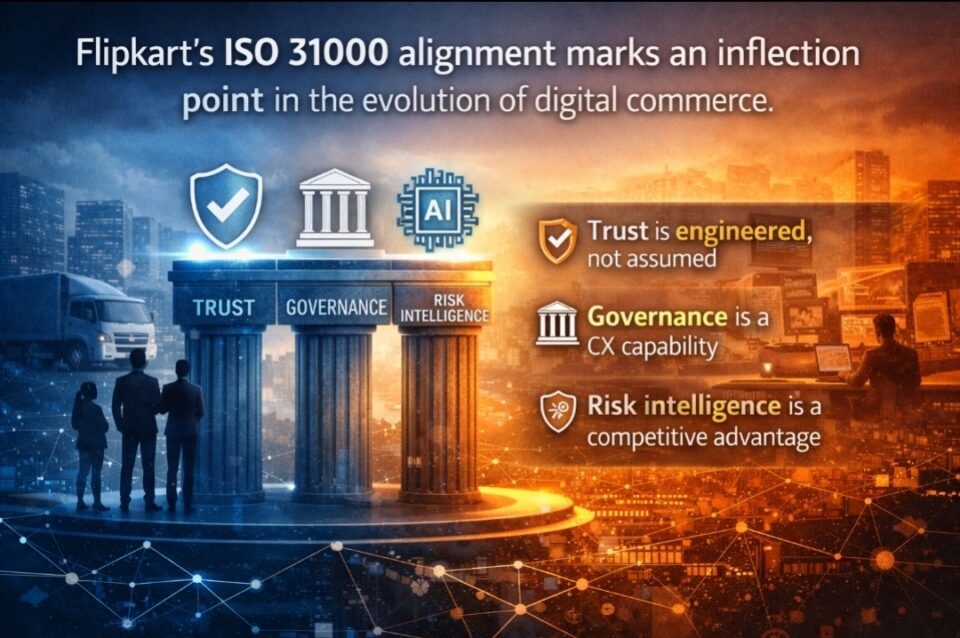
Flipkart’s ISO 31000 alignment marks an inflection point in the evolution of digital commerce.
It signals that:
- Trust is engineered, not assumed
- Governance is a CX capability
- Risk intelligence is a competitive advantage
As the industry moves forward, the winners will not be those who simply deliver faster or cheaper experiences—but those who deliver reliable, consistent, and trustworthy experiences at scale.
And in that future, risk management governance will not sit in the background—it will define the experience itself.
