
Sustainable AI: Can AI’s Environmental Footprint Become CX’s Next Competitive Advantage?
It is 8:30 a.m.
Your sustainability head is worried about rising AI workloads.
Your CIO flags energy bills climbing month over month.
And, your customers ask harder questions about carbon reporting.
Meanwhile, your AI roadmap accelerates.
More copilots. More automation. And, more predictive models.
But here is the tension:
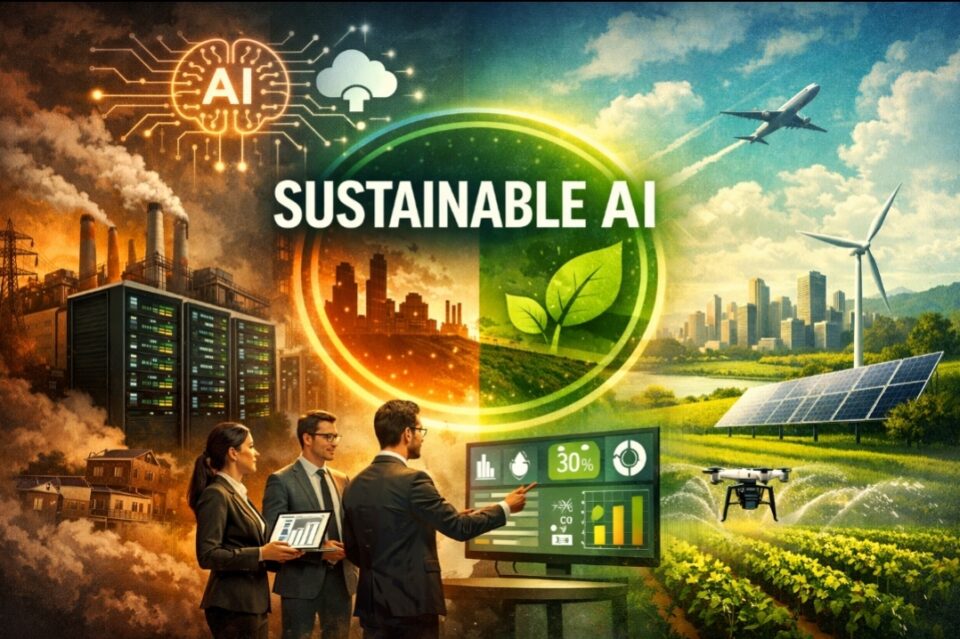
AI consumes serious electricity and water. Yet it also helps cut emissions, optimize operations, and reduce waste.
So what should CX and EX leaders do?
Treat sustainability not as a compliance checkbox, but as a customer experience differentiator.
This is not just an environmental debate. It is a strategy question.
What Is AI’s Environmental Paradox and Why Should CX Leaders Care?
AI increases energy and water use, but it also enables efficiency gains that lower emissions and resource waste.
Data centers consumed about 176 terawatt-hours of electricity in the U.S. in 2023. That rose to 183 TWh in 2024. Globally, internet traffic jumped more than 25-fold since 2010.
Yet global data center electricity use only doubled from 1% to 2% of global consumption during that period.
Efficiency gains played a major role.
For CX leaders, this matters for three reasons:
- Customers demand transparency.
- Regulators demand accountability.
- Employees demand purpose-driven strategy.
Sustainability now shapes brand perception, loyalty, and trust.
The AI footprint debate is no longer technical. It is experiential.
Is Your AI Strategy Creating or Destroying Trust?
AI sits at the center of digital journeys. Chatbots, personalization engines, predictive analytics, and automated workflows shape every touchpoint.
But few CX roadmaps include AI sustainability governance.
That gap creates risk.
When customers learn that generative AI consumes vast energy and water resources, they ask uncomfortable questions:
- Is this automation necessary?
- Is this ethical?
- Is this aligned with your ESG claims?
Trust fractures when intent and impact diverge.
Forward-thinking organizations turn this into opportunity.
Where Is AI Already Reducing Environmental Impact?
Let us look at real-world systems where AI drives measurable sustainability gains.
How Is AI Transforming Agriculture?
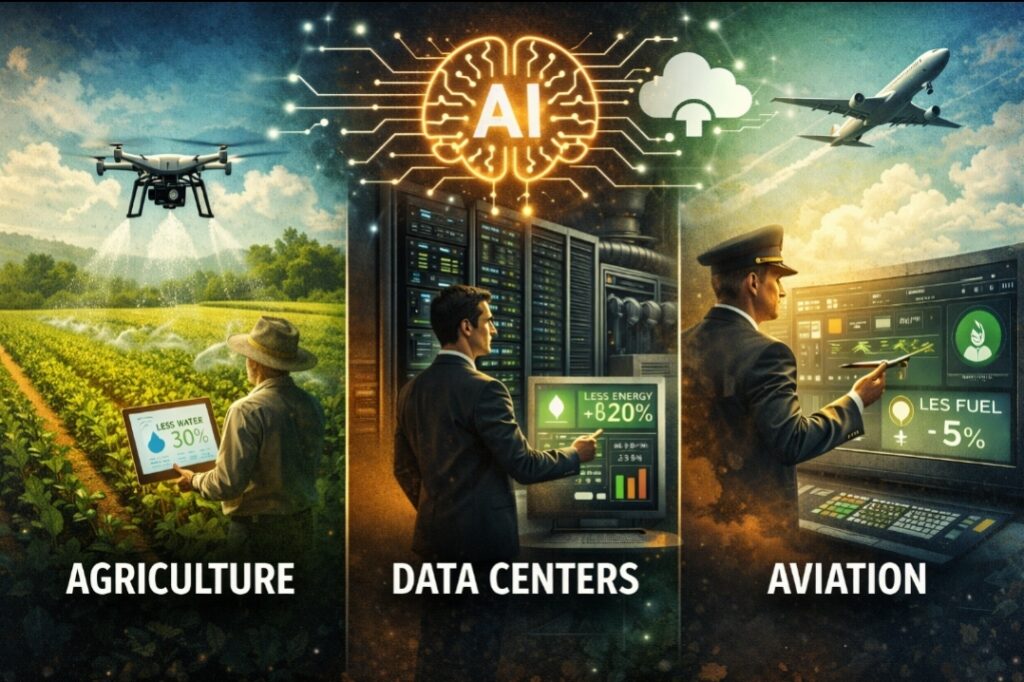
AI-powered irrigation systems reduce water waste while improving crop yields.
Agriculture consumes nearly 70% of global freshwater. Water competition is rising.
Climate tech startup Kilimo uses AI-driven irrigation models. The platform analyzes satellite data, weather forecasts, and soil conditions. It determines precisely when and how much to water.
In Chile’s Biobío region, farms using precision irrigation reduced water use by up to 30%.
Less water pumping means lower energy consumption.
Even more interesting: saved water becomes verified credits. Farmers sell those credits to companies offsetting water use. Many farmers earn 20% to 40% above their initial investment.
CX lesson: AI can align environmental efficiency with economic incentive.
Sustainability becomes profitable.
How Is AI Improving Data Center Efficiency?
AI systems optimize workloads, cooling, and power usage in real time.
Despite exploding internet traffic, energy growth has remained moderate due to efficiency gains.
AI analyzes:
- Workload distribution
- Server demand patterns
- Temperature and cooling metrics
- Energy draw per task
It shifts workloads dynamically. It enables low-power modes during off-peak hours. Then, it adjusts cooling airflow.
Major tech firms use predictive analytics to schedule computing tasks intelligently. Operators reduce wasted energy without compromising performance.
For CX leaders, this means:
- Lower operational costs
- Stronger ESG reporting
- More resilient digital infrastructure
Efficiency here protects margins and reputation simultaneously.
Can AI Reduce Methane and Industrial Emissions?
AI detects leaks, monitors emissions, and optimizes industrial equipment settings.
Energy companies deploy drones with cameras. AI analyzes imagery to detect corrosion and pipeline damage.
It monitors methane concentration and wind data to pinpoint emission sources.
This enables targeted maintenance instead of reactive crisis management.
AI-driven process optimization also improves liquefied natural gas operations. Systems analyze sensor data and recommend more efficient settings.
The strategic shift: From reactive repair to predictive prevention.
Predictive prevention enhances safety, brand trust, and regulatory compliance.
How Does AI Optimize Buildings and District Heating?
AI-driven smart systems forecast energy demand and adjust supply dynamically.
Buildings account for roughly 28% of global emissions.
In Copenhagen, thousands of sensors monitor temperature and energy flows. AI forecasts heating demand 24 hours in advance.
Results:
- 15% to 25% lower energy use
- 30% drop in peak heating demand
- 10,000 tonnes of annual CO₂ reductions
Research from U.S. labs shows medium-sized office buildings could cut energy use by 21% and emissions by 35% using AI.
For EX leaders, this matters deeply.
Employees increasingly evaluate workplace sustainability. Smart buildings improve comfort, reduce emissions, and enhance brand alignment.
How Is AI Changing Aviation?
AI optimizes flight routes to reduce fuel use and contrail formation.
Aviation produced roughly 882 megatons of CO₂ in 2023. Contrails contribute heavily to warming.
AI models analyze weather, humidity, and airspace data. They adjust routes and altitudes to minimize contrail formation.
Airlines using AI route optimization saved millions of gallons of fuel. One airline reduced fuel use by around 5% on long-haul routes in a single year.
CX impact: Sustainable travel becomes a differentiator in premium customer segments.
What Does This Mean for CX and EX Strategy?
AI is both resource-intensive and resource-saving.
The outcome depends on governance, architecture, and intent.
CX leaders must integrate sustainability into three layers:
| Layer | Focus | CX Impact |
|---|---|---|
| Infrastructure | Energy-efficient data centers | Cost + credibility |
| Operations | AI-driven optimization | Faster, greener journeys |
| Communication | Transparent reporting | Trust and loyalty |
Sustainability without storytelling fails.
Storytelling without substance backfires.
Common Pitfalls CX Leaders Must Avoid
1. Ignoring AI’s upstream footprint
Cloud migration does not eliminate environmental impact.
2. Over-automating low-value journeys
Not every chatbot interaction justifies energy use.
3. Greenwashing dashboards
Customers detect vague ESG claims instantly.
4. Siloed ownership
Sustainability, IT, and CX must collaborate. Fragmentation kills credibility.
A Practical Framework: The Sustainable AI CX Model
Here is a structured approach for advanced CX teams.
Step 1: Audit AI Energy Intensity
Map AI workloads by energy demand and customer value contribution.
Ask: Does this model materially improve outcomes?
Step 2: Prioritize High-Impact Automation
Deploy AI where it:
- Reduces physical waste
- Cuts fuel or water use
- Prevents operational breakdowns
Step 3: Integrate ESG Metrics into CX KPIs
Track:
- Energy per transaction
- Emissions per digital interaction
- Efficiency gains per journey
Step 4: Communicate Tangible Impact
Replace vague claims with specific metrics:
“Reduced water use by 30% using AI optimization.”
Clarity builds trust.
Key Insights for CX Leaders
- AI’s footprint is real but manageable.
- Efficiency gains can outweigh energy growth.
- Transparency converts sustainability into loyalty.
- Predictive optimization reduces both cost and emissions.
- Purpose-driven AI improves employee engagement.
FAQ: Long-Tail Questions CX Leaders Are Asking
How can CX teams measure the environmental impact of AI-driven journeys?
Track energy per transaction, cloud workload intensity, and emissions tied to digital infrastructure.
Does generative AI increase carbon emissions significantly?
Yes, it consumes substantial electricity, but optimized infrastructure and efficiency offsets can mitigate impact.
Can AI improve ESG reporting accuracy?
Absolutely. AI improves real-time monitoring, predictive analytics, and compliance reporting.
Is sustainable AI expensive to implement?
Initial investment exists, but operational savings and brand equity often offset costs.
How should CX leaders communicate AI sustainability efforts?
Use measurable data, customer-centric language, and outcome-driven storytelling.
Actionable Takeaways
- Conduct a cross-functional AI sustainability audit this quarter.
- Map energy intensity against customer value delivered.
- Eliminate low-impact AI automations.
- Partner with infrastructure teams on energy optimization.
- Embed sustainability metrics into CX dashboards.
- Publish clear, metric-backed sustainability updates.
- Train employees on responsible AI deployment.
- Position sustainable AI as a competitive advantage.
Final Takeaways
Artificial intelligence increases electricity and water use. Yet it also cuts emissions, saves water, and optimizes energy systems.
AI reduces agricultural water use by up to 30%.
Smart building systems cut energy consumption by 15% to 25%.
Airlines using AI saved millions of gallons of fuel.
The real question is not whether AI consumes energy.
The question is whether your organization uses AI responsibly, efficiently, and transparently.
For CX and EX leaders, sustainable AI is no longer optional.
It is the next frontier of trust.
