
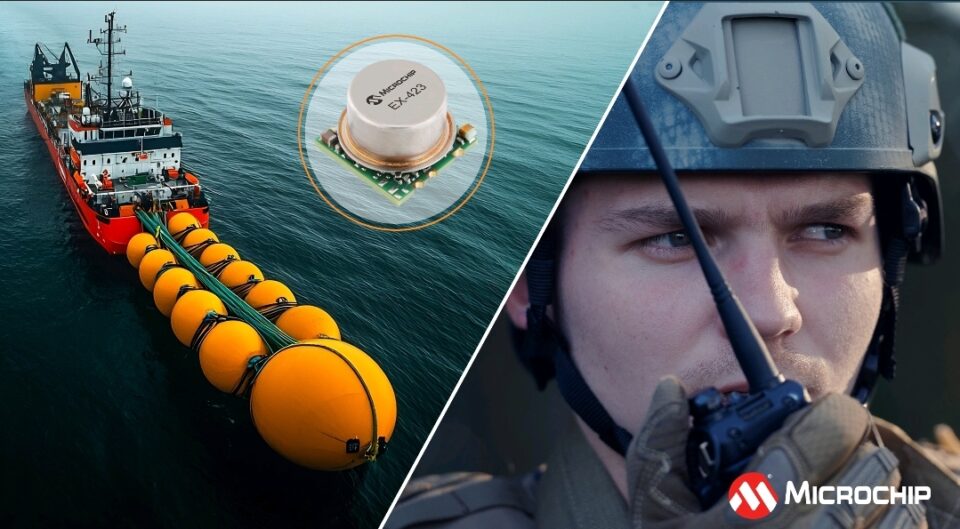
The EX-423 Evacuated Miniature Crystal Oscillator from Microchip Technology is a compact low-power timing solution engineered for mission-critical applications requiring high stability, ruggedization, and long-term synchronization reliability across GPS, defense, medical, and satellite communication environments.
Precision timing rarely receives public attention until systems fail.
Yet across GPS tracking, military communications, satellite systems, medical devices, and industrial sensing infrastructure, synchronization integrity increasingly determines operational trust. That is why the launch of the EX-423 Evacuated Miniature Crystal Oscillator by Microchip Technology matters beyond the semiconductor layer itself.
The announcement reflects a broader shift occurring across distributed systems architecture: enterprises now require timing infrastructure capable of delivering precision, thermal resilience, low power consumption, and environmental survivability simultaneously.
Historically, organizations often accepted trade-offs between size, stability, and energy efficiency. The new generation of edge systems no longer allows those compromises.
Why the EX-423 Evacuated Miniature Crystal Oscillator Matters Now
Connected infrastructure is moving outward — into remote environments, portable systems, autonomous operations, and battery-dependent architectures.
This creates a difficult engineering challenge. Devices must remain compact while still maintaining stable synchronization under thermal fluctuations, vibration, shock exposure, and constrained power budgets.
The EX-423 Evacuated Miniature Crystal Oscillator is designed around that convergence problem.
According to Microchip, the oscillator uses ultra-high vacuum sealing to improve thermal insulation and frequency stability while integrating a four-point quartz mounting system intended to reduce g-sensitivity and improve shock survivability.
“When developing the EX-423, we focused on the key parameters designers use to evaluate high-performance reference oscillators,” — Randy Brudzinski
“Delivering this level of performance in a rugged, small footprint helps customers simplify designs without compromising timing accuracy.” — Randy Brudzinski
The deeper implication is that precision timing is becoming operational infrastructure rather than a discrete hardware component.
The Collapse of Traditional Timing Trade-Offs
Older oscillator architectures typically prioritized one performance dimension at the expense of another.
Higher stability often required larger form factors, increased thermal management, or higher steady-state power draw. That model becomes increasingly problematic in modern edge deployments where space, battery life, and environmental durability are tightly constrained.
This is where the shift occurs.
The EX-423 combines low phase noise, strong Allan deviation performance, rapid warm-up, and low steady-state energy consumption inside a 13 mm x 13 mm package.
Operationally, this translates into several business advantages:
- Reduced thermal management overhead
- Lower battery consumption
- Smaller deployment footprints
- Higher synchronization consistency
- Reduced maintenance intervention risk
From a CX standpoint, customers increasingly judge systems by continuity and dependability rather than raw feature count. Stable synchronization directly influences those outcomes.
Timing Infrastructure Is Becoming a CX Variable
Most users never see oscillators.
They experience what oscillators enable.
In GPS/GNSS environments, timing precision supports location accuracy. In medical infrastructure, synchronization stability contributes to monitoring reliability. And, in satellite communications, phase noise performance affects signal clarity and transmission consistency.
At a structural level, this changes how infrastructure reliability should be evaluated.
The customer experience implications are substantial because timing instability can manifest as dropped connections, navigation inconsistency, degraded telemetry, or unreliable sensor coordination.
For enterprises operating mission-critical infrastructure, these failures increasingly translate into trust erosion.
Strategically, this indicates that backend synchronization quality is becoming part of the user experience layer.
Competition Is Shifting Toward Balanced Optimization
The timing market already contains highly capable players including SiTime, Analog Devices, Texas Instruments, and Renesas Electronics.
However, the competitive landscape is evolving.
The next generation of timing systems will not necessarily win based on absolute specification leadership alone. Vendors increasingly need to optimize across multiple operational dimensions simultaneously:
- Power efficiency
- Thermal resilience
- Miniaturization
- RF purity
- Shock survivability
- Lifecycle stability
Microchip’s positioning appears focused on that balance.
Rather than pursuing timing supremacy in isolation, the company is aligning synchronization precision with deployment practicality.
That matters because enterprises increasingly value integration simplicity alongside raw performance.
Engineering Reliability Into Distributed Systems
The technology architecture behind the EX-423 reveals broader industry priorities.
The ultra-high vacuum enclosure helps reduce thermal variation impact. The four-point crystal mount improves resilience against vibration and motion stress. Low power consumption supports extended operation in battery-dependent deployments.
Individually, these features are technical enhancements.
Collectively, they represent infrastructure resilience engineering.
This becomes especially important in Ocean Bottom Node seismic systems, remote sensing platforms, tactical communications, and satellite environments where servicing opportunities may be limited or impossible.
Operationally, every reduction in synchronization drift lowers recalibration pressure and improves long-term reliability confidence.
From a systems standpoint, the industry is moving toward predictive reliability architectures where stability is engineered proactively rather than corrected reactively.
The Broader Industry Implication
The launch of the EX-423 Evacuated Miniature Crystal Oscillator reflects a wider infrastructure transition occurring across semiconductors and connected systems.
Precision timing is no longer merely an electrical engineering requirement. It is becoming foundational to operational continuity, machine coordination, and customer trust.
As autonomous systems, distributed intelligence, and edge AI expand, synchronization quality will increasingly shape business resilience outcomes.
The deeper implication is that semiconductor vendors are evolving into operational reliability partners.
That transition may ultimately matter more than the component itself.
