
When Titans Stumble: What Volkswagen’s Historic Dresden Plant Closure Reveals About Your Organizational Fragmentation
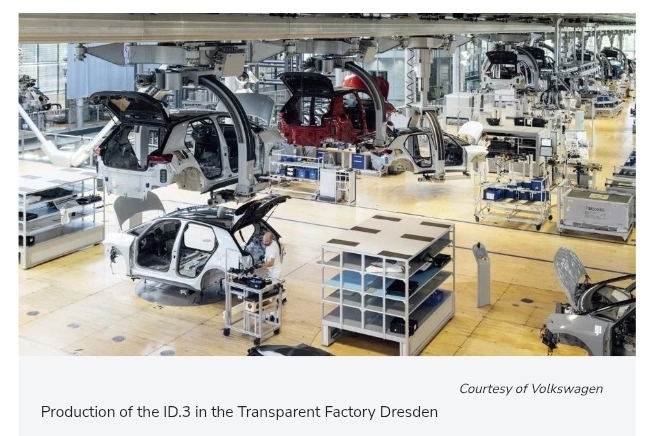
A Glass Factory’s Quiet Collapse—And Why Your CX Roadmap Depends on What Happens Next. Picture this: A sprawling, glass-walled factory in Dresden, Germany. For 23 years, it stood as Volkswagen’s technological showcase—a temple of precision engineering where luxury vehicles and cutting-edge electric cars rolled off the line. Workers proudly signed the final car, a red ID.3 GTX. By December 16, 2025, the assembly line fell silent for the first time since 2002.
But this isn’t just another manufacturing closure in Dresden. In Volkswagen’s 88-year history, the company had never shut down a plant in Germany. Not once. This moment marks a watershed: a signal that even industrial titans with century-long legacies aren’t immune to the cascading effects of fragmented strategy, siloed decision-making, and disconnected organizational responses to crisis.
For CX and EX leaders, the Dresden closure is a mirror. It reveals what happens when your organization fails to align cross-functional teams during market upheaval—when customer experience, employee engagement, supply chain resilience, and strategic transformation operate as isolated fiefdoms rather than an integrated whole.
Why Did Volkswagen Close Its Showcase Plant? A Cascade of Strategic Misalignments
Volkswagen didn’t wake up one day and decide to shutter a factory. The decision resulted from a convergence of pressures that, when seen through a CX/EX lens, exposes a critical organizational vulnerability: the inability to respond cohesively when multiple business systems fail simultaneously.
What Caused the Closure? Understanding the Market Pressures
Weak China Sales. Volkswagen’s largest market faltered when Chinese EV makers like BYD and Geely captured market share VW couldn’t recover—not because of product quality alone, but because of decision-making delays across product, supply chain, and go-to-market teams.
US Tariffs. President Trump’s tariffs placed a $1.5 billion loss on Q3 2025 and threaten over $5 billion in 2026. Yet many VW teams were still optimizing for a tariff-free scenario when the business case for the Dresden facility collapsed. This lag—between market reality and organizational response—is a hallmark of siloed decision-making.
EV Transition Bottlenecks. VW invested heavily in electrification but stumbled on EV software development, battery scaling, and cost competitiveness. Teams managing combustion engines, EV platforms, and digital capabilities weren’t synchronized. Each operated with its own P&L, roadmap, and success metrics.
Structural Cost Misalignment. German labor and energy costs soared while production volume at Dresden remained marginal—fewer than 200,000 vehicles across two decades. The facility never achieved the scale needed to justify its overhead. This fundamental mismatch between capacity and demand should have triggered cross-functional rebalancing years earlier. Instead, it persisted until the only solution was closure.
Why Didn’t the Organization See This Coming?
These market pressures exposed deeper organizational fractures. VW’s Dresden decision didn’t emerge from integrated crisis management—it emerged from desperation. Here’s why:
Production teams were optimizing for throughput on existing platforms while product development was racing toward next-gen EVs. Finance was forecasting cash flow assuming continued sales, while supply chain was already seeing demand destruction. Customer-facing teams were managing dealer expectations and customer communication long after the factory’s fate was sealed, often through fragmented, reactive channels.
This isn’t unique to VW. In CXQuest’s research across manufacturing and automotive leaders, 43% cite limited cross-departmental alignment as their #1 CX challenge, while 38% struggle with siloed systems and fragmented customer data. When crisis hits, these organizational gaps become chasms.
The CX/EX Crisis: How Restructuring Shatters Your Employee and Customer Experience Chains
Volkswagen’s restructuring involves 35,000 job cuts across Germany by 2030. While the company negotiated a “no compulsory redundancy” agreement with unions, the Dresden closure still hit 230 workers with a crisis moment: their jobs were eliminated despite assurances of job security.
But the real CX/EX damage extends far beyond the 230 directly affected. It cascades.
What Is Layoff Survivor Syndrome and Why Should CX Leaders Care?
When restructuring announcements hit an organization, the employees who keep their jobs don’t feel relief—they feel dread. Organizational psychologists call this “layoff survivor syndrome”: a toxic mix of guilt, anxiety, and diminished morale.
The numbers are sobering:
- 74% of survivors report plummeting productivity
- 87% are less likely to recommend their organization as a great place to work
- Organizational commitment drops by 13%+ and often never fully recovers
- Voluntary turnover spikes 31% in the year following a major restructuring
For VW, this means thousands of skilled engineers, production managers, and logistics specialists across German facilities are now updating their LinkedIn profiles and fielding recruiter calls. The company spent decades building manufacturing expertise in Dresden, Wolfsburg, and beyond. Now, it’s hemorrhaging the institutional knowledge needed to execute its EV transition.
This employee exodus also degrades customer experience. Here’s why: Your frontline customer service teams, product managers, supply chain coordinators, and field engineers are customer experience. When they lose faith in your organization’s values—when they see leadership claim “people are our greatest asset” while laying off 35,000 colleagues—they stop going the extra mile for customers. Empathy erodes. Problem-solving becomes mechanical. You deliver a transactional experience, not a relational one.
How Long Does Trust Take to Rebuild After Layoffs?
A common misconception in CX strategy: Trust rebuilds quickly if you communicate well. The Dresden closure reveals a harder truth: Trust takes 18–24 months to rebuild after major organizational disruptions—and some dimensions never fully recover.
When employees witness leadership prioritize cost reduction over “people first” messaging, they experience cognitive dissonance. They see:
- Leadership emails about “difficult but necessary decisions” sent after layoff announcements, not before
- Severance packages that feel misaligned with years of service
- No clear redeployment path for affected workers, despite earlier rhetoric about “career transitions”
This dissonance propagates into how employees interact with customers. A customer service rep who feels betrayed by their employer brings that resentment to the next difficult customer conversation. They lack the psychological safety to take risks, to problem-solve creatively, or to extend grace to customers who make mistakes.
Why Does Organizational Stress Lead to Safety and Quality Issues?
Here’s an underappreciated consequence of poorly managed restructuring: Safety incidents increase. When employees are distracted by layoff anxiety, stressed about their own job security, or grieving the departure of trusted colleagues, accidents happen. Attention lapses. Quality issues slip through.
In manufacturing environments like VW’s German facilities, this carries catastrophic consequences. A lapsed safety protocol, a missed inspection, a preventive maintenance delay—any of these can cascade into recalls, customer injury claims, and regulatory fines. Your cost savings from 35,000 job cuts evaporate when a single quality failure triggers a €500 million recall.
The Organizational Silo: How Fragmented Teams Prevent Coordinated Crisis Response
Before the Dresden closure was announced, did Volkswagen have a unified crisis management framework? The evidence suggests not.
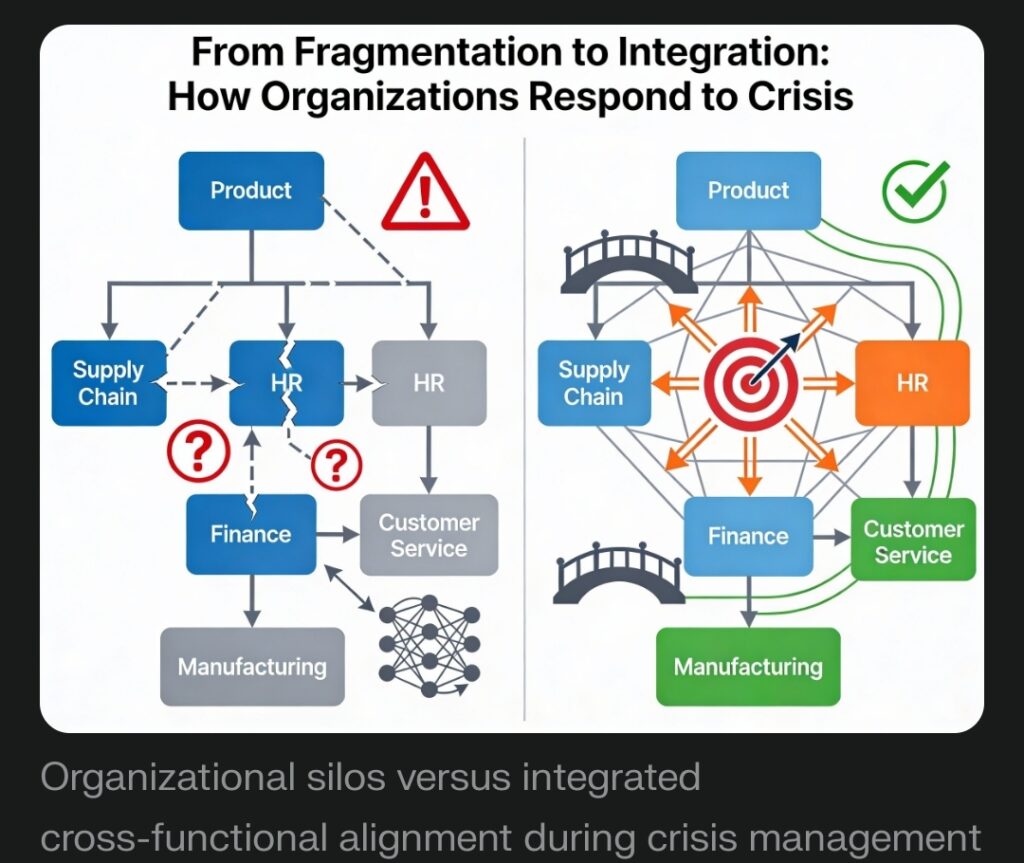
Here’s what a well-aligned organization would have done before announcing plant closures:
- Cross-functional scenario planning: Product teams + supply chain + finance + HR would map out the cascade effects of closure on customers, suppliers, remaining employees, and brand reputation.
- Integrated communication strategy: A single narrative—transparent, values-aligned, and coordinated across leadership, HR, customer-facing teams, and media—would be pre-prepared and rehearsed.
- Employee transition program: Career coaching, redeployment options, retraining partnerships, and boomerang hire pipelines would be designed before announcing cuts.
- Customer impact mitigation: Dealer networks, warranty teams, parts supply chains, and customer service would have contingency plans to ensure no customer is stranded because of production closures.
Instead, the evidence points to siloed responses:
- Manufacturing teams optimized for shutdown logistics (equipment disposition, facility transition)
- HR teams scrambled to design severance packages and redeployment options after the announcement
- Customer-facing teams had to manage dealer questions and customer inquiries reactively, often with incomplete information
- Corporate communications issued statements emphasizing “economic necessity” without addressing the values dissonance that employees and customers experienced
This fragmentation is a hallmark of siloed organizations. Organizations with entrenched functional silos take 40% longer to respond to market crises and suffer 3x higher customer defection during restructuring periods.
What Creates Organizational Silos and Why Are They Hard to Break?
Silos aren’t accidents—they’re byproducts of organizational design and incentive structures.
Functional Performance Metrics: When your CX team is measured on NPS, your supply chain on cost reduction, your product on feature velocity, and your HR on headcount efficiency, each team optimizes locally. They’re not incentivized to slow down and coordinate with “adjacent” teams.
Hierarchical Structure: Traditional reporting lines create “us vs. them” dynamics. Manufacturing reports to COO, CX reports to CMO, Product to CTO. There’s no natural governance forum where these leaders regularly align on cross-functional priorities.
Communication Blockers: In large organizations, information doesn’t flow freely. A supply chain leader’s concern about parts shortages doesn’t reach product management. A customer service leader’s intelligence on product pain points doesn’t reach engineering. Each team operates on incomplete information.
Weak Leadership Integration: If your executive team doesn’t model collaboration, middle management won’t either. Leaders who hoard information, protect their budgets, and view other functions as competitors set the tone for organizational tribalism.
For VW, these silos meant that the Dresden closure, when it came, surprised many internal teams. A well-integrated organization would have had months of cross-functional dialogue before any announcement. Teams would have collectively understood the decision, aligned on communication, and coordinated the response. Instead, the announcement felt like a bolt from the blue.
What Does This Mean for Your CX/EX Strategy? Three Critical Imperatives
If you lead customer experience or employee experience, the Volkswagen closure offers three essential lessons:
Imperative 1: Make Cross-Functional Alignment Your #1 CX Priority
Stop treating silos as a culture problem. Treat them as a business continuity risk.
Action: Establish a Crisis Alignment Council that meets monthly (more frequently during market volatility). Include leaders from: Product, Supply Chain, Finance, HR, Customer Service, Marketing, and Operations. The council’s charter: Identify emerging risks that span multiple functions and develop integrated response plans before crisis strikes.
Use a simple framework:
- Emerging Risk: (e.g., “China demand collapse,” “Tariff escalation,” “Supply chain disruption”)
- Cross-Functional Impact: How it affects each function
- Coordinated Response: What each function commits to do, and where alignment is needed
- Communication Plan: A unified narrative for employees, customers, and stakeholders
This isn’t another meeting. It’s insurance against organizational fragmentation during crisis.
Imperative 2: Design Your Restructuring for Minimal CX Degradation
If your organization faces layoffs or restructuring, treat it as a customer experience project, not just an HR initiative.
Action: Apply these principles from CX crisis management:
Clarity over Secrecy: Share decision-making rationale with employees before announcements. Teams that understand “why” are less prone to survivor guilt and more likely to stay engaged with customers.
Transition Support as a CX Investment: Offer career coaching, redeployment, and retraining not because it’s “nice,” but because it reduces voluntary turnover, maintains institutional knowledge, and signals that your organization lives its values. A 31% voluntary turnover spike after layoffs is a silent customer experience disaster—those departing employees often take customer relationships, vendor connections, and product knowledge with them.
Preserve Your Frontline: If you must cut 35,000 jobs, do not proportionally cut customer-facing roles. Your customer service, sales, and field teams are your CX amplifiers. Cutting them to “share the pain” equally is a false economy—it destroys the customer relationships you can’t afford to lose.
Scenario-Plan the Customer Impact: Before announcing closures, map the ripple effects on customers. Which customer segments depend on the facility being closed? How will you communicate? What alternative solutions can you offer?
Imperative 3: Make Employee Experience a Leading Indicator of CX Performance
Your employee engagement scores predict your customer satisfaction scores.
Action: Establish a CX-EX Leading Indicator Dashboard that tracks:
| Metric | Why It Predicts CX Degradation |
|---|---|
| Employee trust in leadership (pulse survey) | Low trust → less empathy in customer interactions |
| Voluntary turnover (especially frontline) | High turnover → lost customer relationships, knowledge gaps |
| Span of control (avg # direct reports per manager) | Rising span → less coaching, feedback, CX reinforcement |
| Cross-functional collaboration score (360 feedback) | Low collaboration → fragmented customer responses |
| Psychological safety (team surveys) | Low safety → employees don’t raise concerns, issues go unresolved |
When these metrics decline, they’re leading indicators that your CX performance will degrade 60–90 days later. Use them as early warning signals to intervene before customer experience erodes.
FAQ: Six Questions CX/EX Leaders Are Asking About the Volkswagen Closure
How do we maintain customer trust during major organizational restructuring?
Transparency and values alignment matter more than the message’s positivity. Customers and employees can sense inauthenticity. If you claim “people first” but handle layoffs impersonally, you lose credibility.
Start with honesty: “We face [specific market challenge]. We’ve made difficult decisions that affect [X] colleagues. Here’s how we’re supporting them. Here’s how we’re protecting the customer experience. Here’s our roadmap to stability.” Lack of clarity about the future is more damaging than a tough but honest present.
What’s the relationship between employee engagement and customer experience during crisis?
Direct and measurable. Research shows that when organizations handle restructuring poorly, remaining employees’ productivity drops sharply and customer satisfaction follows within 2–3 months. Conversely, organizations that prioritize employee dignity during cuts see less customer churn.
This isn’t sentiment—it’s economics. A customer service rep who feels demoralized provides fewer proactive outreach attempts, spends less time on complex customer issues, and escalates frustrations more readily. Scale this across your organization and your NPS plummets.
How do we prevent organizational silos from metastasizing during times of change?
Make cross-functional accountability a performance metric. Don’t reward product leaders for shipping features fast if it fragments your supply chain. Don’t reward supply chain leaders for cost reduction if it compromises product quality.
Create “shared success metrics.” Example: “Product velocity + supply chain efficiency + customer defect rate + employee engagement = leadership bonus.” This forces collaboration because no single function can succeed without others.
Is it ever okay to cut customer-facing roles proportionally to hit cost targets?
Only if you’re willing to accept temporary CX degradation. Proportional cuts across all functions typically lead to significant customer satisfaction drops within months.
If restructuring is necessary, prioritize: (1) Eliminating redundant back-office roles first, (2) Consolidating management layers, (3) Automating administrative work, (4) Redeploying non-core staff to customer-facing roles. Cut customer-facing headcount only if you simultaneously invest in technology to amplify remaining staff’s effectiveness.
What’s the playbook for handling “survivor guilt” and secondary turnover?
Name it explicitly. In your first communication to remaining teams, acknowledge: “Colleagues we valued are leaving. That’s hard. You’ll feel a mix of relief, guilt, and anxiety. That’s normal. Here’s what we’re doing to support everyone, including you.”
Then execute:
- Increase manager check-ins (move from quarterly to weekly 1:1s for 90 days)
- Normalize mental health support (remove stigma by having leaders visibly use EAP resources)
- Create “connection projects” where teams tackle shared challenges (rebuilds morale faster than anything else)
- Celebrate early wins (as soon as possible, highlight a success story the reorganized team achieves together)
How do we prevent customer defection when our own employees don’t believe in our organization?
You don’t. You stop them from defecting by re-earning their trust before you ask them to re-engage customers.
Employees won’t advocate for your brand if they don’t believe leadership’s values are genuine. Invest in internal trust first: transparent communication, career development during change, fair severance/transition support, and follow-through on commitments. These investments seem costly upfront but they’re the only way to preserve customer relationships through restructuring.
Key Insights: Why the Volkswagen Closure Matters for CX Leaders
- Fragmentation is a leading indicator of crisis. Organizations that struggle to break silos before disruption hits will struggle during disruption. The Dresden closure wasn’t sudden—it was the inevitable result of years of siloed decision-making coming home to roost.
- Your employees’ experience with the organization predicts your customers’ experience. An organization that handles restructuring with transparency and care produces employees who extend that same care to customers. One that handles it coldly produces employees who mirror that coldness back to customers.
- Survivor guilt is a hidden CX tax. A large share of restructuring survivors experience productivity collapse. This is a customer experience disaster that doesn’t show up in traditional CX metrics. By the time your NPS drops, you’ve already lost months to preventable engagement loss.
- Cross-functional alignment isn’t optional—it’s existential. Organizations that operate as integrated wholes respond to crisis faster, maintain customer loyalty better, and retain top talent at higher rates than siloed competitors.
Actionable Takeaways: 8 Steps for CX Pros Facing Organizational Change
- Establish a Crisis Alignment Council immediately. Monthly meetings with leaders from product, supply chain, finance, HR, customer service, and operations. Use a shared framework to identify risks spanning multiple functions and develop coordinated responses before crisis strikes.
- Audit your cross-functional communication now. Where do information flows break down between your team and product? Between supply chain and customer service? Between HR and finance? Map these gaps—they’re your vulnerability points during crisis.
- Create a “Restructuring CX Playbook” before you need it. Design it now: What will customer communication look like? Which customer segments get priority outreach? How will you preserve customer relationships through facility closures or service disruptions?
- Measure employee trust as a leading indicator of CX. Add a monthly question to your pulse survey: “Do you trust leadership to handle difficult decisions in line with our stated values?” When this score drops meaningfully, escalate to your executive team.
- Redesign severance and transition programs as CX investments. Invest in career coaching, redeployment, and retraining for affected employees. This isn’t charity—it’s customer experience insurance.
- Hold cross-functional leadership accountable for integrated outcomes. Stop measuring product leaders only on feature velocity, supply chain leaders only on cost, and CX leaders only on NPS. Create shared incentives that force genuine alignment.
- Map your “vulnerability cascade.” Document: If [function X] fails, which functions suffer next? Which customers are affected? Which business outcomes degrade? Use this map to prioritize protection during restructuring.
- Schedule a post-restructuring CX retrospective. 60 days after any major organizational change, bring together representatives from all functions to assess: Where did we maintain customer experience? Where did we falter? What will we do differently next time?
Conclusion: Your Organization’s Dresden Moment Isn’t Coming—It’s Already Here
Volkswagen’s Dresden closure wasn’t unique to automotive. Every industry faces disruption. Every organization will eventually face a moment when market conditions demand rapid, coordinated change.
The question isn’t whether your organization will face that moment. It’s whether you’ll be ready when it comes.
Organizations that wait until crisis hits to break silos, align teams, and clarify values face the same outcome VW did: painful, last-minute restructuring that damages customer and employee relationships. Organizations that invest in cross-functional alignment, transparent communication, and values-based decision-making before crisis strikes navigate disruption with grace. They retain customers, engage employees, and emerge stronger.
The Dresden factory’s lights went dark on December 16, 2025. But its legacy for CX/EX leaders is clear: Fragmentation is a choice. Integration is a discipline.
Choose wisely.
