

The Future of India’s Cloud Infrastructure: How AI, Community Clouds & Hybrid Models Will Shape the Next Decade
By Piyush Somani – Promoter, Managing Director and Chairman, ESDS Software Solution Ltd.
India is at the threshold of a decisive decade, one that will determine how strongly we participate in the global AI economy. As the global AI market heads toward USD 1.2 trillion by 2030, the focus has now evolved from cloud adoption to cloud readiness. It is about building India’s digital and computational foundation for the next phase of economic expansion. Cloud infrastructure, AI compute, sovereign frameworks and sectoral digital ecosystems are converging to create a new architecture for national growth.
The digital economy is likely to exceed $1 trillion by 2035. Three main input transformation technologie that will directly dictate and determine India’s growth during this period will be AI Native Cloud Infrastructure, Sector-specific Community Clouds and Intelligent Hybrid Models. These elements will drive ‘Digital India,’ creating a reality that is fundamentally different than was previously thought possible.
1. AI Will Redefine the Architecture of India’s Cloud Future
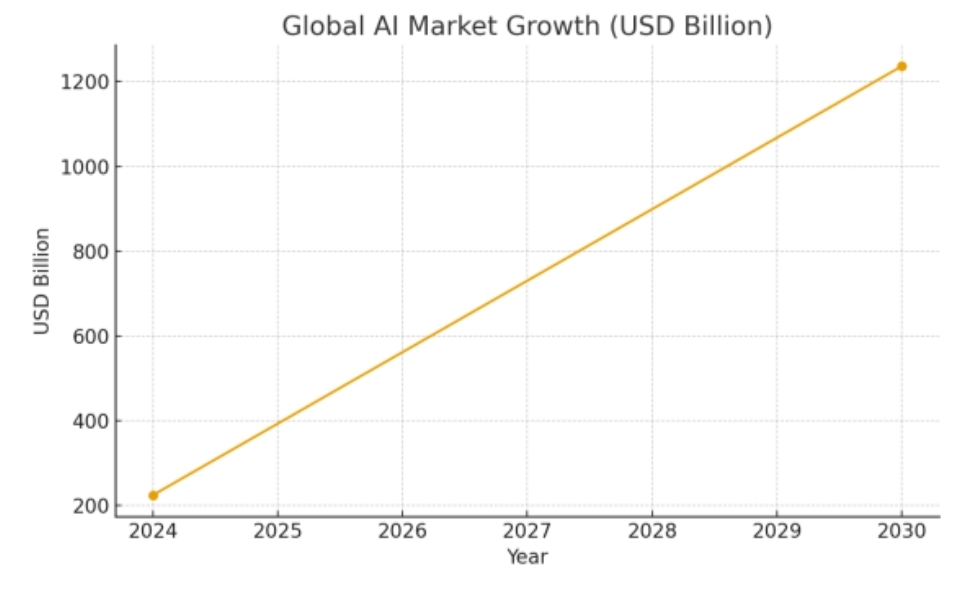
AI is rapidly becoming the world’s largest technology force multiplier. The global AI market is projected to scale from USD 224.4 billion in 2024 to USD 1,236.5 billion by 2030, a staggering 450% jump and nearly 5× expansion. This is a macro-level transformation.
Underlying this shift is the unprecedented surge in compute demand. AI compute requirements are expected to rise, driven by multi-agent systems, multimodal reasoning and foundation models that run into tens of billions of parameters. The GPU-for-AI market is forecasted to expand from USD 21.4 billion in 2025 to USD 76.1 billion by 2034, reflecting the transition toward GPU-centric architectures.
India is aligned with this global trajectory. The Indian AI market is expected to grow from USD 1.25 billion in 2024 to more than USD 12.4 billion by 2033, among the fastest expansions globally. To convert this opportunity into economic value, India will need AI-ready cloud environments – GPU SuperPODs, high-bandwidth interconnects, sovereign-grade data fabrics and scaled MLOps layers capable of supporting parameter LLM training and real-time inference.
AI will not sit on top of India’s cloud infrastructure; AI will define it.
2. Community Clouds Will Mature into India’s Digital Operating Backbone
Over the last decade, India has uniquely demonstrated the value of community clouds—especially in government, BFSI and public sector ecosystems. In the next decade, these platforms will evolve from secure shared environments into industry-scale operating systems.
By 2030, the adoption of Community Cloud in India is to increase 5×, with sector-specific maturity such as:
BFSI: 75% adoption rate
– Government: 65% using
– Healthcare: 55% adoption
This shall be d by increasing regulatory expectations from RBI, IRDAI, NPCI, MeitY and sectoral governance bodies. Compliance will increasingly embed into the infrastructure itself-through data residency controls, policy-driven architecture, auditability frameworks and by automating governance.
Community clouds will no longer be a cloud strategy—they will be a sectoral strategy.
Equally important, industry clouds will shift toward pre-integrated digital ecosystems. BFSI will adopt financial-grade cloud grids. Healthcare will embrace interoperable health data exchanges. And government clouds will power state and national citizen services. Federated learning, anonymised datasets and secure multi-party computation will enable shared intelligence within trusted boundaries.
3.Hybrid Cloud to become the default architecture for Enterprise India
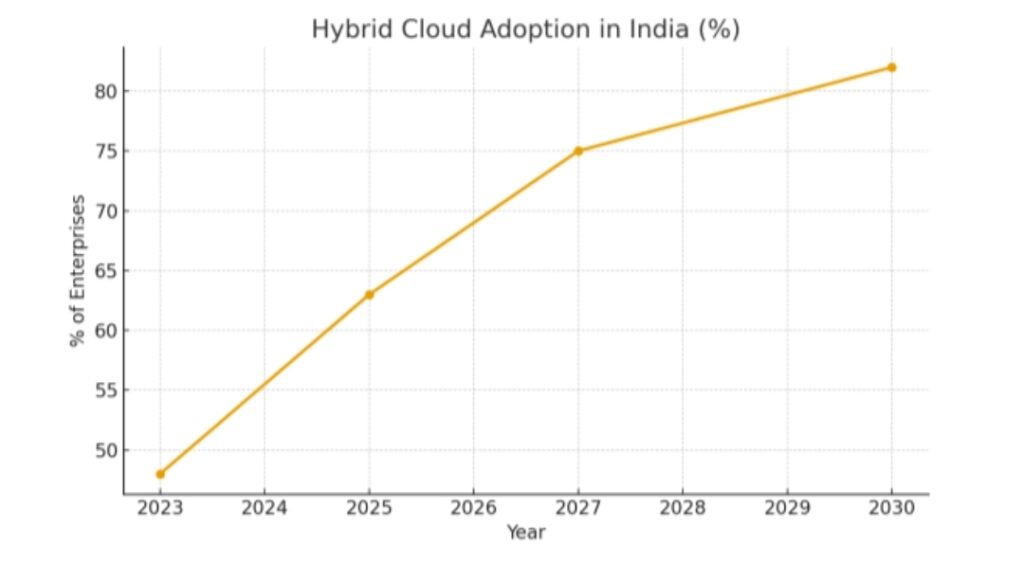
Hybrid cloud will dominate India’s enterprise computing landscape because it reflects the realities of scale, compliance and AI workload diversity.
This means that 72% of all enterprises globally will be adopting hybrid cloud as their main operating model by 2027. In India, the projection of the adoption rate which is 48% today and is to go up to 82% by 2030. This shift is structural and unavoidable.
Enterprises will function across:
Sovereign clouds for regulated and sensitive workloads
GPU Clouds for AI Training and Inference
– Public clouds for scale elasticity
Edge environments for low-latency compute
AI-driven orchestration will govern workload mobility, scaling and self-optimization. Zero-trust security, unified observability and compliance automation will be absolute imperatives. The country’s physical digital footprint, too, is expanding rapidly: forecast is that the data center capacity is to leap from 870 MW in 2024 to more than 1,800 MW by 2027.
India’s Next Decade: Cloud as the Nation’s Intelligence Infrastructure
By 2035, AI could contribute USD 500–600 billion to India’s economy. But realising this potential depends on the strategic foundation we build today. Cloud infrastructure will evolve beyond compute and storage into the central nervous system of India’s digital competitiveness.
– AI-native compute will anchor innovation
– Community clouds will empower regulated sectors
– Hybrid models will ensure resilience, performance and governance
– Sovereign cloud frameworks will secure India’s digital independence
– GPU-led architectures will fuel the intelligence layer of industry and government
As these shifts accelerate, ESDS is offering sovereign, AI-ready and sector-compliant cloud environments that align with the country’s long-term digital priorities. To accommodate this large-scale demand, ESDS’ objective is to help enable enterprises to scale, innovate and adopt AI without compromising compliance or sovereignty. By building future-proof cloud and GPU infrastructures, we aim to enable India’s ability to compete in a rapidly evolving global digital landscape.
India’s next decade will belong to organisations and nations that recognise cloud not as technology infrastructure, but as economic infrastructure.
The groundwork we lay today will define the AI advantage we hold tomorrow.
