

The Hidden CX Bottleneck Inside Insurance Operations
Insurance customer experience is usually discussed in visible terms: digital claims, omnichannel support, faster onboarding, personalized pricing, or AI-powered engagement. Yet one of the most consequential customer experience bottlenecks sits much deeper inside enterprise operations—within regulatory analytics and decision intelligence systems.
This is where the industry faces a growing contradiction.
As insurers collect more data, build more sophisticated risk models, and operate under greater regulatory scrutiny, their ability to deliver fast operational intelligence often slows down. Complexity increases. Dependencies multiply. Reporting pipelines become fragmented. And eventually, customer experience suffers indirectly through delayed decisions, slower responses, and reduced operational agility.
That contradiction became increasingly visible for Verisk, one of the insurance industry’s most influential data analytics organizations.
Regulatory Intelligence Platforms
Through its Insurance Services Office (ISO) subsidiary, Verisk serves as a strategic bridge between insurers and state insurance departments, helping organizations navigate rate filings, regulatory compliance, catastrophe analysis, and policy oversight. Its regulatory intelligence platforms—SAVi-R and SAVi-R CAT—manage more than 250 million records involving insurance premiums, losses, catastrophe events, and regulatory data.
As adoption expanded across state jurisdictions, Verisk encountered a challenge that many enterprise organizations now face:
How do you reduce turnaround time while simultaneously increasing analytical capability?
Traditionally, those two objectives conflict with each other. Faster operations often require simplification. Deeper analytics typically increase operational overhead.
But Verisk’s transformation suggests a different future is emerging.
By integrating embedded AI analytics capabilities through ThoughtSpot, the company shifted from a centralized reporting model toward a self-service operational intelligence environment. The outcome was not merely faster dashboards. It represented a structural change in how regulatory intelligence moved across the organization.
The results were significant:
- Approximately 50% reduction in implementation effort per state
- Around 60% faster development time for pre-built dashboards
- 22% growth in SAVi-R department adoption
- 50% growth in SAVi-R CAT adoption
More importantly, the organization reduced analytical latency while expanding user accessibility and intelligence coverage.
That signals a much larger enterprise shift now taking shape across industries.
Customer experience is no longer determined solely by front-end engagement. Increasingly, it is shaped by the speed, accessibility, and operationalization of intelligence behind the scenes.
“Customer trust is no longer built only through service interactions—it is increasingly shaped by the speed and clarity of operational intelligence.”
Why Operational Intelligence Is Becoming a Core CX Capability
The insurance industry is under mounting pressure from multiple directions simultaneously.
Regulators expect faster transparency. Customers expect quicker claims experiences. Catastrophe events require near-real-time analysis. Competitive pressure demands more precise underwriting and pricing strategies. At the same time, insurers are operating inside increasingly complex data ecosystems.
Historically, many insurance analytics workflows evolved around slower operational cycles. Reporting systems were designed primarily for periodic analysis rather than continuous decision acceleration.
That model is rapidly becoming outdated.
Rising Catastrophe Complexity
Climate volatility has significantly increased operational urgency across the insurance sector. Regulators and insurers increasingly need immediate access to catastrophe exposure insights, claims patterns, carrier performance data, and regional risk analysis.
In post-disaster situations, delayed intelligence is not simply an operational inconvenience—it can directly affect response coordination, regulatory oversight, and customer recovery experiences.
This shifts analytics from a back-office function into a frontline operational capability.
For organizations like Verisk, this means analytical responsiveness becomes strategically critical.
Data Growth Has Outpaced Traditional BI Models
Modern insurance ecosystems now generate enormous data complexity involving:
- Claims records
- Catastrophe exposure data
- Geographic risk models
- Premium intelligence
- Regulatory filings
- Actuarial datasets
- Loss-cost calculations
The problem is not lack of data.
The problem is operationalizing that data quickly.
Legacy business intelligence environments often create bottlenecks because users remain dependent on engineering or analytics teams for even relatively simple analytical tasks. Every request introduces delays. Every dashboard update requires coordination. And, every new user increases operational strain.
The result is analytical friction.
And friction eventually becomes a customer experience issue.
“The true cost of slow analytics is not delayed reporting—it is delayed decision-making.”
Enterprise Users Now Expect Consumer-Grade Analytics Experiences
Another major shift reshaping enterprise software is expectation transformation.
Today’s users—whether regulators, analysts, actuaries, or operational managers—expect enterprise systems to behave more like modern consumer platforms.
They want:
- intuitive exploration,
- conversational interaction,
- embedded intelligence,
- real-time visibility,
- and reduced dependency on technical intermediaries.
Static dashboards and ticket-based reporting systems increasingly feel incompatible with modern operational requirements.
This is why embedded analytics adoption is accelerating across industries.
Organizations are recognizing that operational intelligence itself is becoming a core component of customer experience strategy.
Verisk’s Strategic Shift: From Reporting Systems to Intelligence Platforms
Verisk’s transformation was not simply a dashboard modernization initiative.
It represented a strategic operating model redesign.
As the company’s state jurisdiction customer base expanded, the traditional analytics delivery model became increasingly difficult to scale. Users needed more flexibility, faster responses, and broader analytical access. At the same time, data complexity continued increasing.
Under the older workflow model, even relatively simple analytical requests—such as comparing loss-cost ratios between years—could trigger lengthy back-and-forth interactions between users and data teams.
Turnaround times could stretch to approximately two weeks.
That created several problems simultaneously:
- Reduced operational responsiveness
- Growing pressure on technical teams
- Fragmented analytical workflows
- Limited self-service capability
- Slower regulatory intelligence delivery
The organization needed a model capable of scaling intelligence access without proportionally increasing operational overhead.
Its answer was embedded AI-powered self-service analytics.
Rather than centralizing every analytical request through technical teams, Verisk shifted toward democratized intelligence access where regulators and operational users could independently explore data and generate insights.
This is strategically significant because it changes the role of enterprise analytics entirely.
Traditional business intelligence systems are primarily delivery-oriented. Modern embedded intelligence systems are enablement-oriented.
That distinction matters.
The goal is no longer merely distributing reports.
The goal is accelerating decisions.
Competitive Pressure Is Changing the Analytics Landscape
The broader insurance analytics market is also evolving rapidly.
Organizations increasingly compete on:
- responsiveness,
- operational visibility,
- analytical accessibility,
- and intelligence velocity.
This reshapes how analytics vendors differentiate themselves.
Owning large datasets is no longer enough.
The competitive advantage increasingly comes from how quickly organizations can operationalize insights across workflows.
That shift is influencing the entire enterprise software ecosystem.
Analytics platforms are moving away from isolated reporting environments toward embedded operational intelligence layers integrated directly into business processes.
“The future competitive battleground in enterprise analytics will center on who can operationalize intelligence fastest—not who simply owns the most data.”
Why Verisk Chose Embedded AI Analytics
Verisk evaluated multiple analytics platforms before selecting ThoughtSpot for its embedded analytics capabilities and AI-driven intelligence model.
Several factors influenced the decision.
1. Faster Proof-of-Concept Progress
According to Verisk leadership, ThoughtSpot demonstrated visible progress within the first two weeks of the proof-of-concept phase, while competing tools reportedly stalled during implementation testing.
That early momentum mattered.
Enterprise analytics projects often fail due to implementation complexity, integration friction, and slow deployment cycles. Rapid proof-of-concept validation reduces organizational resistance and accelerates adoption confidence.
2. Developer-Friendly Embedding
One of the major differentiators highlighted by Verisk was the platform’s developer-friendly embedding toolkit.
This matters because embedded analytics success depends heavily on integration quality.
If embedded systems are unstable, difficult to customize, or operationally fragile, adoption suffers quickly.
Verisk reported a relatively smooth embedding process, enabling the organization to finalize infrastructure within approximately one month and complete development in roughly six weeks. Production deployment occurred within around 12 weeks despite a relatively small implementation team.
That speed is strategically important because enterprise modernization timelines often extend significantly longer.
3. Flexibility for Complex Insurance Data
Insurance datasets are rarely straightforward.
They involve:
- layered regulatory structures,
- catastrophe event models,
- actuarial relationships,
- historical policy data,
- multi-dimensional loss calculations,
- and evolving compliance taxonomies.
Traditional BI systems often struggle with these complexities because they require rigid data structures or extensive engineering intervention.
ThoughtSpot’s flexible worksheet architecture and metadata-driven synonym capabilities reportedly allowed Verisk to model complex datasets more naturally while simplifying end-user interaction.
This highlights an increasingly important enterprise principle:
AI analytics systems are only as effective as the semantic infrastructure supporting them.
Without strong metadata governance and contextual modeling, self-service analytics often create confusion rather than clarity.
The Architecture Behind Faster Intelligence
Verisk’s modernization illustrates how embedded analytics transformations operate across three major enterprise layers:
Frontend Layer: User Experience Simplification
At the user level, the objective was reducing analytical friction.
Previously:
- users navigated fragmented systems,
- relied on technical teams,
- and experienced delayed insight delivery.
After implementation:
- analytical exploration became self-service,
- workflows became more integrated,
- and users gained more direct access to insights.
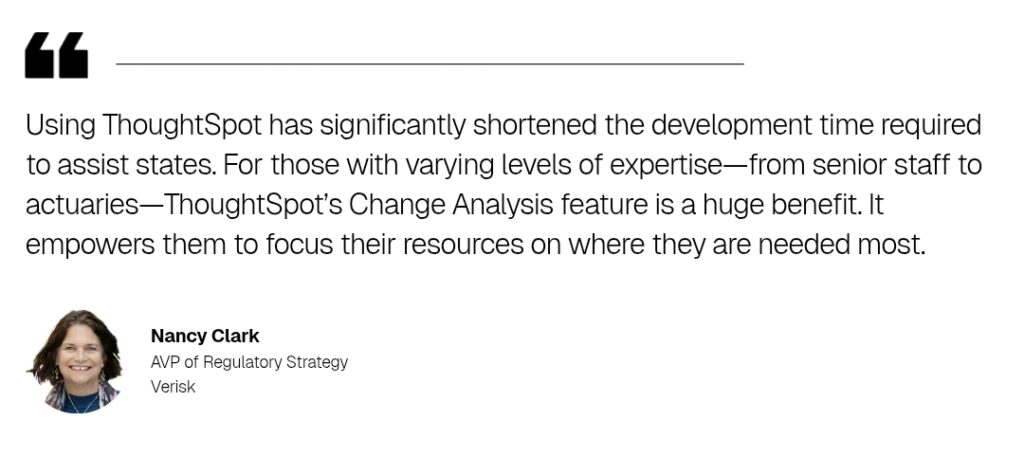
Features like Change Analysis allowed users across varying expertise levels—from senior regulators to actuaries—to independently identify trends, anomalies, and operational issues.
This democratized access significantly reduced dependency bottlenecks.
Middleware Layer: Embedded Workflow Orchestration
The middleware layer was equally important.
Instead of redirecting users into separate analytics environments, intelligence capabilities became embedded directly into SAVi-R workflows.
This reduced:
- context switching,
- operational fragmentation,
- and workflow disruption.
Embedded analytics systems succeed when intelligence feels native to the operational environment rather than externally attached.
That architectural integration improves both usability and adoption.
Backend Layer: Data and Semantic Infrastructure
The backend layer handled the most difficult challenge: translating highly complex insurance datasets into accessible analytical experiences.
Metadata management, semantic translation, and flexible data modeling became essential.
This is one of the most underestimated aspects of enterprise AI adoption.
Organizations often focus heavily on AI interfaces while underestimating the importance of semantic consistency and governance infrastructure.
Verisk’s implementation demonstrates that successful AI analytics modernization depends as much on data architecture discipline as on AI capability itself.
CX Impact: From Delayed Reporting to Decision Velocity
The most important outcome of Verisk’s transformation is not simply faster dashboard creation.
It is decision acceleration.
Before Transformation
Under the previous model:
- analytical requests required technical mediation,
- users experienced operational delays,
- insight accessibility was inconsistent,
- and workflows remained fragmented.
The organization operated in a reactive intelligence environment.
After Transformation
Following embedded AI analytics adoption:
- users gained more direct analytical access,
- operational responsiveness improved,
- dashboard delivery accelerated,
- and intelligence became more scalable.
Most importantly, catastrophe-response workflows became significantly faster.
When major disaster events occur, Verisk can now operationalize carrier data much more efficiently, reducing turnaround times from weeks to days.
That operational improvement has direct downstream implications for:
- regulators,
- insurers,
- operational teams,
- and ultimately policyholders.
Key CX Improvements
Speed
Turnaround reduction dramatically improved responsiveness during high-pressure operational periods.
Reliability
Embedded systems reduced fragmentation and standardized intelligence delivery.
Transparency
Users gained clearer visibility into analytical relationships and operational metrics.
Consistency
Standardized dashboards improved workflow continuity across jurisdictions.
Personalization
Different user groups could independently explore insights aligned with their own analytical needs.
The Organizational Shift Behind Self-Service Intelligence
One of the most overlooked implications of embedded analytics modernization is organizational redesign.
As self-service intelligence expands, the role of analytics teams changes fundamentally.
Previously, technical teams often spent substantial time responding to repetitive reporting requests.
Under self-service models, those teams can shift focus toward:
- strategic modeling,
- governance,
- advanced analytics,
- and innovation initiatives.
This represents a major capability evolution.
Analytics organizations move from: “report fulfillment” toward “decision enablement.”
However, this also increases the importance of governance structures.
Broader data access requires:
- semantic consistency,
- metadata governance,
- permission management,
- analytical trust frameworks,
- and operational accountability.
Without governance maturity, self-service ecosystems can quickly become fragmented and unreliable.
Industry Implications: Embedded Intelligence Is Becoming the New Enterprise Standard
Verisk’s transformation reflects broader structural changes happening across enterprise software markets.
Embedded Analytics Is Becoming Mainstream
Organizations increasingly want intelligence embedded directly into workflows rather than separated into standalone reporting environments.
This improves:
- usability,
- operational continuity,
- and adoption rates.
AI Adoption Is Becoming More Practical
Many enterprises struggle to operationalize AI because initiatives remain disconnected from actual workflows.
Embedded analytics provides a more practical adoption pathway because it integrates intelligence directly into operational environments.
That reduces the gap between data generation and business action.
Decision Velocity Is Emerging as a Competitive Metric
Organizations increasingly compete based on:
- responsiveness,
- adaptability,
- and operational intelligence speed.
This creates a new form of competitive differentiation: decision velocity.
Short-Term Outlook (0–2 Years)
Organizations will likely prioritize:
- embedded AI adoption,
- workflow-integrated analytics,
- and self-service intelligence expansion.
Medium-Term Outlook (3–5 Years)
The market will likely evolve toward:
- conversational analytics,
- predictive operational intelligence,
- autonomous insight recommendation,
- and AI-driven regulatory monitoring systems.
Enterprise Decision Lens
Build vs Buy vs Partner
For most enterprises, partnering with specialized embedded analytics providers remains more practical than building internal intelligence ecosystems from scratch.
The complexity of:
- semantic modeling,
- AI interfaces,
- governance,
- and embedded infrastructure creates substantial development overhead.
Adoption Readiness Factors
Organizations pursuing similar transformations need:
- strong data maturity,
- metadata governance,
- executive sponsorship,
- and workflow integration alignment.
Risk Assessment
Execution Risk
Moderate due to integration and adoption complexity.
Integration Risk
Potentially high in legacy environments with fragmented architectures.
CX Risk
Poorly governed self-service systems can create confusion instead of empowerment.
Implementation Complexity Score: Medium
Modern embedded analytics platforms reduce deployment friction significantly, but governance and operational redesign still require careful coordination.
The Future of CX Is Decision-Centric
The broader significance of Verisk’s transformation extends far beyond insurance analytics.
It signals the rise of a new enterprise operating paradigm where customer experience becomes increasingly shaped by operational intelligence responsiveness.
In this emerging model:
- trust,
- transparency,
- agility,
- and responsiveness
are determined by how quickly intelligence moves across the organization.
The organizations that succeed will not necessarily be those with the largest data environments.
They will be the ones capable of operationalizing insight with the least friction.
“The next generation of CX leaders will compete on decision velocity as much as customer engagement.”
