
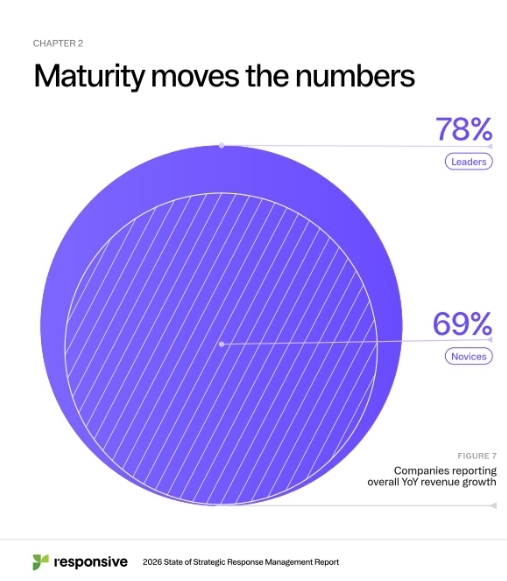
AI adoption is no longer impressive. ROI is.That’s the shift redefining AI in CX strategy right now.
AI in CX Strategy: From Adoption to Accountability
“AI without accountability is just faster inefficiency.”
The New CX Tension: Speed vs Trust
Artificial intelligence has delivered what it promised—speed, scale, and automation.
But in 2026, customer experience leaders are confronting a harder reality: speed alone is no longer enough.
Customers now expect:
- Faster responses
- Higher personalization
- Absolute accuracy
- Verifiable compliance
All at once.
This creates a defining tension in AI in CX strategy:
Automation vs trust. Efficiency vs credibility.
In high-stakes interactions—RFPs, security questionnaires, due diligence—AI is no longer evaluated on how quickly it responds, but on how reliably those responses stand up to scrutiny.
This is where Strategic Response Management (SRM) is evolving—from a back-office function into a frontline CX system.
And more importantly, where AI is being held accountable.
AI Adoption Is Now Baseline—Impact Is Not
AI adoption across CX and revenue workflows has reached scale.
According to According to the State of Strategic Response Management Report 2026, developed with insights from Responsive and APMP, nearly 70% of organizations now use AI in revenue-generating workflows.
Yet, adoption is not translating evenly into outcomes.
- AI is widely deployed—but rarely orchestrated
- Usage is broad—but maturity is uneven
- Measurement exists—but lacks consistency
At the same time, buyer expectations are intensifying:
- Over 80% of organizations report rising demand for faster responses
- Nearly 4 in 5 face increasing expectations for personalization
This creates a structural shift:
AI in CX strategy is no longer about adoption—it is about accountability.
What this looks like operationally
At Proximus NXT, proposal teams are managing increasing volumes of complex questionnaires under tighter timelines.
As Stef De Clerck notes:
“Customers want answers faster, even as demands are increasing—more questionnaires, more compliance, more scrutiny.”
The pressure is no longer just speed—it is credible speed.
From Automation to Orchestration
The market is now bifurcating into two distinct models of AI in CX strategy.
Fragmented AI (Low Maturity)
- AI used for drafting and summarization
- Content remains siloed
- Heavy human validation required
- Limited visibility into ROI
Orchestrated AI (High Maturity)
- AI embedded across workflows
- Centralized knowledge systems
- Built-in governance layers
- Direct linkage to revenue metrics
“AI capability is no longer the differentiator—AI integration is.”
This shift is redefining SRM:
From:
- A response execution layer
To:
- A revenue orchestration engine
Enterprise validation
At EXL, this transition is already underway.
Stephanie Benavidez explains:
“The expectation is no longer to simply respond well, but to design differentiated outcomes.”
This reflects a deeper shift: From answering questions → influencing decisions
The Technology Stack Powering Modern SRM
Modern AI in CX strategy is built on integrated systems—not standalone tools.
Frontend: The CX Interaction Layer
- RFP responses
- Sales proposals
- Security questionnaires
Where customer experience is delivered
Middleware: The Orchestration Layer
- Workflow routing
- SME collaboration
- AI-assisted drafting
- Content retrieval
Where efficiency and coordination are created
Backend: The Intelligence Layer
- Centralized knowledge repositories
- AI models and copilots
- Governance frameworks
- Performance analytics
Where trust and consistency are engineered
Why this architecture matters
At Autodesk, the impact of this systemization is measurable.
Crystal Wright highlights a foundational truth:
“You can have the most amazing technology, but if the source information is incorrect, you’re going to get incorrect answers.”
After centralizing and cleaning knowledge systems:
“We reduced response time from weeks to days.”
This reinforces a core principle:
AI performance is constrained by knowledge quality—not model capability.
CX Impact: From Efficiency Gains to Revenue Outcomes
Before vs After
| Before | After |
|---|---|
| Manual responses | AI-assisted responses |
| Inconsistent messaging | Governed, consistent outputs |
| Slow turnaround | Accelerated response cycles |
| SME bottlenecks | Scalable self-service |
Impact on CX Metrics
- Speed: Reduced turnaround times
- Reliability: Improved accuracy and compliance
- Personalization: Context-aware responses
- Transparency: Traceable knowledge sources
- Consistency: Unified messaging across touchpoints
Cause → Effect Chain
AI-assisted workflows
→ Faster responses
→ Reduced cycle times
→ Higher deal velocity
→ Improved win rates
→ Revenue growth
Metric Shift Table
| CX Lever | Operational Change | Business Impact |
|---|---|---|
| Automation | Reduced manual effort | ↓ Cost, ↓ AHT |
| Knowledge Hub | Centralized content | ↑ Consistency |
| Personalization | Context-aware responses | ↑ Win rates |
| Orchestration | Faster collaboration | ↑ Speed |
| Governance | Verified outputs | ↑ Trust |
The Operating Model Is Being Rewritten
AI is not just transforming workflows—it is redefining roles.
Then:
- Proposal teams → Execution support
- SMEs → Bottlenecks
- Sales → Dependent on internal teams
Now:
- Proposal teams → Strategic growth partners
- SMEs → On-demand contributors
- Sales → Self-service enabled
At Vodafone, this shift is being operationalized with discipline.
Dirk Günter Karl Müller emphasizes:
“You need to be very careful about which opportunities you pursue.”
And Ken Lebek adds:
“AI is powerful—but it’s not yet reliable enough for critical decisions without human judgment.”
The emerging model is clear:
AI scales execution. Humans ensure judgment.
The Real Barrier: Not Technology, But Trust
Despite widespread adoption, three barriers persist:
- Trust in AI-generated outputs
- Data and knowledge quality gaps
- Lack of structured training and adoption
Nearly half of organizations cite AI inaccuracies and hallucinations as a major concern .
Ground reality
At Proximus NXT, AI can:
- Process and respond to extensive questionnaires rapidly
But still requires:
- Expert validation
- Contextual refinement
“Trust, but verify.”
This is not a limitation—it is a design principle.
Industry Implications: A Structural Shift in CX
1. AI Becomes Core CX Infrastructure
No longer optional—now foundational
2. SRM Becomes a Revenue System
Every response directly impacts conversion outcomes
3. Competitive Advantage Redefined
Leaders:
- Orchestrate AI across workflows
- Centralize and govern knowledge
- Measure ROI rigorously
Followers:
- Deploy disconnected AI tools
- Struggle with integration
- Lack measurable outcomes
Time Horizon
Short-term (0–2 years):
- ROI pressure intensifies
- Knowledge centralization accelerates
- Workflow orchestration becomes standard
Mid-term (3–5 years):
- Autonomous response systems emerge
- AI-driven decision intelligence scales
- CX ecosystems become fully integrated
The Future of AI in CX Strategy
The trajectory is clear.
AI in CX is evolving from:
- Tool → System → Infrastructure
Organizations that lead will:
- Invest in knowledge governance
- Orchestrate workflows end-to-end
- Tie AI directly to business outcomes
Those that lag will:
- Deliver inconsistent experiences
- Fail to prove ROI
- Lose competitive positioning
Final Perspective
“Speed is expected. Trust is earned.”
The next phase of AI in CX strategy will not be defined by how much AI organizations deploy—but by how effectively they govern, orchestrate, and prove it.
Because in the end:
Customer experience is not about responding faster.
It is about responding right—with consistency, credibility, and confidence.
