
Fuel Price Shock & CX Stability: How India’s Fuel Duty Cuts Protected Customer Experience at Scale
Fuel Duty Cuts: What Happened and Why It Matters Now
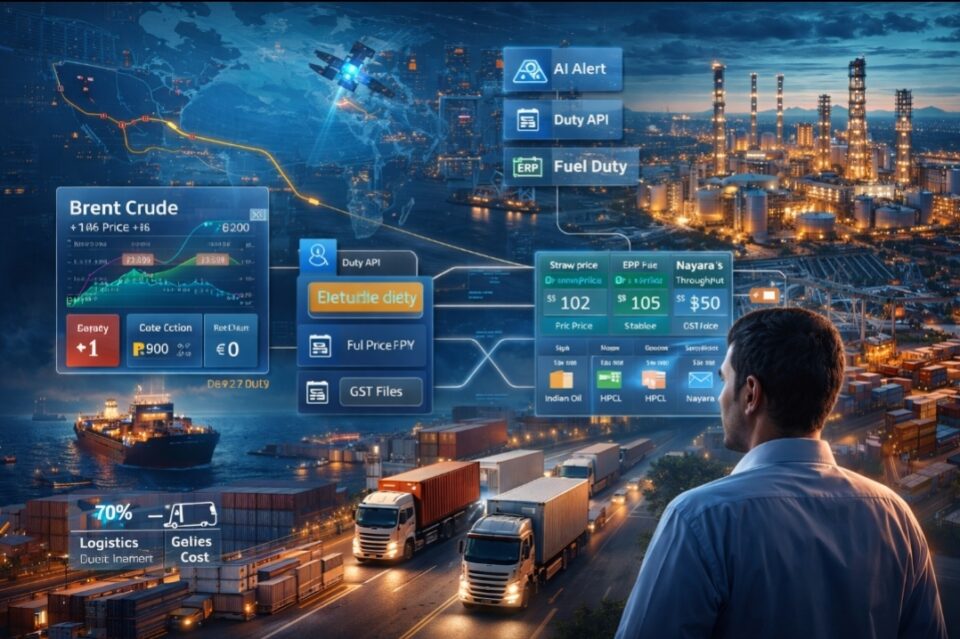
On March 27, 2026, India’s finance ministry significantly reduced excise duties on petrol and effectively eliminated duties on diesel, responding to escalating geopolitical tensions impacting the Strait of Hormuz—a critical artery for global oil supply. Brent crude briefly surged toward $119 per barrel before stabilizing closer to $100, placing immediate pressure on import-dependent economies like India.
State-run fuel retailers such as Indian Oil maintained stable consumer prices, absorbing the shock. However, price movements by private players like Nayara Energy hinted at underlying stress fractures in the system.
This moment matters because fuel is not just an economic input—it is a foundational layer of customer experience infrastructure, underpinning nearly 70% of logistics costs. When fuel becomes volatile, the ripple effects extend across retail, mobility, e-commerce, and manufacturing—disrupting the delicate alignment between digital promises and physical fulfillment.
“In energy CX, governments have become the invisible experience designers.”
2. Fuel Duty Cuts Industry Context — CX Expectations Meets Operational Reality
Modern customers—both consumers and enterprises—expect frictionless, shock-resistant experiences. Households demand affordability and predictability in daily mobility, while businesses depend on stable supply chains to maintain service-level agreements.
However, India’s structural reality complicates this expectation. With approximately 88% dependence on oil imports—and a significant portion transiting through geopolitically sensitive routes—there exists a persistent tension between experience reliability and supply vulnerability.
Government intervention to stabilize retail fuel prices, despite rising input costs, effectively shifted the burden onto oil marketing companies. This creates margin compression while preserving the “moment of truth” at the consumer touchpoint—the fuel pump.
Technological advancements such as AI-driven inventory optimization and demand forecasting have improved operational efficiency. Yet, they remain insufficient against macro disruptions like geopolitical chokepoints.
For CX leaders, the implication is clear:
customer journeys are only as resilient as their weakest physical dependency.
“The real CX breakdown doesn’t happen in the app—it happens when the truck doesn’t arrive.”
3. Strategic Layer — Policy as a CX Stabilization Mechanism
The government’s duty reduction functions as a strategic buffer mechanism, designed to absorb external volatility and protect domestic consumption stability.
Rather than a purely economic move, this represents a macro-level CX intervention—buying time for supply chains to recalibrate while preventing inflationary shocks from reaching end consumers.
This creates a temporary stabilization window during which:
- Alternative sourcing strategies can be explored
- Supply routes can be diversified
- Market sentiment can be managed
At a broader level, it reinforces India’s positioning as a stable consumption market in an otherwise volatile global energy landscape.
For enterprise CX strategists, this signals the need for dual-horizon planning:
- Short-term: Absorb shocks and maintain experience continuity
- Long-term: Build structural resilience into operating models
“Experience continuity is no longer a frontline function—it is a macroeconomic outcome.”
4. Technology Layer — The Digital-Fiscal Control Plane
Behind the scenes, fuel pricing and distribution operate through increasingly sophisticated digital control architectures.
Duty adjustments cascade through:
- ERP systems of oil marketing companies
- Automated pricing engines
- Real-time integrations with global commodity data feeds
- Taxation and compliance systems including GST frameworks
This creates a unified digital-fiscal layer, where policy decisions are translated into near real-time operational execution.
Advanced capabilities now include:
- Scenario simulation engines for pricing sensitivity
- Control tower visibility across supply chains
- AI-assisted demand forecasting under volatility conditions
- Geospatial monitoring inputs informing supply risk models
The result is a shift from reactive operations to decision intelligence ecosystems, enabling leaders to simulate “what-if” scenarios before they materialize.
“Automated pricing is no longer about efficiency—it is about safeguarding experience continuity under stress.”
5. CX Impact — Direct Effect on Customer Journeys
The immediate CX impact of fuel price stabilization is both broad and deeply systemic.
For Consumers
- Stabilized fuel prices protect household budgets
- Reduced anxiety around daily commuting costs
- Greater trust in institutional reliability
For Businesses (B2B CX)
- Fleet operators avoid cost volatility
- Logistics networks maintain route consistency
- E-commerce delivery timelines remain intact
This translates into measurable improvements across:
- On-Time-In-Full (OTIF) delivery performance
- Net Promoter Score (NPS) stability
- Reduced service disruptions
The experience chain becomes स्पष्ट:
Supply stabilization → Margin absorption → Price consistency → Trust preservation → CX continuity
Friction points—such as pricing disputes, delayed deliveries, and opaque cost escalations—are significantly reduced.
“When price volatility disappears, trust compounds.”
6. Industry Implications — Redefining CX Boundaries
This episode reinforces the emergence of what can be termed a “national CX contract” in essential sectors.
In such ecosystems:
- Governments act as experience stabilizers
- Enterprises act as experience orchestrators
- Infrastructure acts as the experience backbone
Private sector deviations—such as selective price hikes—highlight system thresholds and force recalibration across the ecosystem.
At a structural level, several shifts are becoming evident:
- Increased investment in supply chain resilience frameworks
- Exploration of multi-source procurement strategies
- Emergence of scenario planning as a CX capability
- Early experimentation with blockchain-backed transparency in energy logistics
“In critical industries, CX is no longer owned by brands alone—it is co-authored by policy, infrastructure, and geopolitics.”
7. Future Outlook — Designing CX for Volatility
If crude prices sustain elevated levels, fiscal buffers may face exhaustion, forcing deeper structural adaptations.
The next phase of evolution will likely include:
- AI-driven multi-origin procurement systems
- Dynamic pricing transparency for customers
- Tiered resilience offerings for enterprise clients
- Integration of geopolitical intelligence into CX design
This marks the transition toward adaptive CX models—systems designed not just to withstand disruption, but to operate effectively within it.
Forward-looking CX leaders will begin treating supply shocks as design inputs, not external anomalies.
“The next frontier of CX is not stability—it is adaptability under continuous disruption.”
Key Takeaways for CX Leaders
- Geopolitical Buffers Are CX Infrastructure: Macro interventions like duty cuts reveal how national policy now underpins customer trust in volatile sectors. Leaders must map these to journey maps, as external stability enables internal innovation.
- Retailer Defections Signal CX Breaking Points: Nayara’s pricing moves exposed tolerance thresholds—private players can reveal systemic stress. Action: Build contractual CX alignment mechanisms across partner ecosystems.
- Price Stability Trumps Digital Bells: In essential services, reliability consistently outweighs feature innovation. Action: Prioritize resilience KPIs over engagement metrics.
- AI Forecasting Has Limits in Black Swan Events: Predictive systems must be augmented with scenario-based planning and policy awareness. Action: Integrate macro-risk simulations into CX intelligence layers.
- B2B Journeys Amplify Consumer Outcomes: Supply chain disruptions cascade into end-customer experiences. Action: Co-create resilience frameworks with upstream and downstream partners.
