
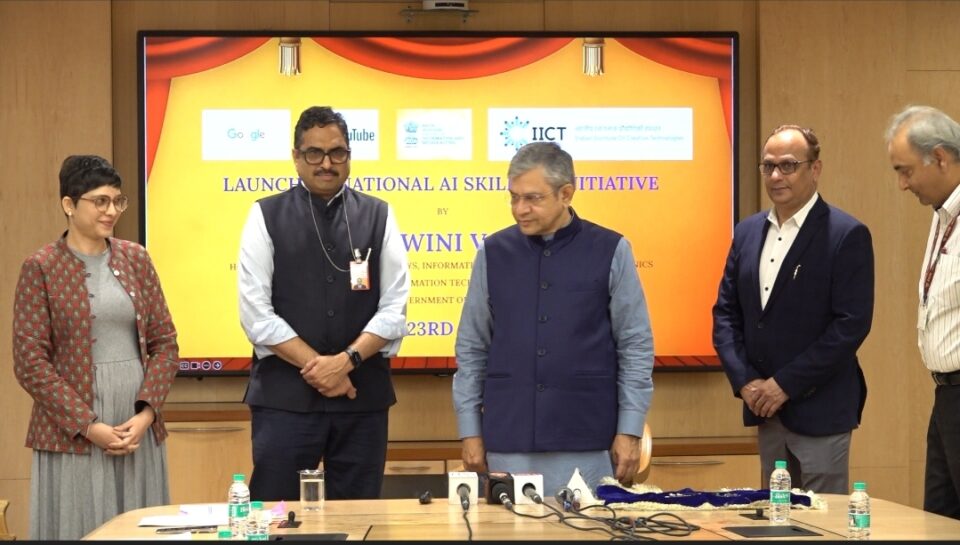
A new AI skilling initiative in India’s creative sector underscores a critical CX shift: experience delivery now depends on AI-ready talent. The collaboration between government, platforms, and academia reflects how workforce capability is becoming central to scalable, personalized, and efficient digital customer experiences.
Building AI-Ready Creative Talent: A Strategic Shift in CX Delivery
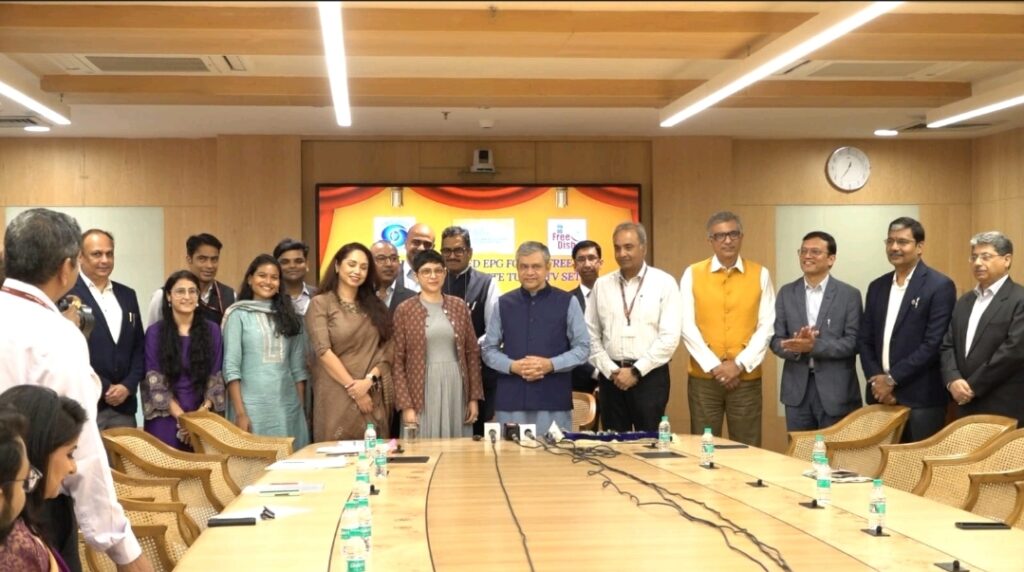
The Ministry of Information & Broadcasting (MIB), in collaboration with the Indian Institute of Creative Technologies (IICT), has announced a national AI skilling initiative aimed at strengthening India’s creative sector. Developed in partnership with Google and YouTube, the program will offer 15,000 scholarships focused on equipping creators and digital professionals with advanced AI capabilities.
Structured in two phases—foundational learning and specialized, project-based training—the initiative is designed to embed artificial intelligence directly into creative workflows. It builds on earlier efforts such as the “Create with AI” program and reflects a broader push to align talent development with emerging digital content demands.
The Changing Nature of Customer Experience
Customer experience in the digital era is increasingly content-driven. Whether through video platforms, social media, or immersive storytelling formats, content has become a primary interface between brands and their audiences.
Consumers now expect personalization, immediacy, and contextual relevance—attributes that are difficult to achieve at scale without automation. AI technologies, including generative AI and predictive analytics, are enabling organizations to meet these expectations. However, their effectiveness depends heavily on how they are applied by human creators and strategists.
“AI is moving from backend systems into the hands of creators shaping customer experiences.”
This shift marks a transition in CX design—from system-led orchestration to creator-led execution, where individuals equipped with AI tools directly influence engagement outcomes.
Strategic Alignment Across Ecosystems
The collaboration between MIB, IICT, Google, and YouTube reflects a convergence of public policy, platform ecosystems, and enterprise technology strategy.
From a national perspective, the initiative aligns with India’s ambition to become a global hub for creative and digital innovation. By focusing on workforce readiness, it creates a pipeline of talent capable of supporting long-term industry growth.
For YouTube, the initiative reinforces its creator ecosystem. Gunjan Soni, Managing Director, India, YouTube, emphasized that the program aims to help creators “become fluent in the tools of tomorrow” and “reach new audiences,” indicating a strategic focus on deepening engagement through capability building.
Google’s participation signals its continued investment in expanding AI adoption through structured learning pathways. Shekar Khosla, Vice President, Marketing, India, highlighted the importance of “specialized AI skills needed to succeed,” underscoring the role of skilling in driving platform utilization.
IICT, as the implementation partner, plays a critical role in operationalizing the initiative at scale, ensuring alignment with industry needs and execution standards.
“Platform ecosystems are now influencing how skills are developed and applied.”
This reflects a broader industry pattern where technology providers are shaping not just tools—but also the talent frameworks required to use them effectively.
From Awareness to Application: How the Program Works
The initiative is structured to move participants from foundational understanding to applied capability.
In Phase I, participants gain access to AI literacy programs, including Google Career Certificates and generative AI learning modules. This stage focuses on building a baseline understanding of AI tools, concepts, and responsible usage practices.
Phase II transitions into hands-on, project-based learning. Participants engage with advanced AI tools, storytelling frameworks, and YouTube platform best practices. Delivered through a hybrid model across creative hubs, this phase emphasizes real-world application.
Vishwas Deoskar, CEO of IICT, notes that the initiative is designed to “move beyond awareness and into capability building,” highlighting its focus on production-ready outcomes.
“Workforce readiness is emerging as a critical constraint in digital transformation.”
By addressing this constraint directly, the program attempts to bridge the gap between AI adoption and effective implementation.
Implications for Customer Experience
For CX leaders, the initiative highlights the increasing interdependence between talent capability and experience delivery.
AI-enabled creators can significantly enhance personalization by leveraging audience insights to produce more relevant and engaging content. This is particularly critical in environments where customer attention is fragmented across platforms.
Operational efficiency is another key impact area. AI-driven workflows can automate repetitive tasks such as editing, tagging, and optimization. Thus, reducing turnaround times and enabling faster response to customer needs.
Consistency and quality also benefit. Standardized workflows and platform-aligned practices can help ensure cohesive experiences across channels.
“Content velocity and personalization are becoming defining factors in CX differentiation.”
As organizations scale content production, the ability to maintain both speed and relevance will increasingly define competitive advantage.
Broader Industry Implications
The initiative signals the emergence of AI-native creative ecosystems, where talent, tools, and platforms integrate tightly.
One notable trend is the rise of platform-led education. Companies like Google and YouTube take a more active role in training. They shape not only tool adoption but also industry standards and workflows.
This has implications for competition. A larger pool of AI-enabled creators could accelerate innovation but also intensify the need for differentiation.
“The future of CX will depend as much on talent as on technology.”
Organizations that successfully align these two dimensions will be in a better position to deliver consistent and scalable customer experiences.
Future Outlook for CX and Digital Transformation
As AI continues to reshape content ecosystems, the focus of CX transformation is expanding. Technology alone is no longer sufficient; organizations must invest in building the human capabilities required to leverage it effectively.
This initiative illustrates a broader shift toward integrated transformation models, where skilling, technology, and platform strategy develop in parallel.
For CX leaders, the challenge will be to embed these capabilities within their organizations. Thus, ensuring that teams equip well with AI tools. And, also become capable of using them to deliver meaningful, customer-centric outcomes.
In the coming years, the ability to combine AI-driven efficiency with human creativity will be of utmost importance. It will likely define the next generation of customer experience leadership.
Key Takeaways
• AI skilling is becoming a foundational element of CX strategy, not just a technical initiative
• Content-driven experiences require creators who can effectively leverage AI tools
• Platform ecosystems are playing a growing role in shaping workforce capabilities
• Talent readiness remains a key barrier to scaling AI-driven CX initiatives
• Hybrid, application-focused learning models can accelerate digital transformation outcomes
