
From Chatbots to Digital Colleagues: How Agentic AI in 2026 Is Reshaping Customer Experience
A Vivid Scenario About Agentic AI in 2026: The Moment Everything Changed
It’s Tuesday morning. A customer logs into their telecom account, increasingly frustrated with sluggish internet speeds. They open the chat window—no wait time. An AI responds instantly, not with a generic script, but with genuine understanding. That’s is the basics of agentic AI in 2026.
Instead of asking routine questions, the system already knows their account history, router model, and recent usage patterns. It runs network diagnostics in real-time, identifies signal interference from a neighboring device, and suggests a fix—then autonomously executes a network reset. Three minutes later, speeds improve. Before frustration even sets in, the AI follows up proactively. That’s agentic AI in 2026.
No escalation. No repeating the problem. And this is best of all No human agent needed.
This isn’t science fiction. This is agentic AI in 2026, and it’s rewriting the rules for customer experience.
What Is Agentic AI and Why CX Teams Need It Now?
Agentic AI represents a fundamental shift from tools that respond to instructions to intelligent colleagues that act autonomously. Unlike traditional chatbots that follow predefined scripts, agentic AI systems perceive their environment, reason through complex situations, make real-time decisions, and execute multi-step workflows without waiting for human approval.
The distinction matters because it changes everything about how customer experience operates. Where traditional AI is reactive—waiting for customers to ask for help—agentic AI is proactive, anticipatory, and adaptive. It doesn’t just answer questions; it predicts needs, resolves issues before they escalate, and continuously learns from every interaction.
For CX leaders wrestling with siloed teams, data fragmentation, and the impossible task of personalizing at scale, agentic AI transforms these pain points into competitive advantages.
Why Does Agentic AI in 2026 Mark the Inflection Point for Agentic AI in CX?
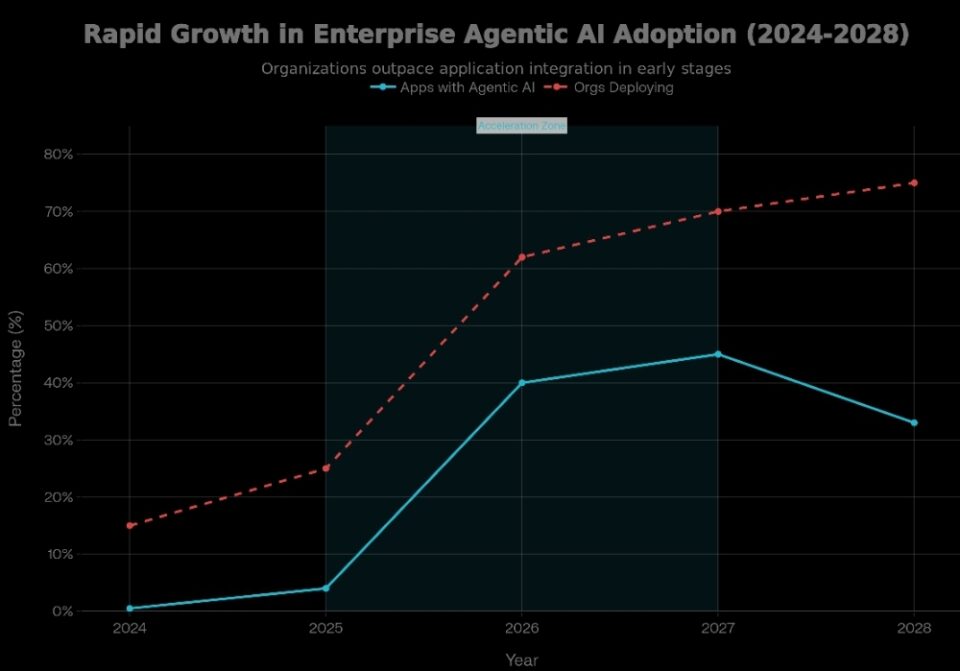
The numbers tell a compelling story. Gartner predicts that by 2028, 33% of enterprise software applications will embed agentic AI capabilities—up from less than 1% in 2024. More immediately, 40% of enterprise applications will integrate task-specific AI agents by the end of this year.
This isn’t just incremental progress. It’s an acceleration. Organizations are moving from experimental pilots to production deployments. McKinsey reports that 23% of enterprises are now actively scaling agentic AI systems, with another 39% experimenting. Deloitte forecasts that 50% of enterprises already using generative AI will deploy autonomous agents by 2027, doubling from just 25% in 2025.
The shift reflects a deeper reality: businesses can no longer afford to delay. Ninety-three percent of leaders believe that those who successfully scale AI agents in the next 12 months will gain measurable competitive edge over peers. This is going to be the power of agentic AI in 2026.
Agentic AI in 2026 Takes a Leap: The Economics Are Compelling
Organizations implementing agentic AI report productivity gains of 30–60% in automated workflows, with payback periods of just 6–12 months. Real-world case studies illustrate the impact: AtlantiCare saw a 42% reduction in documentation time with 80% adoption across clinical teams. Bradesco bank freed up 17% of employee capacity while cutting loan processing lead times by 22%.
The ROI calculation favors early movers. Organizations report 5x to 10x returns on AI agent investments, with 88% of executives seeing early positive returns.
The Three Core Challenges Keeping CX Leaders Awake at Night
Before diving into solutions, it’s essential to understand what makes agentic AI adoption so difficult—and why so many organizations get stuck.
1. Siloed Teams and Fragmented Data Ecosystems
Most enterprise CX operations resemble a patchwork quilt more than an integrated system. Support teams use one platform. Sales uses another. Product data lives in a third. When customers move between channels, the context vanishes.
A support agent handles an issue that gets escalated to a specialist. The specialist solves the problem—but that learning never reaches back to the AI that first encountered the query. The AI doesn’t improve. The frontline agent doesn’t get coaching. Separate systems perpetuate separate learning loops.
Meanwhile, CX leaders struggle to reconstruct a single customer journey. They query the AI platform, pull data from the human agent system, analyze QA scores from another tool, and review Voice of Customer surveys. Stitching this together into a coherent view takes weeks—if it’s possible at all.
The operational overhead becomes crushing. Teams manage 3–4 different vendors, maintain multiple AI systems, tune disconnected platforms, and coordinate incompatible roadmaps. Innovation slows. Decision-making lags.
2. The AI Gap: Reactive vs. Proactive Posture
Traditional CX automation waits. A customer submits a ticket. Systems route it. Agents respond. Resolution comes only when friction has already occurred.
In contrast, agentic AI fundamentally shifts posture from reactive problem-solving to proactive anticipation. It detects payment failures before they disrupt accounts. It identifies delivery delays before customers notice. Above all, it recognizes engagement drops before churn happens.
This requires not just better AI, but better infrastructure. Legacy systems with fragmented APIs, outdated data schemas, and siloed architecture can’t support real-time orchestration across channels. Without unified data access, personalization remains surface-level. Without autonomous decision-making, the system reverts to manual bottlenecks.
3. Journey Fragmentation at Scale
Traditional journey mapping assumes a predictable path: customer arrives → engages at touchpoint A → moves to touchpoint B → converts. Reality is messier.
Customers deviate. Intent changes. Context shifts. A shopper researching on their phone doesn’t follow the same path as one on desktop. A loyalty member expects different treatment than a first-time visitor. A customer dealing with an urgent issue needs different routing than someone exploring casually.
Static workflows break under this complexity. Dynamic adaptation requires AI that understands not just what happened, but why—and what might happen next. Most platforms can’t deliver that.
How Agentic AI in 2026 is Redefining the CX Operating Model
The shift from traditional automation to agentic AI isn’t about adding better chatbots. It’s about rearchitecting how customer experience gets delivered.
From Script-Bound Responses to Contextual Reasoning
Traditional AI: Customer asks “Where’s my order?” → System matches keywords → Returns FAQ link → Customer still unsure.
Agentic AI: Customer asks “Where’s my order?” → System understands intent and urgency → Accesses order, tracking, and delivery data → Identifies that package is delayed due to weather → Proactively offers alternative delivery or partial refund → Follows up to confirm resolution.
The difference isn’t cosmetic. It’s the shift from pattern-matching to reasoning. Agentic AI systems ingest customer history, behavioral patterns, sentiment, and external context (weather, demand, inventory) to construct a complete picture. They don’t just respond; they decide.
Real-Time Orchestration Across Systems
When a customer reports a defective product through chat, agentic AI can simultaneously:
- Validate the claim against order history
- Trigger a replacement order
- Update inventory records
- Notify the shipping team
- Send real-time status updates to the customer
- Flag warranty patterns for quality teams
This multi-step workflow executes in minutes, not hours, across systems that traditionally required manual handoffs. The entire operation becomes autonomous, reducing resolution time from hours to minutes while freeing human agents for genuinely complex issues.
Agentic AI in 2026: Proactive Engagement and Predictive Intervention
Agentic AI doesn’t wait for problems to surface. It continuously analyzes patterns in customer journeys, historical interactions, and behavioral data to identify friction before it becomes pain.
In travel and hospitality, this means autonomous systems detect flight delays and proactively rebook passengers before they file complaints. In retail, it means identifying hesitation signals in shopping patterns and offering incentives before customers abandon carts. And, in financial services, it means flagging compliance risks before they become regulatory violations.
This shift from reactive to anticipatory is perhaps the most consequential: it moves customer experience from a cost center focused on fixing problems to a value center focused on enabling success.
Continuous Learning Without Human Intervention
Traditional automation requires manual tuning. New policies? Update the rules. New customer segment? Rebuild the logic. New competitive threat? Redesign workflows.
Agentic AI learns continuously. It analyzes every interaction outcome—what worked, what didn’t, customer satisfaction signals—and automatically refines its decision-making. If a particular customer segment responds better to email than chat, it adjusts channel selection. If a certain type of query consistently escalates to specialists, it routes similarly complex issues directly. And, if response times improve after a process change, it reinforces that pattern.
This autonomous optimization means systems become smarter over time without manual intervention, reducing the operational burden on CX teams while improving outcomes.
Key Insights: What Successful Implementations Share
Research across healthcare, finance, retail, and telecommunications reveals consistent patterns among organizations achieving strong results with agentic AI.
Pattern 1: Vertical Specialization Works Better Than Generic Agents
Agentic AI solutions tailored to specific industries significantly outperform generic platforms. Why? Because domain expertise matters. Healthcare agents that understand HIPAA requirements, compliance workflows, and clinical contexts deliver better outcomes than general-purpose systems. Financial services agents that grasp multi-step compliance checks and fraud indicators outperform one-size-fits-all solutions.
The implication for CX: start with well-scoped, industry-specific use cases rather than attempting to automate everything simultaneously.
Pattern 2: Escalation Protocols Are Non-Negotiable
The most successful implementations aren’t those that minimize human involvement—they’re those that optimize it. Agentic AI handles what it handles well. When uncertainty rises, complexity increases, or emotional context demands human judgment, the system escalates seamlessly.
Critically, escalations include complete context: full conversation history, system actions already taken, confidence scores, and recommended next steps. The human agent steps in without the customer having to repeat their issue.
This human-AI partnership model delivers better outcomes than full automation because it preserves human judgment where it matters while eliminating human bottlenecks in routine work.
Pattern 3: Governance From Day One Prevents “Black Box” Paralysis
One of the biggest adoption barriers is the opacity of autonomous systems. When agentic AI makes decisions independently and adapts in real time, leaders can’t see why those decisions happened. This creates compliance risk, makes troubleshooting difficult, and erodes stakeholder trust.
Organizations that succeed implement governance frameworks upfront. This includes explainable AI mechanisms that surface decision logic, audit trails that track all agent actions, bias detection systems that flag potential fairness issues, and escalation protocols that involve human oversight for high-stakes decisions.
Pattern 4: Data Readiness Precedes Agent Deployment
You can’t build a sophisticated agent on fragmented data. Successful organizations invest upfront in data consolidation—bringing customer records from CRM and order history from ERP into unified, accessible formats. They standardize schemas, clean historical data, and establish governance for data quality.
This isn’t optional. It’s foundational. Without it, agents make decisions on incomplete information, consistency suffers, and personalization remains shallow.
A Practical Framework: The Agentic Maturity Model
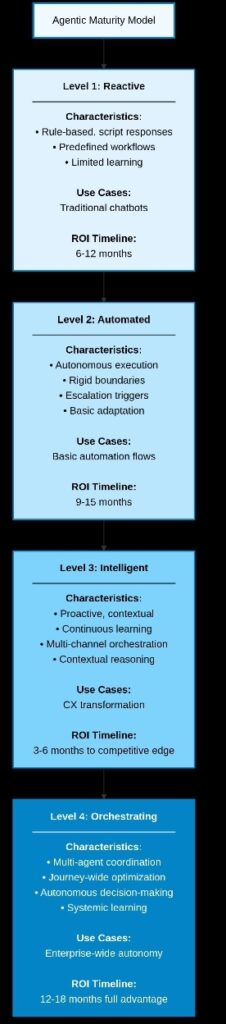
Research from organizations like Passo (a super-app platform) reveals a maturity progression that CX leaders can apply to their own implementations.
Level 1 (Reactive, Rule-Based Agents): The system responds to explicit customer requests using predefined decision trees. Limited context awareness. No learning. Think traditional chatbots.
Level 2 (Automated, Script-Bound Agents): The system executes workflows autonomously but within rigid boundaries. Escalates when it encounters situations outside its training.
Level 3 (Intelligent, Proactive Agents): The system anticipates customer needs, adapts decisions contextually, and learns continuously. It identifies patterns and takes initiative before customers ask.
Level 4 (Orchestrating, Autonomous Agents): The system orchestrates multiple specialized agents, reconciles conflicting objectives, optimizes across the entire customer journey, and refines strategies based on systemic feedback.
The progression matters because it reveals where to invest first. Most CX leaders should target Level 3—where the ROI becomes clear and the operational burden decreases significantly—before pursuing full orchestration at Level 4.
Real-World Implementation: Three Scenarios
Scenario 1: Retail & E-Commerce—Hyper-Personalized Journeys
A customer researches a product on mobile, abandons the cart, receives an email recommendation the next morning, clicks through on her laptop, and encounters a personalized shopping experience that reflects her price sensitivity and style preferences.
Behind the scenes, agentic AI tracked micro-interactions, identified hesitation patterns in her browsing, predicted she’d respond better to email than push notifications, analyzed her purchase history to calibrate recommendations, and dynamically adjusted product positioning.
When she encounters a question during checkout, the AI provides instant, contextual help without escalating. If the purchase is hesitant due to shipping cost, the system autonomously offers expedited shipping or discounts.
Impact: 25% increase in conversion rates, 15% increase in average order value, 30% improvement in customer lifetime value.
Scenario 2: Financial Services—Real-Time Fraud and Compliance
A customer makes a transaction that triggers a fraud signal. Rather than blocking the transaction and requiring manual review, the agentic AI system:
- Evaluates the transaction in context (recent travel, typical spending patterns, time of day)
- Simultaneously runs compliance checks against regulatory requirements
- If high-confidence fraud: autonomously declines and alerts the customer
- If ambiguous: requests verification via SMS while monitoring for additional suspicious activity
- Logs all decision logic for regulatory audit trails
Meanwhile, systems cascade these insights into other agent systems—updating portfolio risk models, adjusting spending limits, and triggering alerts for the customer’s relationship manager.
Impact: 42% reduction in fraud losses, 22% faster loan processing, 17% improvement in employee capacity allocation.
Scenario 3: Telecommunications—Predictive Network Management
A customer experiences slowing internet. Before they file a complaint, the agentic AI detects the signal degradation through network monitoring systems. It:
- Runs diagnostics on the customer’s connection
- Identifies signal interference (overcrowded spectrum in the area)
- Adjusts network routing to compensate
- If customer data suggests previous complaints about the issue, autonomously offers a service credit
- Proactively sends notification: “We detected and resolved a connection issue on your account. Here’s what happened and how we fixed it.”
The system learns from the resolution and applies similar logic to other customers in the same geographic area experiencing related issues.
Impact: Reduced complaints, proactive reputation management, lower churn, improved network efficiency.
Common Pitfalls: Why Agentic AI Initiatives Stall
Understanding what goes wrong helps organizations avoid the traps.
Pitfall 1: Starting Too Broad
Teams try to automate everything simultaneously—all customer queries, all channels, all processes. Scope explodes. Data requirements become unmanageable. Governance complexity spins out of control. Projects stall.
Solution: Start narrow. Choose a specific use case with clear success metrics. Examples: order status inquiries, password resets, appointment scheduling. Prove value, then expand.
Pitfall 2: Ignoring Legacy System Integration
New agentic AI platforms clash with decades-old CRM systems, fragmented databases, and APIs designed for human-paced interactions. Integration takes longer than expected. Data doesn’t flow cleanly. The new system becomes another siloed tool.
Solution: Conduct infrastructure assessment upfront. Consolidate fragmented data sources. Build secure integration pathways between systems. This isn’t glamorous, but it’s essential.
Pitfall 3: Deploying Without Clear Escalation Paths
Teams launch agents without defining when humans should step in. As a result, customers get stuck in loops with AI-generated responses that don’t actually help. Frustration spikes. Trust erodes.
Solution: Define escalation criteria explicitly. If confidence drops below a threshold, escalate. If the issue requires emotional intelligence or judgment, escalate. Furthermore, if the customer explicitly requests a human, escalate immediately. Make escalations seamless—the human gets full context, not a repeat conversation.
Pitfall 4: Neglecting Continuous Monitoring and Iteration
Teams launch agentic AI and assume it will improve automatically. Meanwhile, real-world patterns go unnoticed. Escalation rates spike on certain days. Customer satisfaction drops for specific segments. The system drifts from business objectives.
Solution: Monitor relentlessly. Track resolution times, customer satisfaction, escalation rates, and first-contact resolution. Look for patterns: If escalations spike Monday mornings, dig deeper—the agent may need additional context or updated rules. If certain customer segments report lower satisfaction, the system may need to adapt its approach for that cohort.
The ROI Story: Measurable Business Impact
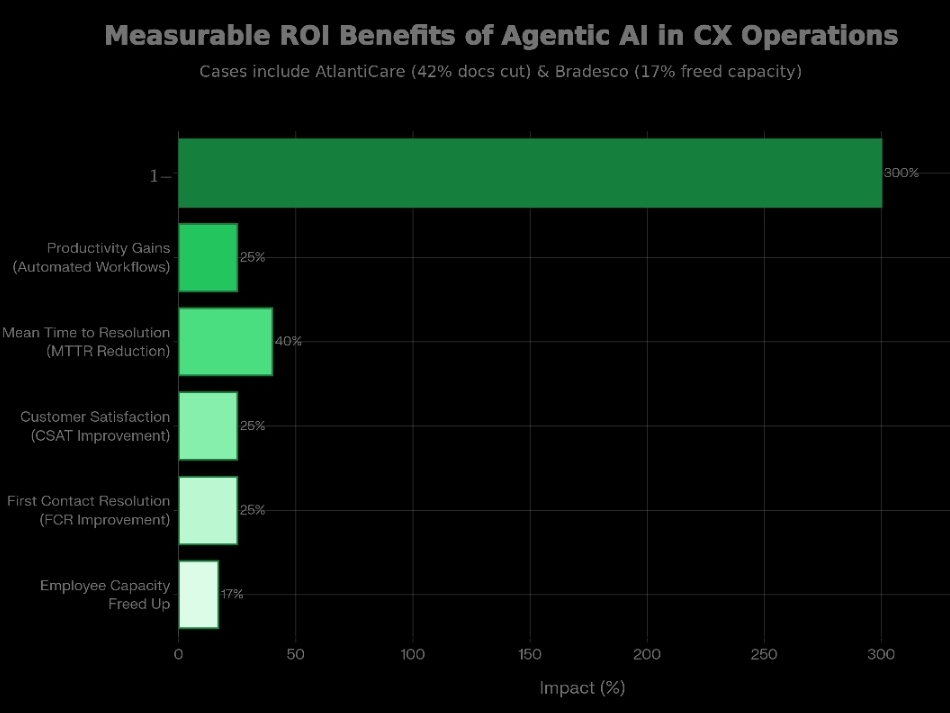
Organizations implementing agentic AI see impact across six critical dimensions.
Cost Reduction: $1–$4 saved per $1 spent. Organizations report 20–35% lower operational costs, particularly in Tier-1 support.
Productivity Gains: 25–30% improvement in automated workflow output. Healthcare teams see 42% documentation time reduction; finance teams report 22% faster processing.
Resolution Speed: 30–50% reduction in mean time to resolution (MTTR). Financial institutions reduced major incident MTTR from 4 hours to under 90 minutes.
Customer Satisfaction: 25% increase in CSAT; 20% improvement in Net Promoter Score.
First Contact Resolution: 20–30% improvement; reduces repeat contacts and customer frustration.
Employee Capacity: 15–20% of team capacity freed up for higher-value work. Bradesco bank reported 17% capacity improvement allowing expansion into new services without hiring.
Actionable Frameworks: Decision-Making for CX Leaders
The Opportunity Scorecard: Evaluating Agentic AI Use Cases
Before investing in any implementation, CX leaders should evaluate opportunities using a structured scorecard.
| Criteria | Strong Signals |
|---|---|
| Volume | >50% of queries; high daily volume |
| Predictability | Clear, repeating patterns; defined outcomes |
| Value | High customer impact; significant cost savings; revenue influence |
| Data Readiness | Sufficient historical data; accessible systems; unified customer context |
| Escalation Paths | Clear criteria for human handoff; manageable exception rates |
| Governance | Compliance requirements understood; audit trails feasible |
Use this to identify high-impact opportunities first.
The Implementation Roadmap: Five Phases
Phase 1: Assessment & Goal Setting (Weeks 1–4)
Identify pain points: long resolution times, repetitive tasks, customer complaints.
Choose a focused use case with clear success metrics.
Define current-state metrics (baseline).
Phase 2: Data Readiness & Pilot Design (Weeks 5–8)
Assess data quality and consolidation needs.
Define agent scope, decision boundaries, escalation rules.
Prepare test environment; identify 5–10% of customer traffic for pilot.
Phase 3: Integration & Testing (Weeks 9–16)
Connect agent to CRM, ERP, support platforms via APIs.
Simulate edge cases: system outages, incomplete data, ambiguous customer intent.
Validate escalation workflows; ensure human handoff includes full context.
Phase 4: Pilot Launch & Monitoring (Weeks 17–24)
Launch with narrow scope; monitor relentlessly.
Track: resolution time, customer satisfaction, escalation rates, first-contact resolution.
Collect qualitative feedback from agents and customers.
Iterate based on patterns.
Phase 5: Scale & Optimization (Weeks 25–52)
Expand use case scope progressively (order tracking → returns → exchanges).
Build new agent capabilities based on pilot learnings.
Invest in governance systems (explainability, bias detection, audit trails).
Plan next agentic AI initiative.
E-E-A-T Considerations: Trust, Safety, and Transparency
When implementing agentic AI in customer-facing contexts, trust becomes the operating constraint.
Expertise: Ensure agents understand industry context. Healthcare agents must know HIPAA. Financial agents must understand compliance. Retail agents must grasp omnichannel nuance. Generic agents underperform in specialized domains.
Experience: Test extensively before launch. Simulate real-world scenarios, edge cases, and failure modes. Customer-facing systems must be bulletproof—failures damage trust rapidly.
Authoritativeness: Be transparent about agent involvement. Clearly indicate when customers interact with AI. Provide easy escalation to humans. Disclose what data the agent uses and how decisions are made. This transparency builds rather than erodes trust.
Trustworthiness: Implement strong governance. Detect and mitigate bias. Maintain audit trails. Respect privacy. Show customers that their data and interactions are handled responsibly. This is non-negotiable.
FAQ: Questions CX Leaders Ask
Q: Will agentic AI replace my support team?
A: No. Agentic AI augments teams; it doesn’t eliminate them. The best implementations automate routine work (order status, password resets, billing inquiries), freeing human agents for complex, emotionally nuanced interactions that require judgment and empathy. The result is a smaller team with higher job satisfaction, better customer relationships, and deeper strategic impact.
Q: How do I ensure agents don’t make biased or unfair decisions?
A: Implement bias detection systems upfront. Audit historical data for patterns that could skew agent behavior. Continuously monitor agent decisions for fairness across customer segments. If disparities emerge, investigate root causes—are they data artifacts, model bias, or legitimate differences in customer context? Address at the source. Include bias detection in your governance framework.
Q: What if the agent makes a decision I disagree with?
A: That’s where explainability matters. Your governance system should surface the logic behind every decision: which data was considered, what trade-offs were evaluated, why this action was chosen over alternatives. If the logic is sound but the outcome unexpected, the governance framework can help you retrain the agent. If the logic reveals a flaw, you fix it.
Q: How quickly can we deploy agentic AI in 2026?
A: Pilot phase: 16–24 weeks for a narrow, well-scoped use case (order status, password resets). This assumes your data is reasonably clean and your systems can be integrated. If data readiness is poor or legacy systems are resistant, add 4–8 weeks. Full enterprise rollout: 12–18 months, depending on scope and complexity.
Q: What’s the real ROI? How do we measure success with Agentic AI in 2026?
A: Start with operational metrics: resolution time, escalation rate, first-contact resolution. Layer in customer metrics: satisfaction (CSAT), net promoter score (NPS), churn rate. Add financial: cost per interaction, customer lifetime value, revenue impact. You’ll likely see improvements across all three dimensions within 6 months. Organizations typically report 30–60% productivity gains and payback within 6–12 months.
Q: What happens if an agent makes a catastrophic error?
A: This is why governance frameworks exist. Implement circuit breakers—decision thresholds beyond which agents auto-escalate rather than act autonomously. For high-stakes decisions (refunds over a certain amount, complex compliance issues), require human approval. Monitor closely during pilot phase to understand where guardrails need to be tighter.
Q: How do we ensure data privacy and security?
A: Treat agent data security the same as human agent data security. Encrypt data in transit and at rest. Implement role-based access controls. Maintain audit trails showing who/what accessed customer data and when. Comply with GDPR, CCPA, and other privacy regulations. Include privacy by design in your governance framework from day one—don’t add it later.
Q: Can agentic AI in 2026 handle multiple languages and regional nuances?
A: Modern language models handle many languages reasonably well. However, cultural nuances—communication styles, formality levels, regional preferences—require customization. Test extensively with native speakers in target regions. Agentic AI is powerful, but it’s not culturally omniscient.
Key Insights: The Strategic Implications
As you contemplate agentic AI adoption, three strategic insights emerge:
First, agentic AI fundamentally redefines what “customer experience” means. It’s no longer about managing interactions after they occur. It’s about orchestrating proactive, personalized journeys where customer needs are anticipated and addressed before friction surfaces. This requires rethinking organizational structure—what skills matter most, what decisions need human judgment, how teams collaborate with AI colleagues.
Second, the window for advantage is narrow. A large share of enterprise applications will have agentic agents by the end of 2026. Organizations deploying now will establish competitive moats that are difficult to overcome. Late movers will face not just catching up on technology but reorganizing teams that have already adapted to AI-augmented operations.
Third, governance is the true competitive differentiator. The technology itself is becoming commoditized. What separates winners from losers is governance—how transparently agents make decisions, how robustly they’re audited, how confidently customers trust them, how ethically organizations deploy them. Governance isn’t overhead; it’s a strategic advantage that builds customer confidence.
Actionable Takeaways: Your Next Steps
Here’s what CX leaders should do now:
Audit Your Current State (This Week)
Map customer journeys across all channels.
Identify top 5 friction points where customers abandon or escalate.
Calculate the cost of each friction point (time, resources, churn).
This becomes your baseline for measuring agentic AI impact.
Assess Data Readiness (Week 2–3)
Inventory all systems that contain customer data: CRM, ERP, support platforms, billing, analytics.
Evaluate data quality: How clean is it? How current? How accessible?
Identify major gaps: siloed systems, missing context, fragmented records.
Create a data consolidation roadmap if gaps exist.
Select Your First Use Case (Week 4)
Choose something with high volume, clear patterns, and manageable complexity.
Examples: order status inquiries, billing questions, appointment scheduling, password resets.
Define success metrics upfront: resolution time, satisfaction, escalation rate, first-contact resolution.
Conduct a Vendor Evaluation (Week 5–6)
Identify 3–5 agentic AI platforms that serve your industry.
Request demos focused on your use case.
Evaluate not just capability but governance, explainability, and integration maturity.
Ask about customer references from similar organizations.
Develop Your Implementation Roadmap (Week 7–8)
Break the initiative into phases: Assessment → Data Readiness → Pilot → Scale. Assign ownership for each workstream.
Build a realistic timeline (pilot: 16–24 weeks; first production deployment: 4–6 months after pilot closure).
Identify resource needs: data engineers, AI specialists, CX domain experts, governance leads.
Build Cross-Functional Alignment (Week 9–10)
Secure executive sponsorship and budget commitment.
Align IT, CX, Legal, and Compliance on governance requirements.
Address organizational change management: How will agent workflows change? What new skills are needed?
Communicate vision to teams; assuage concerns about job displacement.
Launch Your Pilot (Week 11+)
Begin with the narrowest possible scope.
Monitor obsessively; collect feedback from agents and customers.
Iterate rapidly based on real-world patterns.
Don’t expand scope until you understand failure modes and have mitigation strategies.
Establish Continuous Optimization (After Pilot Closure)
Implement monitoring dashboards for real-time insights.
Create a feedback loop: Monitor → Analyze → Iterate → Improve.
As confidence grows, expand use cases progressively.
Invest in governance systems before they become necessary.
The Bottom Line
Agentic AI in 2026 isn’t a futuristic concept—it’s an immediate competitive reality. Organizations deploying thoughtfully will unlock dramatic improvements in customer experience, operational efficiency, and team satisfaction. Those that delay will find themselves defending against competitors who’ve already transformed their operations.
The path forward isn’t about chasing the latest AI trend. It’s about addressing real CX challenges—siloed teams, fragmented data, reactive support postures—with intelligent systems that learn, adapt, and deliver genuine customer value.
Your first step isn’t technological; it’s strategic. Define your friction points, understand your data readiness, and choose a use case where success is within reach. The organizations that move decisively now will set the standard for customer experience throughout the decade.
The future of CX belongs to those who master the partnership between human judgment and autonomous intelligence. The time to start is now.
About CXQuest: CXQuest is your destination for cutting-edge customer experience strategy, insights, and implementation guidance. It helps CX leaders navigate emerging technologies, optimize customer journeys, and build organizations where customers don’t just return—they advocate.
Have questions about agentic AI for your organization? Share your challenges, and explore how autonomous agents can transform your customer experience.
