
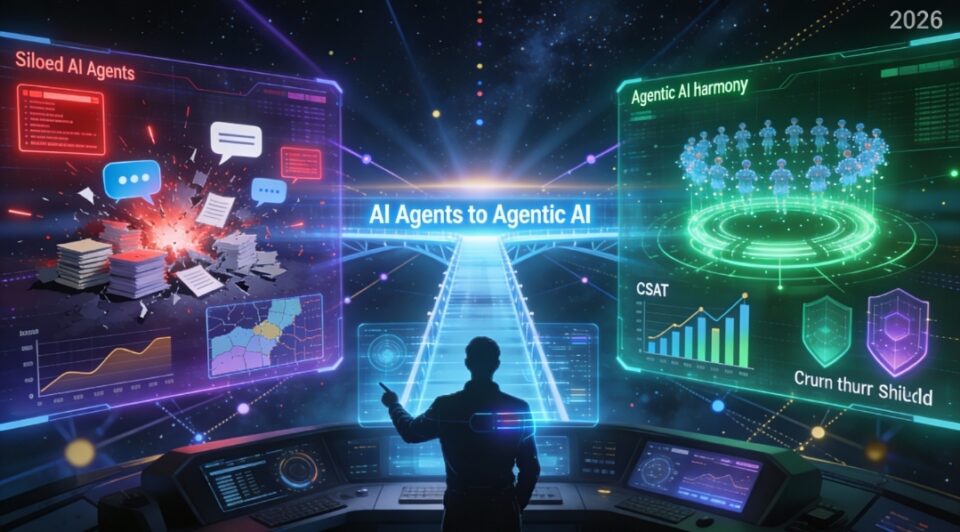
From AI Agents to Agentic AI: Transforming CX Workflows for 2026 Excellence
Picture this: CX leader Sarah stares at her dashboard at 2 AM. Siloed teams flood her inbox with alerts—chat support lags, marketing campaigns miss personalization, and fragmented journeys push CSAT below 70%. She wonders, “Can AI finally unify this chaos?” Agentic AI steps in as the evolution from basic agents, orchestrating autonomous workflows that predict, adapt, and deliver seamless experiences across silos.
What Are AI Agents, and Why Do CX Teams Still Rely on Them?
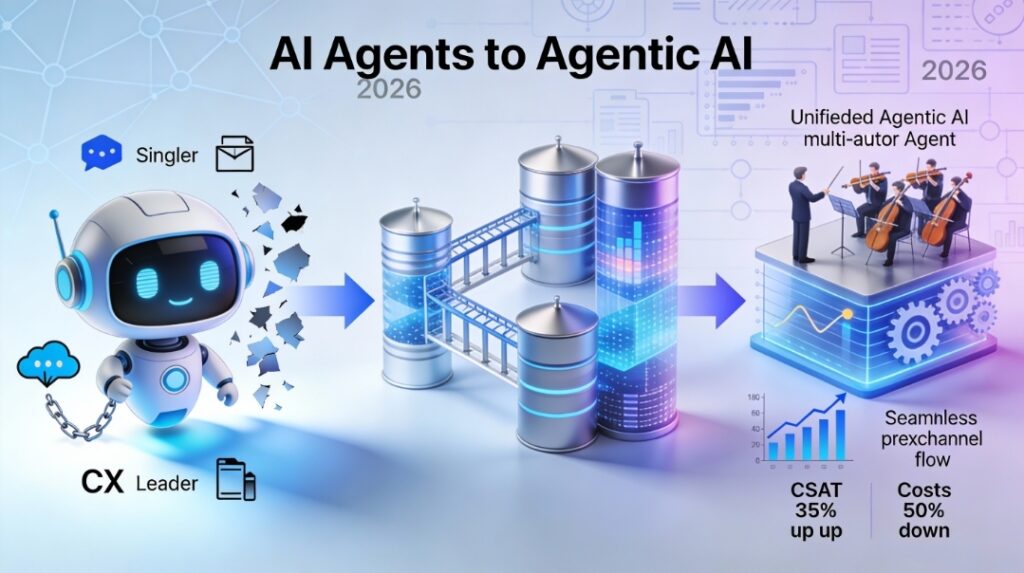
AI agents handle specific tasks like chat responses or ticket routing. They react within rules, boosting efficiency by 30% in routine support, yet they falter in complex journeys.
However, these single-purpose tools create gaps. Teams juggle multiple agents, leading to data silos and inconsistent experiences. Early adopters like Salesforce Agentforce IT Service automated ticketing, cutting resolution times by 40%. Still, without orchestration, they miss proactive insights. CXQuest.com analyses show 65% of leaders face integration hurdles here. Transition to agentic AI solves this by evolving agents into intelligent networks.
How Does Agentic AI Evolve from Traditional AI Agents?
Agentic AI builds autonomy on agent foundations, enabling goal-driven planning and multi-step execution. Unlike reactive agents, it anticipates needs, learns continuously, and coordinates across systems.
For instance, it pulls CRM data, predicts churn, and triggers retention campaigns autonomously. Reports show agentic systems unlock 2-3x productivity gains in CX operations. Real-world shifts appear in platforms like Zoho Agentic AI, which integrates 55+ apps for seamless workflows. CX leaders gain a “conductor” that unifies siloed efforts, reducing fragmentation by 50%. This evolution demands advanced LLMs and orchestration layers.
Why Do CX Leaders Face Siloed Teams with Basic AI Agents?
Siloed teams emerge because AI agents operate in isolation—support uses one tool, marketing another. This fragments customer journeys, inflating costs by 25%.
Moreover, AI gaps widen as agents lack context across channels. A bank’s support agent resolves billing but misses marketing’s upsell data. Result? Customers repeat issues, eroding trust. Experts note agentic AI automates micro-workflows like context gathering, freeing humans for strategy. CXQuest.com case studies reveal 70% of firms battle this, yet agentic platforms bridge gaps via unified data fabrics.
What Real-World Challenges Does Agentic AI Solve in CX?
Agentic AI tackles journey fragmentation by maintaining holistic views across touchpoints. It predicts escalations, routes intelligently, and personalizes at scale.
Consider a global apparel brand: Agentic recommendations blended weather data with browsing, lifting repeat purchases 40%. Healthcare providers send adaptive care plans, boosting adherence 35%. Challenges like inadequate infrastructure persist, but solutions include scalable APIs and governance frameworks. Siloed execution wastes resources—agentic AI enforces shared metrics for cohesion.
How Can CX Leaders Implement Agentic AI Frameworks?
Start with unified data layers. Map silos into real-time graphs using vector embeddings for instant insights.
Deploy intent-driven triage. Agents classify issues by impact, resolving 80% autonomously while escalating high-value cases.
Enable self-optimization. Monitor patterns, auto-scale resources, and refine models—cutting costs 40%.
Palo Alto Networks’ Cortex AgentiX governs AI workforces securely, integrating with CRMs seamlessly. Trend Micro’s Agentic SIEM uses digital twins for proactive threat detection in CX stacks. Follow this phased rollout:
- Pilot phase: Test on high-volume queues.
- Scale phase: Integrate omnichannel data.
- Optimize phase: Measure CSAT and ROI.
Key Insights from Top Brands Using Agentic AI
Top performers redefine CX through autonomy. Sutherland Global automates tedious tasks, enhancing agent capacity.
- Proactive retention: Spots churn signals, triggers personalized offers—reduces defection 25%.
- Hyper-personalization: Adapts financial advice in real-time for banks.
- Omnichannel continuity: Maintains context from chat to voice, lifting satisfaction 30%.
Enterprises cut agent load 50% via autonomous escalation. Solutions solve scalability by streamlining workflows across clouds. Unified layers ensure consistent brand voice everywhere.
| Challenge | AI Agents Limitation | Agentic AI Solution | Outcome Impact |
|---|---|---|---|
| Siloed Data | Isolated processing | Unified fabric, cross-references | 40% faster insights |
| Journey Fragmentation | Reactive responses | Predictive orchestration | 35% CSAT uplift |
| AI Capability Gaps | Rule-bound execution | Continuous learning loops | 2x productivity |
| Scalability Issues | Manual scaling | Auto-optimizing infrastructure | 50% cost reduction |
Common Pitfalls in Transitioning to Agentic AI
Fragmented execution traps teams. Product, IT, and legal chase separate goals, spawning shadow IT.
Avoid by aligning cross-functionally early. Siloed AI centers hinder scaling—integrate with core IT from day one.
Cultural resistance slows adoption. Employees fear job loss; leaders doubt ROI.
Counter with change management: Share case studies, pilot inclusively, and communicate augmentation benefits. Leadership commitment builds trust.
Inadequate infrastructure stalls progress. Legacy systems block agentic flows.
Invest in agent-ready platforms pre-scale. Governance tools provide safe deployment.
Expert Quotes on Agentic AI’s CX Impact
“The biggest impact? Automating repetitive CX micro-workflows for faster outcomes.”
“Agentic AI turns data overload into actionable intelligence.”
“From analysis paralysis to proactive strategy.” – CXQuest.com synthesis of enterprise shifts.
Resolution before escalation preserves empathy at scale.
Actionable Frameworks for 2026 CX Excellence
Agentic Maturity Model:
- Reactive Agents: Automate basics (chat, tickets).
- Coordinated Networks: Link agents for workflows.
- Fully Agentic: Autonomous goal pursuit.
Use this to benchmark progress. Pilots yield mastery.
FAQ
What separates AI agents from agentic AI in CX workflows?
AI agents execute predefined tasks reactively; agentic AI plans autonomously, adapts goals, and orchestrates multi-agent systems for end-to-end journeys—ideal for fragmented CX.
How does agentic AI fix siloed teams in customer experience?
It creates unified intelligence layers, auto-mapping data across CRM, ERP, and support tools, enabling shared insights and reducing silos by 50% through real-time collaboration.
What are real 2025 case studies of agentic AI in CX transformation?
Apparel brands saw 40% repeat purchase lifts via weather-personalized recommendations; banks gained 35% adherence with adaptive plans—proving proactive orchestration drives ROI.
Can CX leaders integrate agentic AI without ripping out legacy systems?
Yes, platforms like Cortex AgentiX and Zoho offer seamless CRM/ticketing hooks, starting with pilots on high-impact queues for quick wins and low disruption.
What ROI can enterprises expect from agentic AI adoption?
Expect 2-3x productivity, 40% cost cuts, and 30% CSAT gains through automation of micro-tasks and predictive retention.
How to overcome cultural resistance to agentic AI in CX teams?
Launch inclusive pilots, share augmentation case studies, set clear metrics, and secure leadership buy-in—transforming fear into enthusiasm for human-AI synergy.
Actionable Takeaways
- Audit silos now: Map data flows across teams; identify top fragmentation points.
- Pilot one workflow: Deploy agentic triage on support queues for 30-day CSAT test.
- Build data fabric: Integrate CRM/ERP with vector embeddings for instant context.
- Align cross-functions: Form AI governance council with CX, IT, legal reps.
- Measure agentic ROI: Track resolution time, churn reduction, agent capacity gains.
- Scale with governance: Use platforms for secure rollout.
- Train for augmentation: Upskill teams on oversight, not replacement.
- Iterate quarterly: Refine models via feedback loops for continuous evolution.
Agentic AI propels CXQuest.com readers from reactive fixes to proactive mastery. Embrace the shift—your 2026 workflows await transformation.
