

Tenable Hexa AI and the Shift Toward Autonomous Security Operations
The introduction of Tenable Hexa AI marks a critical inflection point in how enterprises approach cybersecurity—and more importantly, how they deliver consistent, reliable customer experiences in an increasingly volatile digital environment.
For years, organizations have invested heavily in visibility—tools that identify vulnerabilities, map attack surfaces, and generate alerts. Yet the operational gap between detection and remediation has persisted. In today’s threat landscape, that gap is no longer tolerable.
AI-powered attacks, rapid vulnerability discovery, and expanding digital ecosystems have compressed the response window to near zero. Enterprises are now operating in an environment where delays are not just technical inefficiencies—they are business risks with direct customer impact.
Tenable Hexa AI is positioned to address this gap by enabling organizations to move from insight to coordinated, automated action.
“The real challenge is no longer knowing what’s wrong—it’s acting on it fast enough to matter.”
Security as a Customer Experience Imperative
Customer expectations have evolved beyond functionality and convenience. Reliability, continuity, and trust are now baseline expectations.
When systems fail, customers do not differentiate between a technical issue and a service failure—they experience both as a breakdown in trust. Whether it’s an outage, latency issue, or data exposure risk, the consequences are immediate and visible.
At the same time, enterprise environments have become significantly more complex. Hybrid infrastructures, cloud-native architectures, AI-driven applications, and interconnected systems have expanded the attack surface exponentially.
Security teams are expected to manage this complexity while maintaining operational efficiency and ensuring minimal disruption to customer-facing services.
This is where traditional approaches fall short.
“When response times lag behind threat speeds, customer trust becomes collateral damage.”
Strategic Intent: Closing the Execution Gap
With Tenable Hexa AI, Tenable is making a deliberate move to reposition itself from a provider of exposure insights to an orchestrator of security outcomes.
This reflects a broader industry shift. Enterprises no longer need more alerts—they need systems that can interpret, prioritize, and act on those alerts in real time.
The strategic intent here is clear: own the execution layer of security operations.
By embedding agentic AI into its platform, Tenable is addressing a critical bottleneck in enterprise security—the inability to scale remediation efforts at the same pace as threat detection.
Eric Doerr, Chief Product Officer at Tenable, highlights the urgency of this transition, noting that the window between vulnerability discovery and exploitation has effectively disappeared.
“In a machine-speed threat environment, execution is the only defensible advantage.”
This positions Tenable Hexa AI as both a defensive necessity and an offensive differentiator in the exposure management market.
How Tenable Hexa AI Works
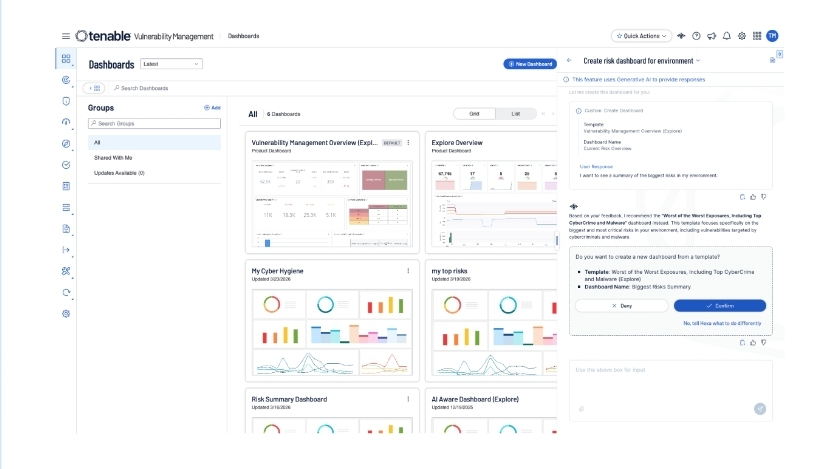
At a functional level, Tenable Hexa AI operates as an orchestration engine within the Tenable One Exposure Management Platform.
Its foundation is the Exposure Data Fabric—a unified layer that aggregates and contextualizes data across vulnerabilities, assets, identities, configurations, and AI systems. This provides a holistic view of the attack surface and enables more accurate prioritization.
What differentiates the solution is its agentic architecture.
Rather than simply generating alerts, Tenable Hexa AI coordinates multiple agents—both prebuilt and custom—to execute multi-step workflows. These workflows can:
- Validate the relevance of a detected exposure
- Identify impacted systems and dependencies
- Initiate remediation actions
- Update system states and records
This orchestration happens across domains, including IT, cloud, identity, OT, and AI environments.
Importantly, the system incorporates human-in-the-loop controls, ensuring that automation operates within defined governance frameworks.
“Automation without context creates noise; orchestration with context creates outcomes.”
This shift from isolated tools to coordinated execution represents a fundamental change in how security operations are conducted.
Translating Security Operations into CX Outcomes
While Tenable Hexa AI operates within the security domain, its implications extend directly into customer experience.
First, speed. Faster remediation reduces the likelihood of service disruptions. Vulnerabilities are addressed before they can impact customer-facing systems, improving uptime and reliability.
Second, prioritization. By leveraging contextual data, the system ensures that risks affecting critical services are addressed first. This aligns operational decisions with customer impact.
Third, consistency. Automated workflows standardize responses, reducing variability and ensuring predictable outcomes across incidents.
Fourth, efficiency. By automating routine tasks, security teams can focus on high-value activities such as threat analysis and strategic risk management.
A practical example illustrates this impact. A user reported reclaiming two days per month from a single process due to automation. That time is reinvested in proactive risk reduction—activities that directly enhance system stability and customer trust.
“Every hour saved in operations is an hour reinvested in customer reliability.”
In effect, Tenable Hexa AI strengthens the invisible layer of CX—ensuring that systems are stable, secure, and consistently available.
Industry-Wide Implications
The introduction of Tenable Hexa AI reflects a broader transition toward agentic AI in enterprise operations.
Organizations are moving beyond AI-assisted insights to AI-driven execution. This shift is redefining expectations for enterprise platforms. The benchmark is no longer visibility—it is action.
Competitors in the exposure management and cybersecurity space will need to accelerate their own capabilities in orchestration and automation. The ability to integrate across domains and execute workflows autonomously will become a baseline expectation.
At a structural level, security platforms are evolving into control layers that unify data, intelligence, and execution.
“The future of enterprise security is not reactive or predictive—it is autonomous.”
This transformation has implications not only for technology adoption but also for governance, compliance, and organizational design.
Future Outlook: Autonomous, Context-Aware CX Infrastructure
Looking ahead, the trajectory is clear. Security operations will become increasingly autonomous, operating at machine speed with human oversight.
For CX leaders, this evolution introduces both opportunities and challenges.
On one hand, automation enables faster recovery times, improved reliability, and more consistent service delivery. These are critical components of modern customer experience.
On the other hand, increased automation requires robust governance frameworks to ensure that decisions made by AI systems align with customer expectations, regulatory requirements, and organizational policies.
Tenable Hexa AI represents an early step in this direction—demonstrating how agentic AI can bridge the gap between insight and execution.
“As systems become autonomous, trust will depend on how well they align with human expectations.”
Ultimately, the convergence of security and CX will become more pronounced. Reliability, resilience, and trust will no longer be backend metrics—they will be core components of the customer journey.
Organizations that recognize this shift—and invest accordingly—will be better positioned to deliver consistent, high-quality experiences in an increasingly complex digital landscape.
Key Takeaways
- Execution is the new differentiator in security: Identifying risks is no longer enough—organizations must, in fact, resolve them at machine speed.
- Security is now a core CX driver: Reliability and trust are shaped by how effectively enterprises manage cyber risk.
- Agentic AI is redefining operations: Autonomous orchestration reduces latency, improves consistency, and scales remediation efforts.
- Contextual intelligence enables smarter prioritization: Connecting risk to business impact ensures customer-facing systems are protected first.
- Automation must be balanced with governance: Human oversight remains essential to align AI-driven actions with customer and regulatory expectations.
