
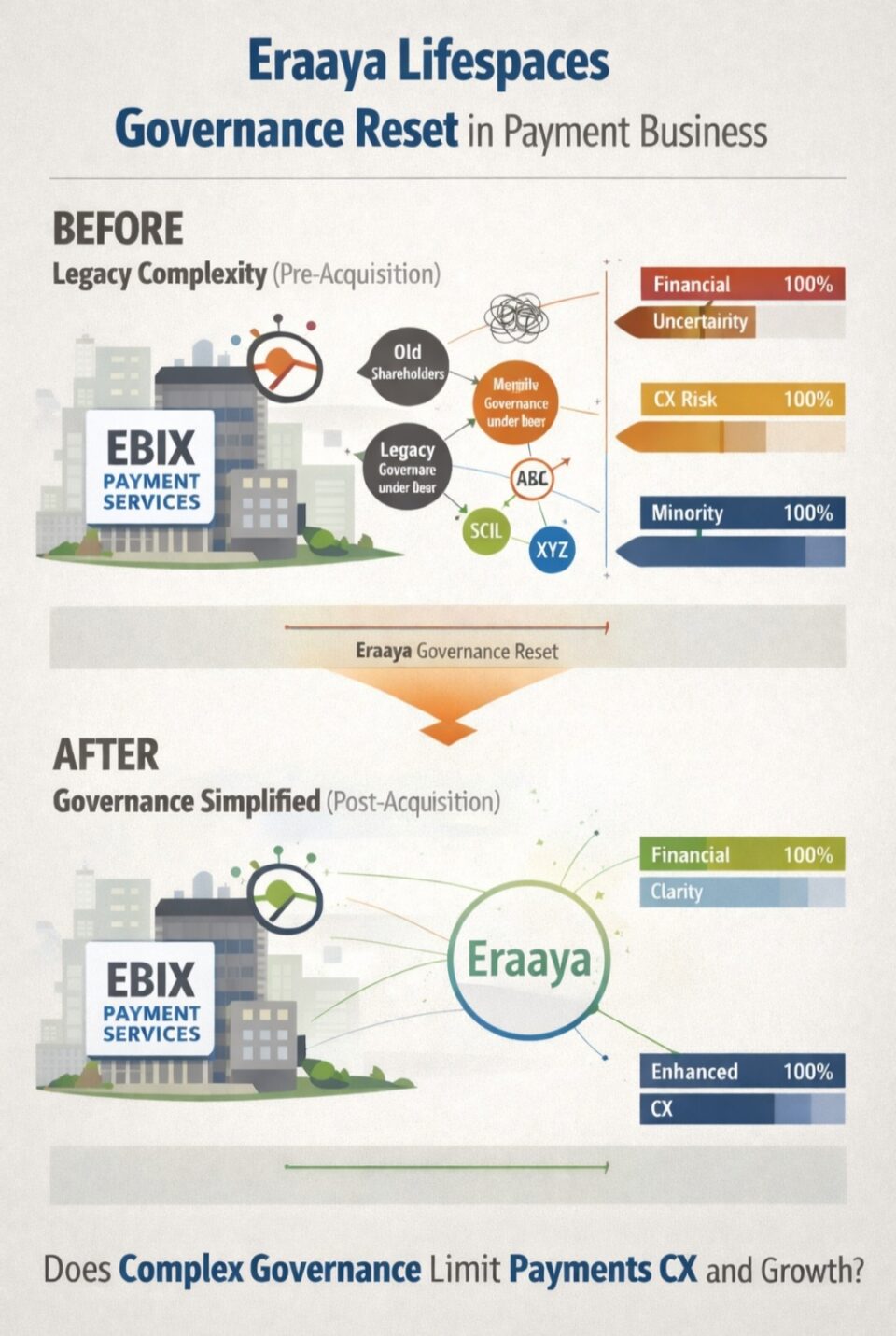
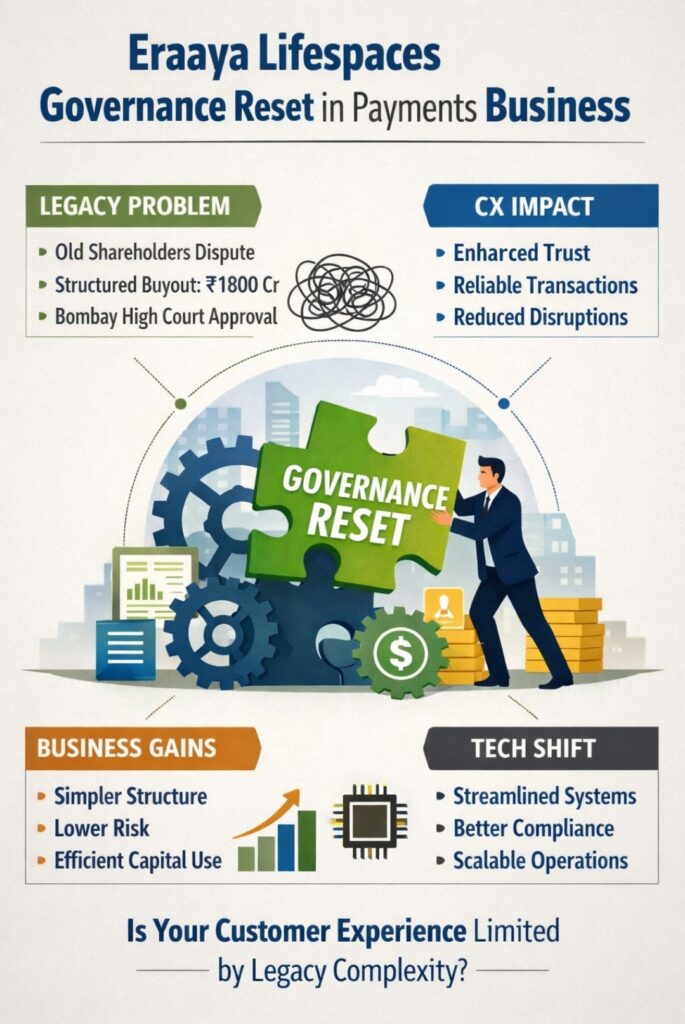
The Eraaya Lifespaces governance reset in payments business is not just a regulatory disclosure—it is a structural inflection point that redefines how customer experience is engineered in fintech ecosystems. Following its acquisition of Ebix Inc, Eraaya Lifespaces Limited has moved to eliminate a long-standing shareholder issue within Ebix Payment Services Private Limited, with approval from the Bombay High Court.
“…a long-standing shareholder matter… has been conclusively resolved…” — Arun Batra, Director, Eraaya Lifespaces Limited
This move signals something deeper: experience reliability in payments is rooted in structural clarity—not just technology layers.
Why Eraaya Lifespaces Governance Reset in Payments Business Matters Now
The payments industry is undergoing a silent but critical shift. Customer expectations are no longer limited to speed—they now demand certainty, transparency, and uninterrupted trust.
Legacy ownership structures—especially in acquired entities—create invisible friction:
- Settlement delays
- Compliance ambiguity
- Capital inefficiencies
“…eliminating uncertainty, simplifying the group structure…” — Arun Batra, Director, Eraaya Lifespaces Limited
This becomes critical when platforms like ItzCash operate at scale. The deeper implication is unavoidable:
Customer experience failures often originate from governance complexity—not UI gaps.
From Legacy Burden to Strategic Clarity
At a structural level, the Eraaya Lifespaces governance reset in payments business represents a decisive break from traditional post-acquisition inertia.
Historically, companies:
- Deferred legacy issue resolution
- Ring-fenced liabilities
- Accepted structural inefficiency as a cost
Eraaya has taken the opposite route.
“…a considered and decisive call to resolve the matter in entirety…” — Arun Batra, Director, Eraaya Lifespaces Limited
Strategically, this indicates a shift toward ownership accountability and capital discipline, where complexity is not managed—it is eliminated.
This is where the shift occurs:
Governance transitions from compliance overhead to CX infrastructure.
Competition: Redefining the Benchmark for Integration
Most fintech players fall into predictable patterns:
- Global players delay cleanup due to scale complexity
- Regional players operate within fragmented structures
- Emerging players avoid acquisitions altogether
The Eraaya Lifespaces governance reset in payments business disrupts this pattern.
By absorbing a ₹1,800 crore settlement obligation that was not part of the original acquisition construct, Eraaya signals a new integration philosophy:
Speed of cleanup = Speed of CX stabilization
This positions Eraaya ahead in:
- Integration maturity
- Risk normalization
- Experience consistency
Technology: The Invisible Constraint Layer
While governance actions may appear non-technical, their impact is deeply embedded in system performance.
Payments infrastructure—especially within ecosystems like ItzCash—relies on:
- Real-time processing engines
- Settlement orchestration layers
- Compliance automation systems
“…enhance operational flexibility within the payments business…” — Arun Batra, Director, Eraaya Lifespaces Limited
Operationally, this translates to:
- Faster reconciliation
- Reduced system friction
- Improved API reliability
The deeper implication is critical:
Technology scalability is impossible without structural clarity.
CX Impact: Trust Engineered Through Structure
From a CX standpoint, the Eraaya Lifespaces governance reset in payments business delivers multi-layered impact:
Customer Layer
- Higher transaction reliability
- Reduced service uncertainty
- Strengthened trust perception
Business Layer
- Cleaner balance sheet
- Optimized capital deployment
- Reduced operational risk
System Layer
- Simplified architecture
- Improved processing efficiency
- Lower compliance overhead
“…stability, transparency and long-term value creation…” — Arun Batra, Director, Eraaya Lifespaces Limited
This becomes critical in payments, where trust is not built through branding—it is delivered through consistency.
Maturity Shift: From Operational Fixes to Structural CX
Eraaya’s approach signals a transition into advanced CX maturity, where backend governance decisions directly shape frontend experience outcomes.
“…enhancing institutional quality and reducing structural complexity…” — Arun Batra, Director, Eraaya Lifespaces Limited
At this level, organizations:
- Eliminate friction at the source
- Align capital with experience outcomes
- Design systems for scalability from the core
Decision Intelligence: Paying for Clarity
The ₹1,800 million settlement is not merely a financial event—it is a strategic decision.
Eraaya has effectively chosen:
- Short-term financial outflow
over - Long-term operational drag
“…disciplined and forward-looking capital allocation…” — Arun Batra, Director, Eraaya Lifespaces Limited
This becomes a defining leadership signal:
Clarity is treated as an investment, not a cost.
Industry Implications: Governance Becomes Competitive Advantage
The Eraaya Lifespaces governance reset in payments business sets off a ripple effect across fintech:
- Competitors will face pressure to resolve legacy complexities
- Regulators may tighten expectations on structural transparency
- Investors will begin pricing governance quality into valuations
The deeper implication is profound:
Governance is no longer a hygiene factor—it is a differentiator in CX delivery.
The Road Ahead: Building a Clean, Scalable Payments Engine
With this resolution, Eraaya is repositioning itself as a structurally simplified, execution-focused fintech platform.
“…a cleaner and more agile platform for future strategic initiatives…” — Arun Batra, Director, Eraaya Lifespaces Limited
This creates a foundation for:
- Faster expansion
- Scalable innovation
- Sustainable CX delivery
Final Takeaways
- The Eraaya Lifespaces governance reset in payments business reframes CX as a structural outcome
- Legacy complexity is a hidden but critical CX risk
- Governance discipline directly impacts scalability and trust
The question for industry leaders is direct:
Are you optimizing customer experience—or still managing structural complexity?
