

Chat360 and Meta Partnership Ushers in a New Era for Voice-Driven CX on WhatsApp
In today’s fast-paced digital world, customers don’t just want to be heard—they expect to speak and be understood instantly. From banking to healthcare and retail to travel, one common challenge unites customer experience (CX) teams globally: reducing friction in customer communication. Despite automation and chat-driven convenience, there’s still one human element customers crave—voice interaction that feels natural, immediate, and empathetic.
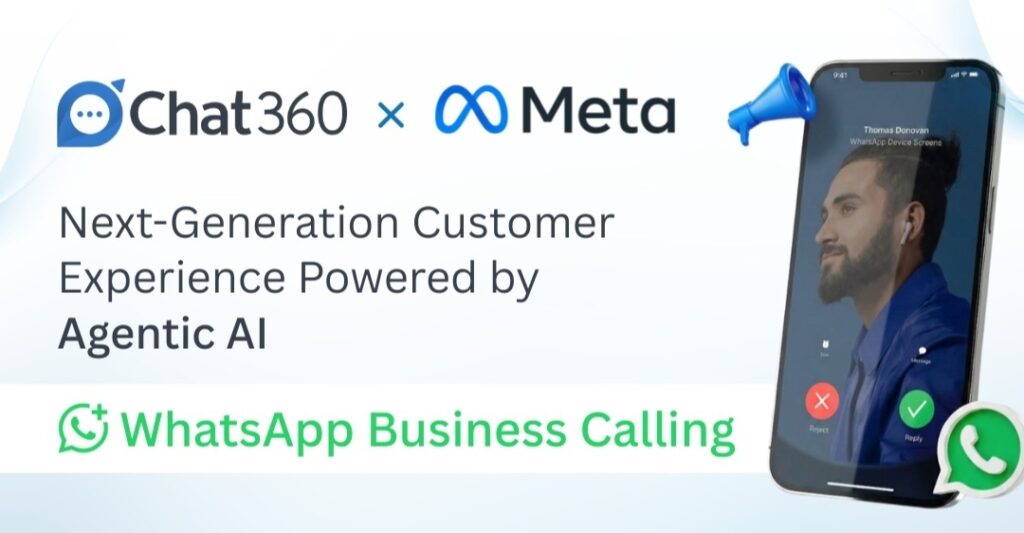
Now imagine bringing that human touch to the world’s most widely used messaging app. Chat360’s new partnership with Meta does exactly that. This integration enables enterprises to provide WhatsApp Business Voice Calling—marrying the speed of chat with the familiarity of voice—to transform conversational CX from reactive support to proactive engagement.
The Evolving Landscape of Conversational CX
Customer interactions have rapidly shifted from traditional call centers to conversational platforms powered by AI and automation. According to recent data from Meta and internal survey benchmarks, WhatsApp hosts over 2 billion active users monthly, with nearly 175 million users messaging a business every day. Those numbers tell a clear story: customers live on WhatsApp, and businesses must keep up.
But while text-based service has scaled efficiently, it doesn’t always capture emotion, clarity, or urgency. “A typed message can solve a query, but a voice call can win a customer’s trust,” says Sunnyraj Agarwal, Founder & CEO, Chat360. With this partnership, businesses can now integrate real-time voice conversations into their existing chat workflows—bridging a critical gap in omnichannel service design.
Why Voice Still Matters in a Digital-First CX World
Voice channels continue to play a vital role in high-stakes or emotionally driven interactions. Think of a distressed banking customer reporting fraud, a parent confirming a medical appointment, or a traveler rebooking a flight. In each case, tone, empathy, and reassurance matter just as much as resolution time.
Voice also builds deeper contextual understanding. With tone and sentiment analysis, AI can detect urgency cues, emotion weights, and conversation intent more accurately. Chat360’s integration uses Agentic AI and NLP to route these calls intelligently, ensuring that customers reach human or bot agents best suited to solve their issue.
The result: higher first-contact resolution (FCR) and more personalized post-call experiences informed by unified data across channels.
Bringing Omnichannel to Life: Voice Inside WhatsApp
The integration of WhatsApp Business Voice Calling within Chat360’s unified conversational platform unlocks several new capabilities for enterprises. Beyond simple chatbots or IVR systems, it offers converged communication experiences—where customers can interact seamlessly through chat, voice, or both, without leaving their preferred app.
Key benefits include:
- Real-time issue resolution: Voice-enabled calls let customers clarify complex problems instantly, improving satisfaction and decreasing ticket volume.
- AI-enhanced efficiency: Agentic AI assists in routing calls, contextual handovers, and predictive support using customer intent.
- Integrated data streams: Call logs, ticket history, and CRM data synchronize automatically, eliminating data silos.
- Lead conversion via voice: WhatsApp campaigns can trigger immediate sales calls, increasing conversions in retail and BFSI sectors.
- Multi-language voice experiences: Enterprises can localize conversations across markets—vital for India’s multilingual audiences and global customer bases.
For CX leaders, this marks a major leap toward “channel-less” service—where customers freely transition between text, voice, and automation, without ever losing continuity.
Use Cases Across Key Industries
1. Retail and eCommerce:
Imagine a customer browsing a brand’s WhatsApp catalog and getting a voice callback for instant product consultation. Personalized conversations close sales faster, while integrated analytics help track engagement and conversion metrics.
2. BFSI:
Banks and insurers can handle KYC verifications, policy renewals, or fraud clarifications securely within WhatsApp. The elimination of third-party calling tools enhances compliance and trust.
3. Healthcare:
Hospitals and clinics can connect patients directly with staff via verified WhatsApp calls, automating appointment confirmations and providing real-time health guidance.
4. Real Estate:
Instant voice calls convert browsing prospects into qualified leads. Agents can guide potential buyers or renters over WhatsApp while sharing listings or images in parallel.
5. Education and Travel:
Institutions and agencies can use integrated calling for enrollment support or fare assistance, maintaining 24/7 voice response without heavy infrastructure costs.
These scenarios showcase why voice-in-messaging is fast becoming the next frontier of customer engagement.
AI and Agentic Automation: The Behind-the-Scenes Catalyst
At the heart of this innovation lies Chat360’s Agentic AI, which blends automation with adaptive decision-making. Agentic AI moves beyond static chatbot flows—it “understands” context, learns from outcomes, and collaborates with human agents when needed.
In practical terms, this means:
- Smart routing: AI directs calls based on intent, customer type, and agent expertise.
- Automated follow-ups: After each voice chat, AI can share relevant links, payment prompts, or updates automatically.
- Sentiment sensing: Voice tone and speech analytics enable dynamic escalation to live agents when customers sound dissatisfied or stressed.
- Unified analytics: Enterprises see combined insights—voice, chat, and text interactions integrated in one dashboard.
This synergy between voice, automation, and intelligence enhances both Efficiency Metrics (AHT, CSAT, FCR) and Experience Metrics (NPS, CES)—cornerstones of modern CX measurement.
A Seamless Path to Enterprise Deployment
One of Chat360’s strongest differentiators is accessibility. Implementation requires no technical expertise, thanks to its low-code platform and out-of-the-box integrations with CRMs, help desks, and ecommerce platforms. This matters because many CX leaders cite IT dependencies as a primary obstacle in digital transformation.
Deployment of WhatsApp Voice Calling follows Chat360’s hallmark promise: fast, frictionless, compliant. Enterprises retain full control of infrastructure security through Meta’s approved WhatsApp Business API, ensuring compliance with international standards such as ISO 27001 and GDPR.
For globally distributed operations, Chat360’s multilingual voice framework also adapts seamlessly—localizing speech recognition and AI responses based on geography. It’s a global solution designed with local nuance in mind.
Expert View: Bridging Conversational Commerce and Care
The convergence of voice, messaging, and AI is reshaping both customer service and commerce. As Agarwal notes, “WhatsApp is no longer just a chat tool—it’s becoming the world’s largest digital storefront and service desk combined. By adding voice, enterprises can now replicate in-store personalization within digital channels.”
This perspective aligns with industry trends: conversational commerce is projected to surpass $130 billion in global transaction value by 2028. The brands that thrive will be those that merge automation efficiency with human authenticity—precisely what Chat360’s Meta partnership aims to deliver.
The Broader CX Impact: From Speed to Empathy
Modern CX is moving beyond being “fast” to being emotionally intelligent. In practice, enterprises must weave empathy into every interaction—whether it’s an automated response or a live voice exchange.
WhatsApp Voice Calling through Chat360 enables precisely that balance. AI ensures efficiency by automating routine engagement, while the integrated voice channel allows human interactions when it matters most. The outcome: responsive, contextual, and emotionally resonant customer journeys.
Moreover, every interaction—voice or text—feeds data back into enterprise systems. Over time, this builds predictive models that anticipate customer needs, personalize outreach, and even prevent churn. Voice becomes not just a medium but a CX intelligence layer.
Actionable Insights for CX Leaders
For organizations striving to advance their CX and EX strategies through conversational AI, the Chat360-Meta launch offers critical takeaways:
- Adopt a hybrid service model. Combine automated chat for routine tasks with voice escalation for high-value or emotional interactions.
- Centralize conversation data. Treat voice calls, chats, and tickets as part of one continuous journey for analytics and personalization.
- Train AI on emotion and context. Incorporate sentiment analysis and tone detection into your conversational design to build empathy at scale.
- Empower agents through augmentation. Use AI to surface insights and scripts during live calls—turning every agent into a “super agent.”
- Localize and scale. Personalize voice workflows to linguistic and cultural nuances to strengthen brand trust in diverse markets.
- Measure with purpose. Track both operational (AHT, FCR) and emotional (NPS, CES) metrics to evaluate impact holistically.
By following these steps, enterprises can evolve from reactive communication silos to fluid, intelligent ecosystems that meet customers wherever they are—literally, in their pockets.
A New Chapter in Conversational CX
The partnership between Chat360 and Meta signals a pivotal shift. Voice is no longer an isolated legacy channel—it’s now an embedded part of the omnichannel narrative. As WhatsApp Voice Calling enters the enterprise mainstream, CX leaders have a rare opportunity to create experiences that are efficient and human in equal measure.
In essence, the future of customer experience isn’t about replacing humans with AI—it’s about letting technology extend human connection. And for enterprises worldwide, this partnership represents exactly that: a smarter, more empathetic way to speak with customers at scale.
