
VergeOS 26.2: Can a VMware Exit Simplify Enterprise Operations?
VergeOS 26.2 is VergeIO’s infrastructure software release designed to accelerate VMware migration, support Microsoft Failover Clustering on VergeFS, and simplify infrastructure at remote sites. Its claimed 120% migration speed improvement and broader workload support could remove migration barriers, but enterprises must validate resilience, compatibility, total cost of ownership, and operational readiness before committing.
VergeOS 26.2 Targets the Workloads That Can Stall a VMware Exit
Leaving VMware is not simply a matter of moving virtual machines to another hypervisor. Enterprises must preserve application availability, maintain data integrity, accommodate existing storage dependencies, and ensure that business-critical services continue to operate throughout migration.
VergeOS 26.2 addresses three obstacles in this process: migration transfer performance, shared-storage support for mission-critical Windows workloads, and infrastructure requirements at distributed locations. VergeIO says the release is available immediately.
The announcement matters because infrastructure migration is ultimately a business continuity exercise. A delayed cutover can extend project costs, while an architectural gap can force an enterprise to retain legacy infrastructure alongside its replacement.
For customer-facing organizations, the consequences can extend beyond the data center. Retail transactions, customer service platforms, financial applications, and order-processing systems depend on reliable underlying infrastructure. Any migration strategy that introduces avoidable complexity can increase operational risk.
However, a feature announcement is not evidence of a successful enterprise migration. The central question is whether the new capabilities deliver measurable improvements under production conditions.
Why VMware Migration Has Become an Operating-Model Decision
Infrastructure decisions have become more complicated as enterprises reconsider their virtualization strategies, licensing commitments, hardware lifecycles, and operating costs. Recent reporting on a survey of VMware users highlights a gap between organizations considering an exit and those prepared to replace the platform completely. The transition is often gradual rather than a single, decisive migration. Express Computer’s coverage of the survey.
This distinction is important. Enterprises may be able to migrate conventional virtual machines relatively easily while retaining dependencies that complicate the remaining workloads. Shared storage, application clustering, specialized integrations, backup arrangements, and recovery requirements can determine whether the final phase proceeds.
The traditional response is to assemble additional infrastructure or maintain a mixed environment. That can preserve application compatibility, but it can also create parallel administration, separate support relationships, additional licensing, and more complicated recovery procedures.
For customers, these are not merely internal IT concerns. The operational consequences may include longer service interruptions, slower incident resolution, or reduced capacity to introduce new digital services.
A VMware exit should therefore be assessed against the entire operating model: the infrastructure being removed, the capabilities being replaced, the skills required to operate the destination, and the service risks introduced during transition.
The strategic opportunity is not simply a lower virtualization bill. It is a simpler, supportable infrastructure that meets business requirements without creating a new set of dependencies.
VergeOS 26.2 Changes the Migration Performance Equation
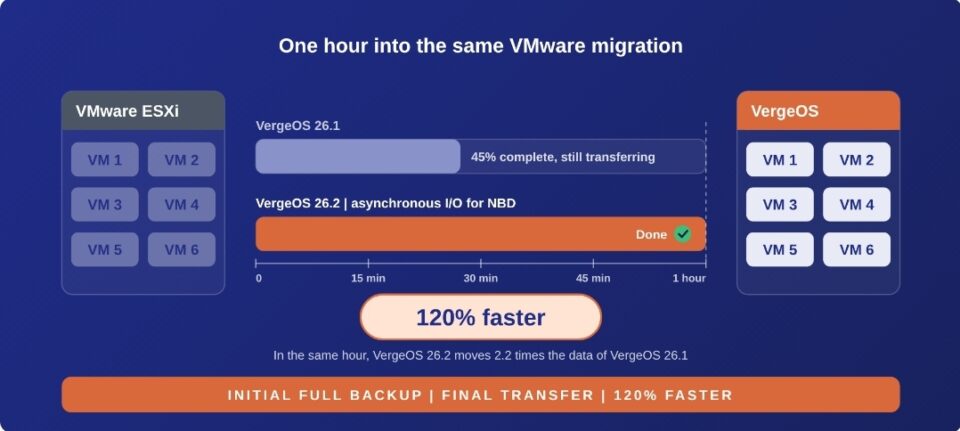
VergeIO says the new release introduces asynchronous I/O into its network block device transfers. The change accelerates both the initial full backup and the final transfer in its VMware migration service.
The company claims that these transfers are 120% faster than in VergeOS 26.1. Its supplied comparison illustrates the same workload after one hour: VergeOS 26.2 has completed the transfer, while VergeOS 26.1 has progressed approximately 45% of the way through. VergeIO describes the resulting throughput difference as 2.2 times.
The distinction between transfer speed and migration duration matters. Faster data movement can shorten a migration window, but total migration time also depends on workload size, change rates, network throughput, storage performance, validation, application dependencies, and cutover procedures.
Initial transfer performance affects how quickly a workload can be copied while production continues. The final transfer is particularly important because it helps synchronize changes before the workload moves to its destination. Reducing this phase may make scheduling easier and lower the operational exposure associated with cutover.
Nevertheless, the 120% figure remains a vendor-reported result. The supplied material does not establish independent testing, the complete benchmark methodology, the hardware configuration, or how performance changes across different workload profiles.
Enterprise buyers should request reproducible measurements using representative production workloads. They should also compare the duration of the full migration process, not just the data-transfer component.
The business case becomes stronger when a shorter cutover translates into less downtime, fewer after-hours engineering hours, lower migration-service costs, or a reduced need to maintain parallel environments.
Microsoft Failover Clustering Could Remove a Critical Migration Barrier
One of the more consequential changes in VergeOS 26.2 is support for Microsoft Failover Clustering on VergeFS.
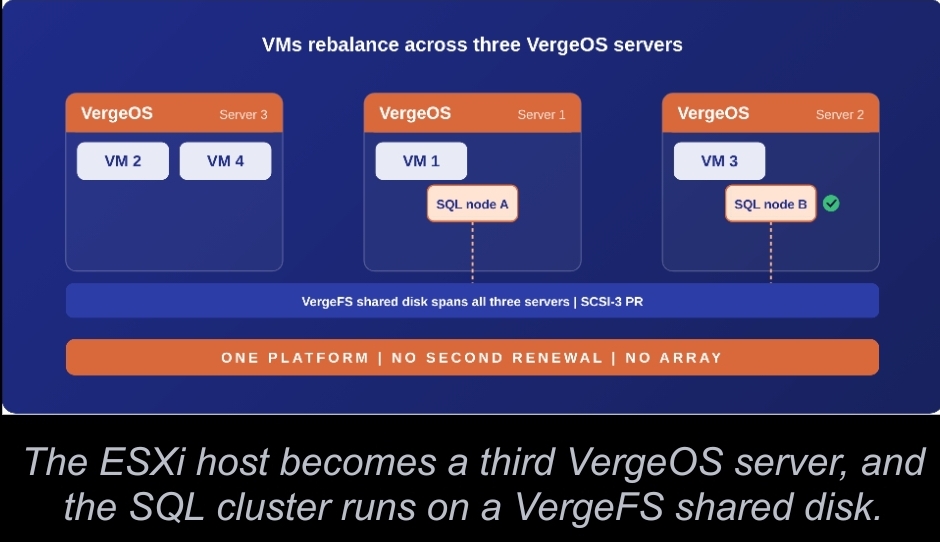
Microsoft SQL Server deployments often use failover clustering to support application availability. Such configurations require shared-disk access and SCSI-3 Persistent Reservations. These mechanisms help coordinate access to shared storage between cluster nodes.
VergeIO says these capabilities can now operate within VergeFS, its internal storage layer, which aggregates commodity drives across servers. The company argues that this can remove the need for a dedicated storage array or a second hypervisor in the relevant configurations.
The strategic significance is straightforward: a migration destination becomes more useful when it supports workloads that would otherwise remain behind.
A company may migrate general-purpose virtual machines while keeping its SQL Server infrastructure on VMware because the replacement environment does not meet the application’s clustering requirements. Maintaining two platforms can dilute the benefits of migration and prolong the need for legacy expertise.
However, protocol support alone does not establish production equivalence. Buyers must verify supported Windows Server and SQL Server versions, cluster configurations, storage behavior during failures, and the operational procedures required for recovery.
They should also test node loss, storage-path disruption, network partitioning, and recovery after a failed migration. Application-level consistency and recovery objectives must remain intact.
The CX implication is indirect but important. Where SQL Server supports order management, customer records, billing, or service applications, infrastructure resilience contributes to service continuity. The platform must demonstrate that resilience in the enterprise’s own architecture.
Distributed Data Centers: Less Infrastructure, More Responsibility
VergeIO also says VergeOS 26.2 enables certain distributed sites to operate with one server and two network connections, without a core network.
The intended environments include remote locations such as retail sites that replicate data to a central VergeOS deployment. Reducing local infrastructure requirements could make it easier to include smaller locations in a wider VMware exit.
This is relevant to organizations with many branches, stores, or remote operating facilities. A centralized technology strategy can become difficult to execute when each location requires a different infrastructure footprint or specialized support arrangements.
A smaller local footprint could reduce hardware requirements and simplify deployment. Standardizing operations across central and remote environments could also help IT teams manage distributed infrastructure more consistently.
Yet a single-server design creates questions that a feature list cannot answer. What happens if the server fails? Which workloads can be restored remotely, and how quickly? What happens when the site loses connectivity? Can the location continue essential operations independently, and how is data reconciled after recovery?
These questions are especially important where a remote location supports transactions or time-sensitive customer services.
A smaller footprint should not be confused with greater resilience. Enterprises must evaluate the complete failure model, including local recovery, data replication, network dependencies, and the consequences of losing the only server at a site.
The right architecture depends on the business impact of an outage, not simply the number of servers required.
The Competitive Question Is Architectural Fit, Not Feature Count
VergeIO operates in a market with several distinct VMware replacement approaches. TechnologyMatch’s 2026 comparison identifies options including Nutanix AHV, Microsoft Hyper-V, Red Hat OpenShift Virtualization, Proxmox VE, and VergeOS.
These platforms do not all solve the same problem in the same way. Some buyers want a conventional virtualization replacement. Others want an integrated hyperconverged infrastructure platform, an open-source approach, a Microsoft-aligned environment, or a broader application modernization strategy.
VergeIO’s proposition is to consolidate infrastructure capabilities within one software platform running on existing servers. Its differentiation therefore needs to be assessed across virtualization, storage, networking, data protection, migration tooling, and distributed operations—not just hypervisor performance.
A useful comparison has three levels.
Level 1: Workload compatibility. Can the alternative run the organization’s existing applications, clustering configurations, operating systems, and integrations?
Level 2: Infrastructure consolidation. Can it reduce the number of products, management interfaces, support relationships, and infrastructure components that the organization must operate?
Level 3: Business operating model. Does the new environment improve total cost of ownership, service reliability, change velocity, recovery performance, and the team’s ability to support customer-facing workloads?
VergeOS 26.2 adds capabilities relevant to the first two levels. Whether it delivers superior business outcomes at the third level requires comparative evidence.
An enterprise should benchmark shortlisted platforms using identical workload requirements, service-level objectives, hardware assumptions, migration scenarios, and three-to-five-year cost models. A feature matrix alone is insufficient.
From Infrastructure Consolidation to Customer Experience
Infrastructure does not create a good customer experience by itself. It establishes the conditions under which customer-facing applications can operate reliably, respond consistently, and recover when something fails.
For a retailer, this may mean keeping point-of-sale and inventory services operational across distributed locations. For a financial services organization, it may mean protecting transaction processing and customer records. For a contact center, it may mean preserving the availability of applications that agents depend on to resolve customer issues.
VergeIO’s release could help such organizations if it reduces migration friction and allows more workloads to move onto a consistent infrastructure platform. But the benefits depend on the implementation and the workloads involved.
Three measures can help connect the infrastructure investment to customer outcomes.
First, measure service availability and disruption during migration and after cutover. Track unplanned downtime, failed transactions, application errors, and recovery time.
Second, measure operational efficiency. Record migration hours, the number of tools and support teams involved, incident-resolution time, and the ongoing effort required to maintain the environment.
Third, measure economic impact. Compare licensing, hardware, storage, energy, support, migration services, training, and recovery costs. Where appropriate, correlate infrastructure incidents with customer-service performance and lost transaction opportunities.
This is where the distinction between a technical improvement and a business improvement becomes critical. Faster transfers are valuable when they reduce operational exposure. Consolidation is valuable when it simplifies the environment without weakening resilience.
The appropriate outcome is not merely a successful migration. It is a dependable service platform that the business can operate and evolve with confidence.
Build, Buy, or Partner: What Enterprise Leaders Should Decide
VergeOS 26.2 does not eliminate the need for an explicit migration strategy. It changes the capabilities that buyers can evaluate when choosing a destination.
Buy is the natural starting point for organizations that want a commercially supported, integrated infrastructure platform and whose workloads fit the product’s verified compatibility matrix. The decision should include support commitments, upgrade policies, security processes, licensing terms, and exit provisions.
Build may be appropriate for organizations with substantial infrastructure engineering capabilities and a strategic reason to assemble or maintain their own virtualization and storage architecture. Greater control can come with greater integration and lifecycle responsibility.
Partner can reduce execution risk when a migration requires specialist workload discovery, application dependency mapping, complex clustering, or coordinated recovery testing. A partner should be evaluated on demonstrable experience, not only vendor certification.
A prudent implementation begins with discovery and a representative pilot. Select workloads that test the platform’s actual strengths and limitations, then expand in controlled phases.
The risk register should cover application compatibility, data integrity, security controls, backup and restore, disaster recovery, skills availability, performance variability, support responsiveness, and vendor dependency.
Decision-makers should also establish measurable acceptance criteria before migration begins. These might include maximum cutover duration, recovery-time and recovery-point objectives, application performance thresholds, and a quantified reduction in operating costs.
CX Maturity: Infrastructure Capability Is Not Yet CX Maturity
VergeOS 26.2 should be assessed as an infrastructure-enablement release, not as a customer-experience solution in its own right.
At the infrastructure level, its new capabilities could support a more consolidated operating environment and reduce some barriers to migration. At the operational level, the outcome depends on monitoring, incident response, recovery procedures, and staff readiness.
At the business level, mature organizations connect those capabilities to service outcomes. They understand which applications are critical to customers, establish service-level objectives, test failure scenarios, and measure the effect of infrastructure changes on availability and service quality.
The gap is evidence. The announcement does not provide customer case studies demonstrating improvements in customer satisfaction, service availability, recovery performance, or total cost of ownership attributable to this release.
A sensible maturity progression is therefore to move from technical validation to operational standardization and then to business-outcome measurement. Enterprises should not claim customer-experience gains until they have measured them.
The Broader Industry Implication: Migration Is an Opportunity to Redesign
The release reflects a wider infrastructure challenge: replacing an incumbent platform can reproduce the old operating model if organizations focus exclusively on the hypervisor.
An enterprise may reduce licensing expenditure yet retain separate storage, networking, backup, and management products. Alternatively, consolidation may reduce operational complexity but introduce new dependencies on a single vendor or integrated architecture.
Neither outcome should be assumed in advance.
The decision requires a full assessment of the existing environment, including the features currently used, the workloads that depend on them, the costs of maintaining the current stack, and the operational capabilities needed in the destination environment.
For IT leaders, the important question is which architectural changes create measurable value without compromising availability or recovery. For procurement teams, the question is whether the financial model captures the complete lifecycle rather than just the subscription price. And, or customer-facing business leaders, the question is whether the transition protects the services on which customers depend.
What Enterprises Should Verify Before Committing
Before adopting VergeOS 26.2, infrastructure leaders should ask VergeIO for evidence in five areas.
- Migration performance: Independent or reproducible benchmarks covering initial transfer, final synchronization, cutover, and representative workloads.
- Clustering and compatibility: A documented support matrix for Microsoft Failover Clustering, Windows Server, SQL Server, and the organization’s specific configurations.
- Resilience and recovery: Demonstrations of server failure, storage disruption, network loss, restoration, and recovery against defined service objectives.
- Economics: A like-for-like total cost of ownership model that includes licensing, hardware, support, training, migration, energy, and ongoing operations.
- Production references: Customer evidence showing deployment scale, operational results, and any limitations encountered in comparable environments.
These checks should be part of a formal evaluation rather than deferred until after procurement.
Conclusion: A More Complete VMware Exit Must Prove Its Business Value
VergeOS 26.2 addresses meaningful infrastructure migration challenges. Faster transfers may shorten a critical phase of migration; support for Microsoft Failover Clustering may bring previously difficult Windows workloads into scope; and a reduced footprint at remote sites may simplify distributed deployments.
The strategic promise is a more complete exit from VMware, with fewer reasons to retain parallel infrastructure. The unresolved question is whether those technical capabilities produce demonstrable improvements in cost, resilience, and operational simplicity under real enterprise conditions.
For CIOs and infrastructure leaders, the right response is neither to accept the vendor’s claims uncritically nor to dismiss the release as another feature update. It is to test the platform against the workloads, failure scenarios, economics, and service objectives that define their environment.
Ultimately, VergeOS 26.2 will be judged not by how many virtual machines it can move or how few servers a remote site can use, but by whether enterprises can operate the resulting infrastructure more reliably, efficiently, and confidently.
