

The JVM Vulnerability Risk Assessment from Azul helps organizations identify hidden security exposure across their Java environments. As AI-powered systems accelerate vulnerability discovery and exploitation, runtime visibility, remediation prioritization, and patch readiness are becoming critical capabilities for maintaining security, compliance, and customer trust.
JVM Vulnerability Risk Assessment: Why AI-Driven Threats Are Turning Java Runtime Visibility Into a Strategic Imperative
The launch of Azul’s JVM Vulnerability Risk Assessment reflects a growing enterprise challenge: AI-powered systems can now discover and weaponize software vulnerabilities faster than traditional attackers. By providing visibility into Java runtime exposure, patch gaps, and Known Exploited Vulnerabilities (KEVs), the assessment helps organizations reduce security risk, improve compliance readiness, and strengthen operational resilience before attackers find hidden weaknesses.
When the Invisible Attack Surface Becomes the Greatest Risk
For years, enterprise cybersecurity conversations have focused on networks, endpoints, cloud workloads, and applications. Security investments flowed toward detecting malicious behavior, strengthening access controls, and improving incident response.
Yet one of the most important attack surfaces in modern enterprises has often remained hidden in plain sight: the Java runtime environment.
This is the context behind Azul’s launch of its free JVM Vulnerability Risk Assessment, a service designed to help enterprises identify security exposure across their Java estates before AI-enabled attackers exploit them.
The timing is significant.
As artificial intelligence evolves from a productivity tool into a force multiplier for cybersecurity offense and defense, assumptions that have guided enterprise security programs for decades are being challenged. What once required highly specialized expertise can increasingly be automated, accelerated, and scaled.
According to Azul, the unmanaged Java estate is becoming a critical security blind spot precisely as the time required to exploit vulnerabilities continues to shrink.
“Anthropic’s Mythos has shown that AI can now discover and weaponize vulnerabilities on its own — including flaws that survived decades of human review. That’s the real lesson for every CISO: the deep expertise that used to stand between attackers and your software estate is no longer a barrier,” said Scott Sellers, co-founder and CEO of Azul.
From a CX standpoint, this is not merely a technology story. It is a business continuity, trust, and resilience story.
Why the JVM Vulnerability Risk Assessment Matters Now
The enterprise security landscape has entered a new phase.
Historically, discovering a sophisticated software vulnerability required extensive reverse engineering skills, deep platform expertise, and months of technical effort. Organizations operated with the understanding that most attackers lacked these capabilities.
That assumption is rapidly eroding.
Azul points to developments such as Anthropic’s Mythos research as evidence that advanced AI systems can autonomously identify previously unknown vulnerabilities and generate exploit pathways that traditionally demanded expert human intervention.
This becomes critical when enterprises continue to operate large numbers of legacy Java environments.
Many organizations maintain extensive Java estates accumulated over decades of application development. These environments often include unsupported Java versions, embedded JVMs, shadow IT deployments, incomplete runtime inventories, and delayed patch cycles.
The result is a widening gap between perceived security posture and actual security posture.
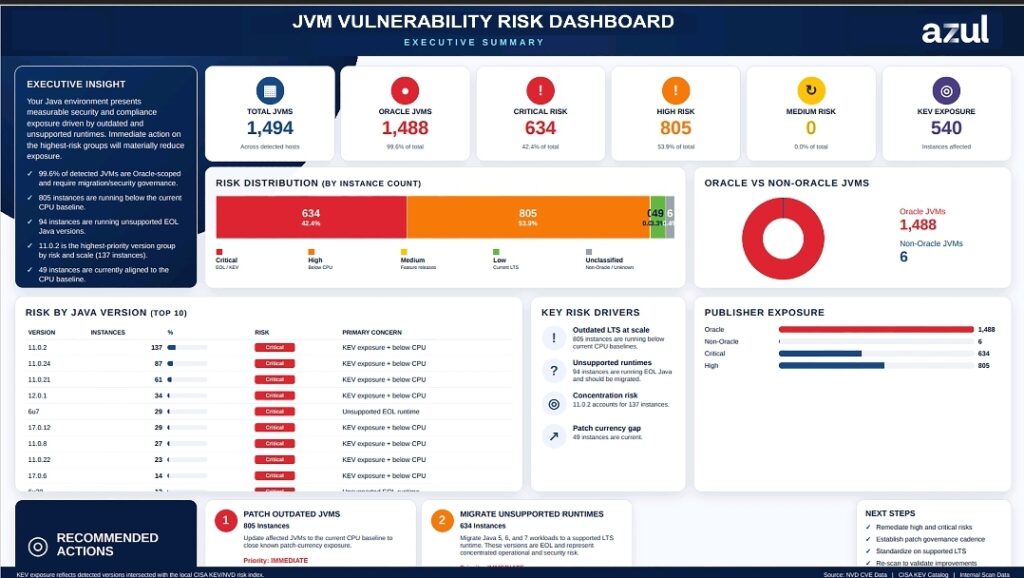
The JVM Vulnerability Risk Assessment is positioned to address that gap by providing visibility into runtime exposure, KEV-related risks, end-of-life systems, and remediation priorities.
Strategically, this indicates a shift from vulnerability management toward exposure intelligence.
The question is no longer whether vulnerabilities exist.
The question is whether organizations can locate and prioritize them before attackers do.
The AI Security Inflection Point Enterprises Can No Longer Ignore
The deeper implication of Azul’s announcement extends beyond Java.
It highlights a broader transformation occurring across cybersecurity.
Traditional security models assumed defenders had sufficient time between vulnerability disclosure and active exploitation. Patching programs, quarterly updates, and periodic audits evolved around this timeline.
AI is compressing that window.
When autonomous systems can analyze codebases continuously, identify weaknesses, and chain together known vulnerabilities into exploit paths, the speed advantage increasingly shifts toward attackers.
Operationally, this translates to a new requirement: organizations must improve visibility before they improve response.
Security teams cannot remediate what they cannot see.
This is where runtime intelligence becomes strategically valuable.
Unlike application scanners that focus on source code or endpoint tools that focus on active threats, runtime-focused visibility examines the software layer actually executing enterprise workloads.
That distinction matters because many security incidents originate from assets organizations do not realize they have.
The future battleground may not be detection.
It may be discovery.
How Azul Is Positioning Itself Differently
The cybersecurity market is crowded with vendors promising visibility, protection, and resilience.
Many leading security vendors focus on threat detection, endpoint protection, cloud security, and security operations. Application security providers concentrate on software composition analysis, code security, and vulnerability management.
Azul occupies a narrower but deeper position.
Its focus is not general cybersecurity visibility but Java-specific runtime intelligence.
This is where the differentiation occurs.
Rather than attempting to become another detection platform, Azul is concentrating on an area where many enterprises have limited operational visibility despite substantial business dependence.
The approach reflects a broader trend toward specialized security platforms that address previously overlooked layers of enterprise infrastructure.
As environments become increasingly complex, depth may become more valuable than breadth.
Translating Runtime Intelligence Into Action
Technology initiatives frequently fail because they generate information without generating decisions.
The JVM Vulnerability Risk Assessment attempts to avoid that trap.
In a single engagement, organizations receive an executive-ready dashboard, risk-by-version analysis, Key Risk Indicators related to Known Exploited Vulnerabilities, and a prioritized remediation roadmap.
The assessment combines several critical capabilities.
Runtime Discovery
Organizations gain visibility into JVM instances deployed throughout the enterprise, including embedded and unmanaged environments that often escape traditional asset inventories.
Risk Correlation
Detected runtimes are mapped against vulnerability databases, KEVs, support status, and patch baselines.
Executive Reporting
The assessment produces dashboards designed for leadership teams, enabling technical exposure to be translated into business risk.
Prioritized Remediation
Rather than treating every vulnerability equally, remediation activities are ranked according to impact and urgency.
This is where the shift occurs.
The value is not merely finding vulnerable JVMs.
The value is understanding which vulnerabilities matter most and which actions will deliver the greatest risk reduction.
For security leaders facing constrained budgets and limited resources, prioritization is often more important than detection.
Why Patch Velocity Is Becoming a Competitive Advantage
Java’s quarterly update cycle has long served as the primary mechanism for remediating known vulnerabilities.
However, AI-driven attack models are creating a new reality.
Organizations must not only patch vulnerabilities but do so at a pace that keeps ahead of increasingly automated exploit discovery.
Azul argues that patch velocity is becoming one of the most important frontline defenses available to enterprises.
Its enterprise Java platform supports this objective through security-focused update strategies, emergency remediation capabilities, and estate-wide runtime visibility.
The goal is straightforward: reduce the amount of exploitable legacy infrastructure that remains available to attackers.
“The unpatched JVM is already a growing liability, not a future one. Azul’s JVM vulnerability risk assessment was created to help security leaders find and close that exposure before AI-driven attackers can exploit it,” said Scott Sellers, co-founder and CEO of Azul.
From a strategic perspective, patch management is evolving from an operational discipline into a risk-management capability.
Security as a Customer Experience Capability
Cybersecurity discussions often focus on technical outcomes.
Customers experience business outcomes.
When a cyberattack occurs, customers rarely know whether the root cause involved a JVM, a cloud misconfiguration, or an application vulnerability.
What they experience is downtime, service interruption, delayed transactions, data exposure, and reduced trust.
From a CX standpoint, security visibility is therefore a foundational experience capability.
The relationship is increasingly direct.
A stronger security posture contributes to higher service reliability, reduced outage frequency, improved trust, stronger regulatory compliance, and better brand reputation.
This becomes especially important in regulated industries.
Financial institutions, healthcare providers, utilities, and government agencies depend heavily on public trust.
A security failure creates not only operational disruption but also reputational consequences that can persist for years.
The deeper implication is that cybersecurity investments should increasingly be evaluated through customer outcomes rather than technical metrics alone.
Lessons From the Field
The value of runtime standardization and visibility is already being demonstrated by organizations managing complex Java estates.
“Through our strategic partnership with Azul, we significantly reduced our security risk level with our Java applications and Java-based infrastructure, which certainly helps me sleep better at night,” said Jenny Nelson, Head of ICT & Digital at Newcastle City Council.
She added:
“In addition, the benefits of switching to Azul Core as our JVM are clear. Our Java estate is now consistent, standardized, easier to maintain, and has brought a level of simplicity that’s a huge benefit to our organization.”
The significance of this observation extends beyond security.
Consistency and visibility reduce operational complexity, simplify governance, and improve the ability of organizations to execute modernization initiatives.
The Maturity Shift From Reactive Security to Exposure Management
Many organizations remain in a reactive security posture.
They respond to alerts, remediate discovered vulnerabilities, and address audit findings.
The AI era demands a higher level of maturity.
Exposure management represents the next stage.
Rather than waiting for threats to surface, organizations continuously identify, prioritize, and reduce attack paths before exploitation occurs.
The JVM Vulnerability Risk Assessment aligns with this philosophy.
Its focus on runtime visibility, patch readiness, KEV exposure, and remediation planning suggests a move toward predictive risk reduction rather than incident-driven response.
Organizations that succeed in this transition are likely to gain advantages beyond security.
They may also improve operational efficiency, governance effectiveness, and compliance readiness.
Elevated Stakes for Regulated Industries
The challenge is particularly acute for organizations operating in highly regulated environments.
Frameworks such as PCI-DSS, SOX, HIPAA, DORA, NERC CIP, and FedRAMP increasingly require demonstrable visibility into software assets, vulnerability remediation processes, and patch histories.
Autonomous AI exploitation tools do not distinguish between regulated and unregulated targets.
However, the consequences of a breach can differ dramatically.
For regulated enterprises, security failures can trigger financial penalties, audit scrutiny, operational disruption, and long-term reputational damage.
This transforms runtime visibility from a technical best practice into a compliance and governance requirement.
Looking Ahead
The launch of Azul’s assessment may signal a broader evolution within enterprise cybersecurity.
As AI continues to compress exploitation timelines, visibility itself becomes a competitive advantage.
Organizations that understand their environments in greater detail will likely respond faster, remediate more effectively, and withstand attacks more successfully.
Meanwhile, vendors will increasingly compete on their ability to uncover hidden exposure rather than simply detect known threats.
Runtime intelligence, asset visibility, and exposure prioritization could become central pillars of enterprise cyber resilience strategies.
This is particularly relevant for Java, which continues to power critical applications across banking, healthcare, government, telecommunications, retail, and industrial operations.
The systems that organizations depend upon most are often the systems they understand least.
That paradox is becoming increasingly dangerous.
The Takeaway
The launch of Azul’s JVM Vulnerability Risk Assessment reflects a fundamental shift in enterprise security thinking. AI-powered vulnerability discovery is reducing the expertise barrier that once protected organizations from sophisticated attacks while simultaneously shrinking the time available for remediation.
From a CX standpoint, the significance extends beyond Java security. The assessment highlights a broader reality: visibility is becoming the foundation of trust, resilience, compliance, and service continuity.
Organizations can no longer assume that unknown vulnerabilities will remain undiscovered.
In an environment where AI accelerates both attack and defense, the JVM Vulnerability Risk Assessment represents a move toward a more proactive model of exposure management—one where understanding the runtime environment becomes as important as protecting the applications that run on it.
