
When a Missed Touch Becomes a Missed Moment: Why Automotive CX Now Begins at the Screen
Imagine this.
You’re driving through unfamiliar city traffic at night. The dashboard glows with a massive curved display. You reach to adjust navigation. The screen lags. Or worse, it misreads your touch. A second passes. Then another. Your focus slips from the road.
That tiny interaction failure just became a safety risk—and a broken customer experience.
As vehicles evolve into software-defined platforms, the cockpit display is no longer an interface. It is the experience. And touch reliability has quietly become one of the most critical CX battlegrounds in automotive.
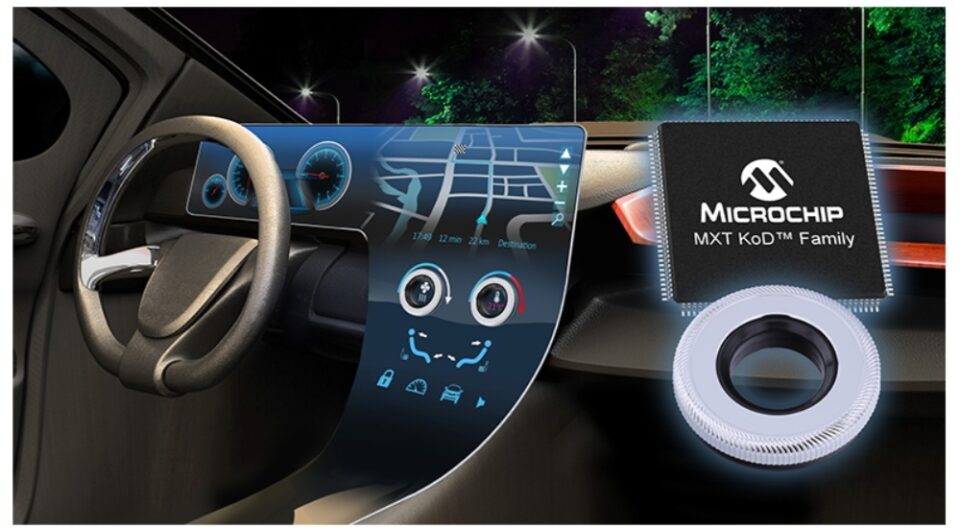
That context makes Microchip Technology’s latest expansion of its maXTouch® M1 touchscreen controller family far more than a hardware update. It signals a deeper shift in how OEMs, Tier 1 suppliers, and CX leaders must rethink journey integrity, trust, and interaction design at scale.
What Is the maXTouch® M1 Expansion—and Why Should CX Leaders Care?
Short answer: Microchip has expanded its automotive touchscreen controllers to reliably support displays from 2 inches to 42 inches, across OLED and microLED formats, with significantly higher noise immunity.
For CX and EX leaders, this matters because touch accuracy of maXTouch® M1 touchscreen directly shapes perceived quality, safety, and brand trust inside modern vehicles.
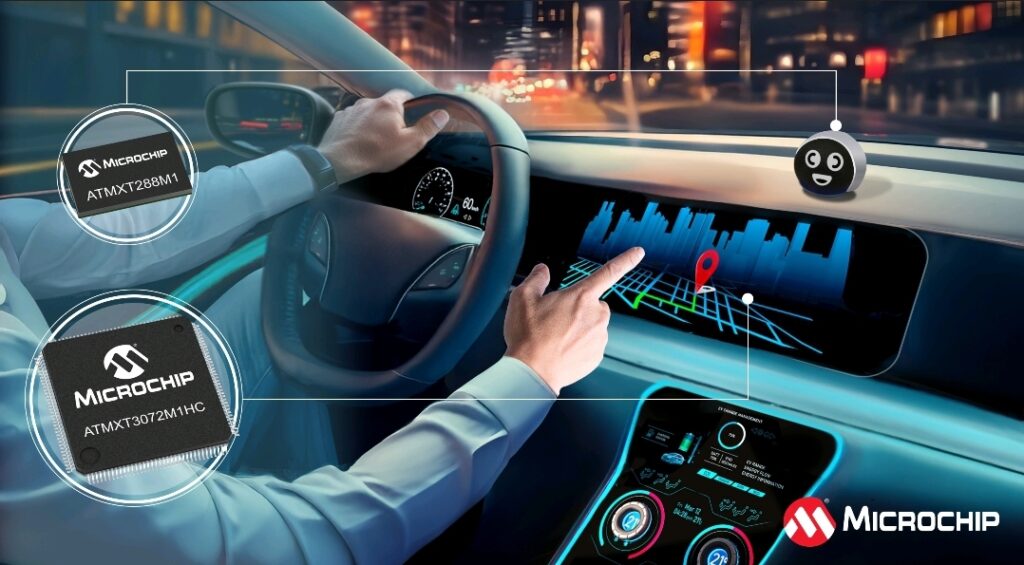
The newly announced ATMXT3072M1-HC and ATMXT288M1 controllers extend coverage from ultra-compact maXTouch® M1 screens to sweeping free-form widescreen displays, while boosting signal-to-noise ratio by up to 15 dB over previous generations.
That technical leap translates into fewer false touches, fewer missed inputs, and fewer moments where users feel friction instead of flow.
Why Are Automotive Displays Becoming a CX Risk Surface?
Short answer: Larger, thinner, and more integrated displays increase noise, capacitive load, and interaction complexity—raising failure risks across the journey.
Cockpit displays are changing fast:
- Instrument clusters merge with center displays
- Free-form, curved, and continuous screens replace segmented layouts
- OLED and microLED panels reduce thickness but increase electrical noise
- Touch sensors embed directly into display stacks
For CX teams, this creates a hidden challenge. The more immersive the interface, the more fragile the experience becomes if touch sensing fails under real-world conditions like heat, vibration, glare, or electromagnetic interference.
A missed touch isn’t just a UX bug. It’s:
- Driver frustration
- Cognitive overload
- Safety concern
- Brand credibility erosion
maXTouch® M1 touchscreen: How Does Smart Mutual Touch Technology Improve Experience Reliability?
Short answer: Smart Mutual improves touch accuracy under high noise and capacitive load, especially on large, thin displays.
Microchip’s proprietary Smart Mutual touch acquisition scheme is designed for environments where traditional capacitive sensing struggles.
In large on-cell OLED displays, embedded touch electrodes face:
- Higher parasitic capacitance
- Increased display noise coupling
- Greater risk of ghost touches or unregistered inputs
Smart Mutual counters this with advanced algorithms that isolate real touch signals more effectively, improving reliability even in harsh automotive conditions.
From a CX perspective, this delivers interaction confidence—the feeling that the system responds exactly as expected, every time.
What CX Problem Do Continuous Displays Actually Solve?
Short answer: They reduce journey fragmentation across driver, navigation, and infotainment interactions.
The ATMXT3072M1-HC supports large continuous touch sensor designs that span both the instrument cluster and center information display.
This matters because fragmented hardware often leads to fragmented journeys:
- Separate screens
- Inconsistent response behaviors
- Visual and interaction discontinuity
By enabling a single, continuous sensor that works across left-hand and right-hand drive vehicles, Microchip helps OEMs standardize experiences globally while simplifying hardware architectures.
One host MCU sees the system as a single maXTouch device, removing the need for external controllers to merge touch coordinates.
Less system complexity means:
- Faster development cycles
- Fewer failure points
- More consistent CX delivery across markets
Why Small Screens Still Matter in a Big-Display World?
Short answer: Compact displays power critical micro-moments, especially for AI assistants and ambient interfaces.
While large displays grab headlines, small screens are multiplying inside vehicles.
Examples include:
- AI driver assistant displays
- Digital analog clocks
- Secondary control surfaces
- Context-aware notification panels
The ATMXT288M1 targets 2–5 inch displays with a 20% PCB area reduction using a Thin Profile Fine-Pitch BGA package.
For CX teams, this enables:
- Cleaner industrial design
- More placement flexibility
- Better integration into constrained spaces
Micro-interactions still shape perception. A small screen that responds instantly can feel more premium than a massive display that hesitates.
What Does This Mean for Software-Defined Vehicle CX?
Short answer: Reliable hardware is the foundation for adaptive, software-led experiences.
As vehicles shift toward software-defined architectures, expectations rise:
- Personalized interfaces
- OTA feature updates
- Context-aware interactions
- AI-driven assistants
None of this works if touch input is unreliable.
Giovanni Fontana, Director of Microchip’s Human Machine Interface division, captures the shift clearly. OEMs are pushing boundaries in size, shape, and technology to deliver immersive experiences. The complexity now lies in making those experiences robust under real-world conditions.
For CX leaders, the lesson is clear. Experience ambition must be matched by interaction integrity.
A CX Framework: The Touch Reliability Stack
To evaluate touch-driven experiences, CXQuest recommends a four-layer framework.
1. Physical Integrity
Display size, thickness, sensor placement, and materials.
2. Signal Integrity
Noise immunity, SNR performance, and capacitive load handling.
3. Interaction Consistency
Uniform response across lighting, temperature, and usage conditions.
4. Journey Trust
User confidence that every touch will register correctly, without thought.
Microchip’s M1 expansion strengthens layers one and two—often the most overlooked in CX strategy discussions.
Common Pitfalls CX Teams Still Miss
Over-indexing on UI design, under-investing in sensing reliability
Beautiful interfaces fail when touch misfires.
Treating hardware as “someone else’s problem”
CX outcomes increasingly depend on silicon-level decisions.
Fragmented ownership across teams
Display, software, and experience teams often optimize in isolation.
Ignoring edge conditions
Heat, vibration, glare, and noise expose real CX weaknesses.
How Do Development Tools Influence EX and Time-to-Experience?
Short answer: Strong tooling accelerates iteration and reduces production friction.
Microchip supports the M1 controllers with:
- maXTouch Studio IDE for development
- maXTouch Analyzer for production testing
- Host driver support across Linux, Android, Windows, QNX, Zephyr, and more
For engineering teams, this improves developer experience (EX). For CX leaders, faster iteration means quicker validation of real-world journeys.
Better EX upstream leads to better CX downstream.
Key Insights for CX and EX Leaders
- Touch reliability is now a strategic CX differentiator, not a technical footnote
- Display size diversity demands sensing flexibility
- Continuous displays reduce journey fragmentation
- Small screens still drive high-impact moments
- Hardware choices directly shape emotional trust
FAQ: CX Leaders Ask These Questions
How does touch accuracy impact perceived vehicle quality?
Users equate responsiveness with premium quality. Delays feel cheap and unsafe.
Why are OLED and microLED displays harder to manage?
They increase noise coupling and capacitive load, stressing traditional touch solutions.
Can one touch solution support global vehicle platforms?
Yes. Continuous sensor designs reduce regional hardware variants.
Is touch reliability a safety issue or a UX issue?
Both. Missed touches increase cognitive load and distraction.
How early should CX teams engage with HMI hardware decisions?
At concept stage. Retrofitting reliability is costly and limited.
Actionable Takeaways for CX Professionals
- Map critical in-vehicle journeys where touch failure creates risk
- Audit display size diversity across your vehicle portfolio
- Align CX, HMI, and hardware teams early in design cycles
- Stress-test touch experiences under real-world noise conditions
- Treat touch sensing as a trust signal, not a component
- Evaluate EX tooling as part of CX readiness
- Design for continuity, not just visual immersion
Final Thought
In modern vehicles, experience doesn’t begin with software. It begins the moment a finger meets glass.
Microchip’s expansion of the maXTouch® M1 family is a reminder that the future of automotive CX depends on invisible reliability—where every touch works, every time, without demanding attention.
And in a world where attention equals safety, that reliability is no longer optional.
