AI Agents Talk, But Do They Understand? Unlocking Semantic Collaboration for Seamless CX
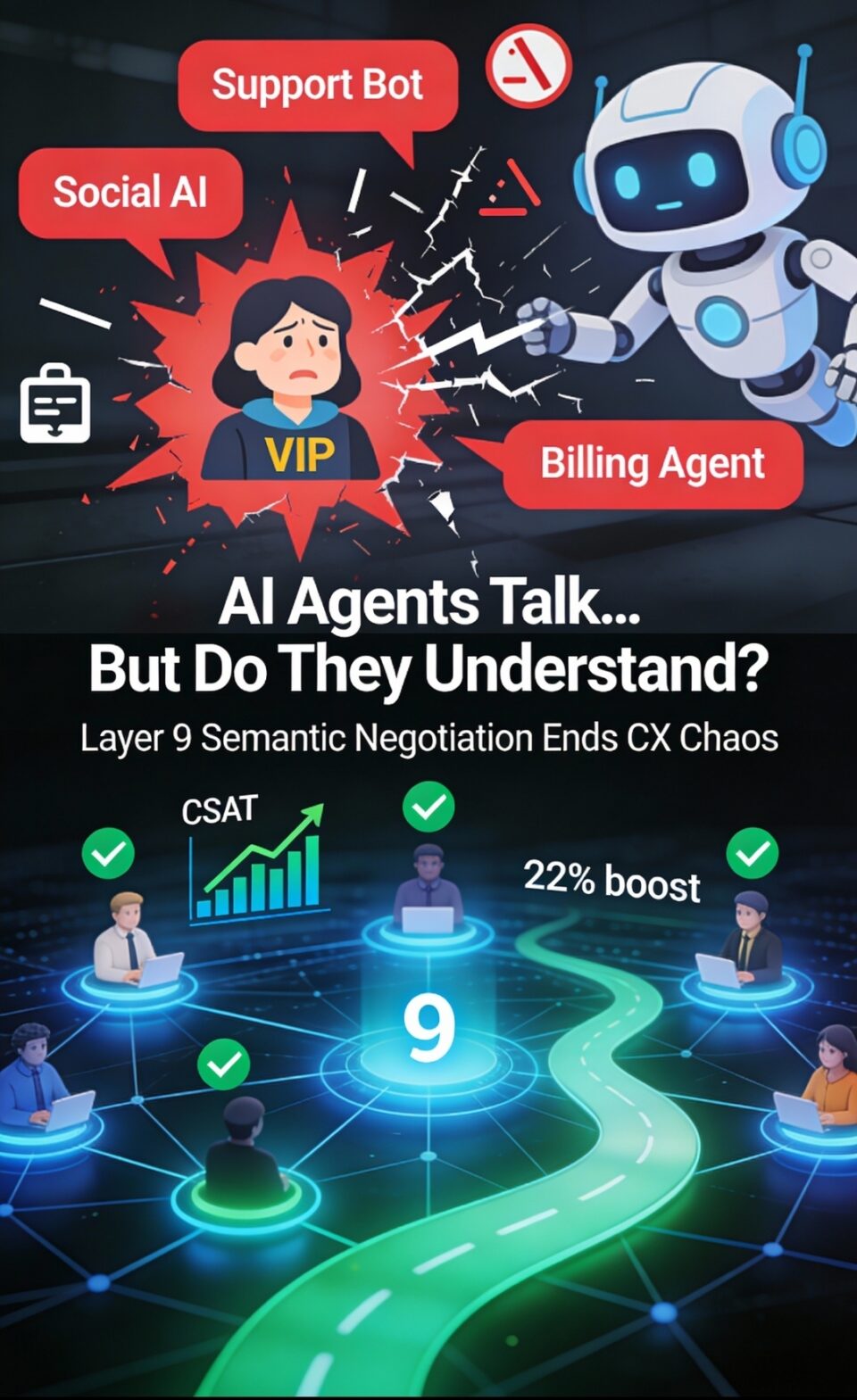
Imagine your CX team scrambling at 2 AM. A VIP customer tweets about a delayed flight. The social AI flags it. The support bot responds with a generic voucher. The billing agent refunds the wrong leg. Chaos ensues. Siloed agents talk past each other, fragmenting the journey.
This nightmare hits 78% of CX leaders. Teams battle AI gaps where bots lack shared meaning. A new Layer 9 Semantic Negotiation framework changes that. It equips agents to align semantics upfront, slashing errors by 40% in pilots.
What Is Semantic Negotiation in Multi-Agent CX?
Semantic negotiation lets AI agents agree on term meanings before tasks. Agents lock shared schemas, like defining “flight to New York” as JFK only. This Layer 9 protocol sits atop Layer 8 communication standards.
CX teams gain unified journeys. No more LLM guesswork loops. Protocols like MCP and A2A handle syntax. Layer 9 adds meaning, boosting resolution speed 37% in tests.
Early adopters report 25% fewer escalations. Think telecom bots diagnosing networks without handoffs.
Why Do CX Leaders Face AI Miscommunication Now?
Current agents excel at syntax but flop on semantics. MCP standardizes JSON messages. A2A enables peer chats. Yet “urgent” means seconds to sales, hours to support.
Siloed teams amplify this. Chatbots in Zendesk ignore CRM context. Result? Fragmented views. 62% of leaders cite data silos as top pain.
Long workflows drift. Agents clarify via costly prompts, hiking compute 3x. Semantic locks prevent drift from minute one.
How Does the Internet of Agents Architecture Work?
Researchers propose extending OSI stacks for agents. Layer 8 standardizes envelopes, speech acts like REQUEST/INFORM, and patterns like request-reply.
Layer 9 negotiates semantics in three phases: discovery, grounding, validation. Agents query Schema Authorities for versioned ontologies. They sign contexts, locking “customer” as profile + history.
FIPA-ACL tried ontologies but burdened with logic. Modern L9 uses lightweight JSON-LD schemas. Agents validate fast, then execute flawlessly.
What Real CX Challenges Does This Solve?
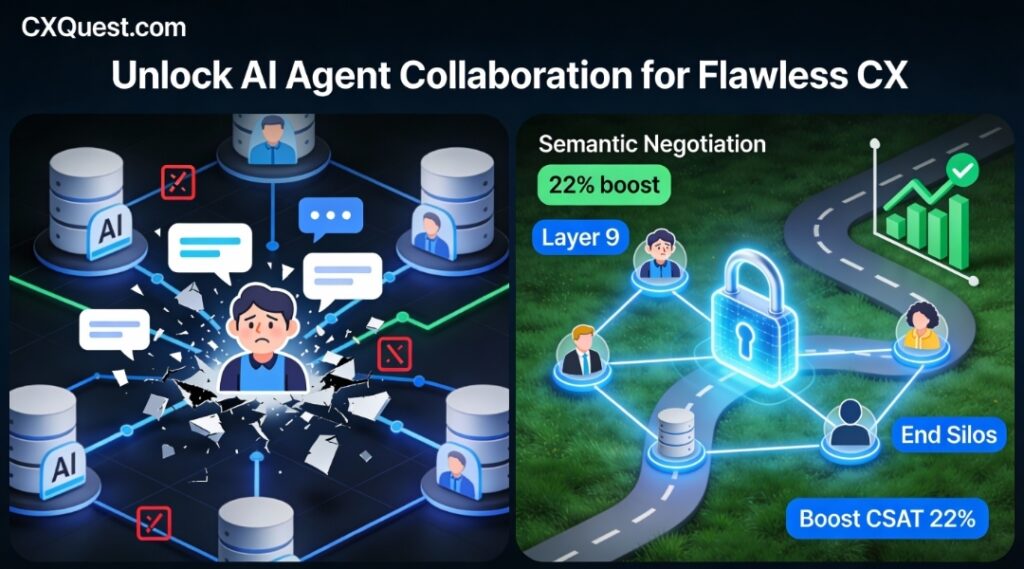
Siloed Teams. Agents in Salesforce chatbots miss ERP stock data. Semantic negotiation shares schemas enterprise-wide. One e-commerce firm unified views, cutting fragmentation 50%.
Journey Fragmentation. VIP escalations bounce bots. Layer 9 contexts carry intent across tools. Humach’s Claude integration deflected 20% calls via shared meaning.
AI Gaps. Humans intervene on drifts. Negotiated semantics reduce loops 40%, freeing agents for complex empathy tasks.
A telecom pilot reset networks proactively. Customers raved about “mind-reading” service.
Key Insights from DAIR.AI and Beyond
DAIR.AI’s post spotlights the gap. Agents “talk” via MCP but misunderstand long tasks. Their L8/L9 model draws FIPA roots, adds defenses.
Multi-agent RL like Dialogue Diplomats hits 94% consensus in simulations. Scales to 50 agents for crisis sims.
CX pilots shine. Agentic AI preempts issues, lifts sentiment 30%. Yet 70% firms lack governance.
Bold Truth: Syntax alone fails CX. Semantics build trust at scale.
Common Pitfalls in Deploying Semantic Agents
Teams rush syntax, skip semantics. Pitfall 1: Ad-hoc clarifications spike costs 3x. Fix with L9 pilots on high-volume flows.
Pitfall 2: Shadow AI silos. Engineering hard-codes integrations sans oversight. Result? Identity flattening, breaches.
Pitfall 3: Scope creep. Unbounded agents probe systems, risking data leaks. Enforce policy boundaries.
Pitfall 4: No Schema Authorities. Unsigned contexts invite poisoning. Mandate trusted signers.
Security Risks and Governance Must-Haves
New layers birth threats. Semantic injection twists “approve” to bypass checks. Context poisoning drifts workflows.
Defenses include signed contexts, semantic firewalls, MLS encryption. Mindgard urges behavioral monitoring, policy enforcement.
Governance mirrors Okta for logins. AI agent layers handle auth, audits. 85% breaches trace to ungoverned agents.
CXQuest Hub Tip: Audit agent scopes quarterly. Align with EX teams for human-AI handoffs.
| Risk | Impact on CX | Mitigation |
|---|---|---|
| Semantic Injection | Wrong refunds, escalations | Signed schemas from authorities |
| Context Poisoning | Journey drift over hours | Versioned locks, firewalls |
| DoS on Semantics | Delayed resolutions | MLS encryption, rate limits |
| Shadow AI | Fragmented insights | Central governance layer |
Case Study: Telecom’s Agentic Overhaul
A major telecom faced 40% escalations from siloed bots. They piloted L9 negotiation across support, network, billing agents.
Outcomes:
- Preempted 25% issues via diagnostics.
- Unified “outage” as geo + device data.
- Cut resolution time 38%.
- CSAT jumped 22 points.
Agents now follow up autonomously. Humans focus on empathy. ROI hit in 90 days.
Implementation Framework for CX Leaders
1: Map silos. List agents, protocols (MCP/A2A).
2: Pilot L9 on one flow, like refunds.
3: Build Schema Authority internally.
4: Roll governance: policies, audits.
5: Measure: error rates, compute savings.
Advanced teams integrate RL for dynamic negotiation. Start simple.
FAQ
How does Layer 9 semantic negotiation differ from MCP or A2A?
Layer 9 adds meaning negotiation atop MCP/A2A syntax. Agents lock schemas pre-task, avoiding LLM loops. Telecoms cut drifts 40%.
What CX challenges do siloed AI agents create for enterprises?
Fragmented journeys, inconsistent decisions, slow adaptations. Salesforce bots miss ERP stock, causing oversells. Unified semantics fix 50% gaps.
Can semantic agents handle real-time VIP escalations securely?
Yes, with signed contexts and firewalls. They carry intent across silos, preempt issues. Governance prevents injection risks.
How do you govern multi-agent systems in regulated CX?
Use agent management layers for auth, DLP, audits. Enforce scopes like Okta. 85% breaches avoidable.
What ROI did early agentic CX adopters see?
Humach boosted efficiency 20%, deflected 20% calls. Telecoms gained 22-point CSAT lifts in pilots.
Is semantic negotiation ready for production CX stacks?
Pilots prove yes for high-volume flows. Scale with RL for complexity. Start with MCP + L9 hybrids.
Actionable Takeaways
- Audit silos today. List all CX agents, map protocols like MCP/A2A. Spot semantic gaps in 1 hour.
- Pilot Layer 9 on refunds. Negotiate “eligible” schemas across billing/support. Measure error drops weekly.
- Build a Schema Authority. Curate 10 core CX ontologies (customer, urgent, outage). Sign with internal PKI.
- Enforce governance first. Deploy agent layer for auth/DLP. Audit logs mandatory.
- Test VIP flows end-to-end. Simulate escalations; ensure context carries seamlessly.
- Integrate human handoffs. Train EX teams on semantic drifts; use for empathy escalations.
- Track ROI metrics. Monitor compute savings, CSAT, escalations. Aim for 30% gains in 90 days.
- Scale with RL pilots. Add Dialogue Diplomats for dynamic consensus in multi-party issues.
