
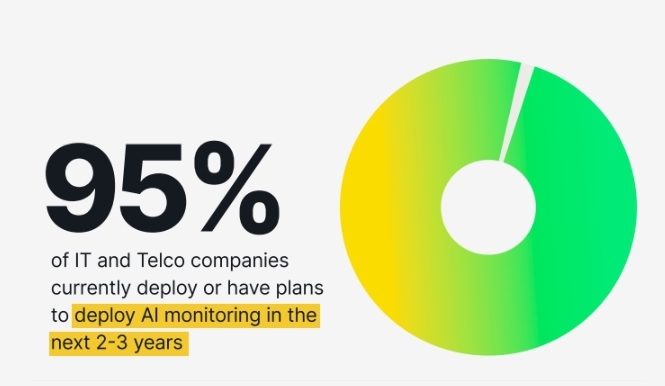
Released by New Relic, the 2025 Observability Report for Telecom & Technology arrives at a pivotal moment for the industry. Telecom and IT organizations are navigating complex digital ecosystems, rising customer expectations, and unprecedented operational pressure. Outages cost millions, distributed architectures create new visibility gaps, and CX leaders must now connect platform performance directly to customer impact. This observability report brings clarity to that chaos. It reveals how telcos and IT companies differ in their observability maturity, where their biggest risks lie, and which strategies deliver the highest ROI in an AI-driven landscape. Above all, it shows how modern observability is shaping the future of customer experience, employee productivity, and business resilience.
Why Telco and IT CX Leaders Must Rethink Observability in 2025: The Leapfrog Moment
Walk into any telecom or IT operations war room today, and one theme dominates the air: pressure.
-Pressure to keep systems up.
-Pressure to ship faster.
-Pressure to solve issues before customers even notice.
And pressure to prove to leadership that digital investments actually move business metrics.
Yet the reality behind the dashboards is messy. Outages happen more often than anyone wants to admit. Customer journeys break at odd hours. Distributed stacks introduce more mystery than clarity. And teams still scramble to pinpoint what failed, why it failed, and who needs to fix it.
This is the world where observability was supposed to be the hero. But as the latest 2025 Telecom & Technology Observability Report reveals, different approaches to observability are creating very different outcomes—especially between telecom and IT organizations.
What emerges is a fascinating split:
Telcos are skipping foundational layers and betting heavily on AI-powered observability.
IT organizations are doubling down on maturity, discipline, and DevOps-driven practices.
Surprisingly, both groups are seeing success—just in very different ways.
Let’s dig deeper.
The CX Reality Check: Outages Hurt, and Telcos Feel It the Most
When a telco’s network goes down, customers don’t wait.
-They switch apps.
-They switch providers.
-They switch opinions instantly.
And the report underscores this. Telcos now experience some of the highest business-impact outage costs of any industry. An hour of high-impact downtime hits them with a $2 million loss. This exceeds both the global average of $1.7 million and the IT average of $1.6 million.
Telcos also face more frequent pain:
- 57% experience high-business-impact outages weekly or more.
- 22% face such outages 2–6 times per week.
- 14% face them daily.
That is an existential CX problem.
And it’s made worse by slower detection, with a median time to detect outages sitting at 42 minutes, compared to 32 minutes globally.
The biggest culprits?
- 33% of outages stem from network failures.
- A striking 34% come from security failures, far above the global average.
In simple terms:
Telcos are battling both legacy infrastructure risk and modern cyberthreat overload simultaneously.
This is exactly where observability should shine.
But the story is more complicated.
Telco vs IT: Two Opposite Strategies Forming a Surprising Pattern
IT organizations: disciplined, structured, and maturing quickly
IT companies show strong foundational maturity:
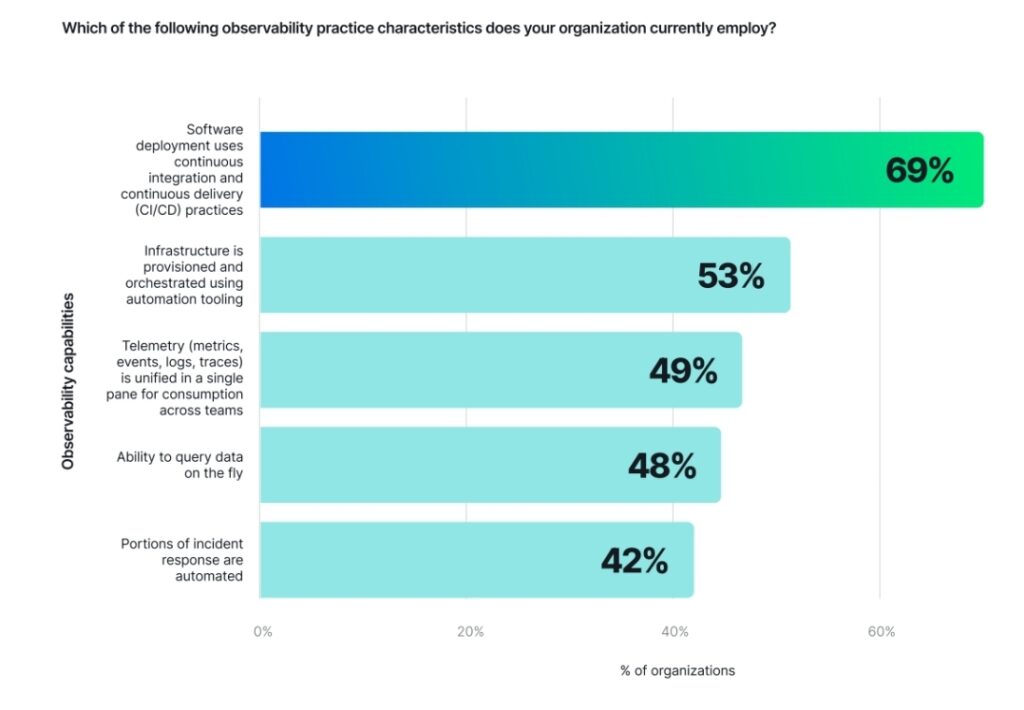
- 69% use CI/CD practices.
- High deployment across infrastructure monitoring, APM, log management, and dashboards.
- Better operational discipline and frequent use of observability tools.
- Stronger understanding of how observability connects to business value.
In fact, IT leaders treat observability as part of a long-term DevOps journey.
-They build architecture first.
-They automate workflows.
-They create unified telemetry environments.
-They refine, improve, and optimize.
This gradual, structured approach makes observability a strategic capability rather than a rescue tool.
Telcos: skipping foundational maturity and leaping straight into AI
Telcos present a surprisingly different picture.
They lag global averages by 20–30 percentage points in foundational areas:
- 31% database monitoring vs. 62% globally
- 31% infrastructure monitoring vs. 57% globally
- 42% network monitoring vs. 63% globally
- 48% security monitoring vs. 62% globally
Despite these gaps, they have the highest adoption of AI monitoring at 74%, far beyond the industry average of 54%.
This is not a small strategic shift.
This is a leapfrog.
Executives are clearly betting on next-generation automation, even before conventional observability plumbing is fully established. And surprisingly, the bet is paying off:
- 58% of telcos see 2x ROI or more.
- 10% see 5–10x ROI, the highest in any industry category.
This raises a bold question for CX and EX leaders:
Is it always necessary to build foundations first, or can AI help accelerate maturity when time-to-value pressures surge?
The answer may lie somewhere in between.
Why the Leapfrog Strategy is Working for Telcos (For Now)
Telcos face intense pressure from both consumers and regulators.
Network experience directly affects brand loyalty.
Digital customer experience is now a revenue driver, not a support function.
This urgency forces leaders to look for immediate, scalable, automated answers—which explains the aggressive move toward AI monitoring.
The report suggests that telco adoption is being driven by top-down business mandates, not grassroots engineering evolution. Executives want:
- Faster detection
- Predictive insights
- Autonomous remediation
- Ability to correlate outages with business KPIs
And AI promises exactly that.
Telco leaders also highlight business outcomes more prominently than technical metrics:
- 50% cite achieving business KPIs as the top benefit of observability.
- Only 42% cite technical KPIs.
This is a sharp contrast with IT leaders, who prioritize increased operational efficiency, improved uptime, and better developer workflows.
Telcos are building their observability strategy backwards—starting from business outcomes and tracking down to tooling.
And that is why they leapfrog to AI.
But there is a risk.
The Maturity Gap: The Hidden CX Threat
The observability report reveals a paradox.
Telcos demonstrate:
- High executive confidence
- High AI adoption
- High ROI
But they also show:
- Low operational maturity
- High outage frequency
- Slow incident detection
- Incomplete foundational monitoring
This over-reliance on AI, without strengthening traditional layers, may create blind spots.
For instance:
- Without robust database monitoring, AI can’t always detect bottlenecks in the data layer.
- Without strong infrastructure monitoring, AI’s predictive models weaken.
- Without distributed tracing, teams can’t understand cross-service failure flows during multi-service customer interactions.
In short:
AI can accelerate visibility, but cannot replace fundamentals.
Telecom CX leaders must ask:
“Is our AI-powered observability operating on solid ground or shaky scaffolding?”
DEM Becomes the CX Lifeline for Both Telco and IT
As customer journeys shift almost entirely to digital, both telco and IT organizations are ramping up digital experience monitoring (DEM).
DEM combines:
- Real User Monitoring (RUM)
- Mobile and browser monitoring
- Synthetic monitoring
Its purpose mirrors modern CX priorities:
Track every interaction. Understand every customer journey. Optimize every experience.
For CX and EX leaders, DEM becomes the final mile of observability.
It translates technical health into customer-facing reality.
A network may show green across dashboards.
But if the app crashes for 20% of users on a specific OS version, CX leaders want immediate answers.
DEM bridges that gap.
How Observability Directly Improves CX and EX Outcomes
The observability report highlights clear benefits that tie observability to real business value.
For telcos:
- 38% cite improved system uptime.
- 32% cite improved developer productivity.
- 50% say observability directly supports business KPIs.
Telco CX teams benefit from:
- Faster outage detection
- Better cross-team alignment
- More predictable deployment cycles
- Reduced fire-fighting
- Increased customer trust
For IT organizations:
- 43% cite improved operational efficiency—a core EX benefit.
- 40% cite improved uptime and reliability.
IT EX teams gain:
- Smoother developer workflows
- Reduced on-call stress
- Fewer escalations
- Better cross-team data visibility
Both groups report improved productivity, less guesswork, and stronger ability to prioritize investments.
Observability is no longer an engineering choice.
It is a CX and EX differentiator.
What Telecom and IT CX Leaders Must Do in 2025: A Strategic Playbook
Based on the trends in the report, here’s a focused playbook for CX and EX leaders in telco and IT.
1. Strengthen foundations before scaling AI
AI adoption is valuable, but only when applied to robust underlying telemetry.
CX leaders must ensure teams don’t rely on AI to compensate for missing basics.
2. Treat DEM as a core CX function, not a technical add-on
Customer-facing journeys demand active measurement.
Invest in real user monitoring, mobile performance analytics, and synthetic scripts for key service flows.
3. Unify the telemetry layer across teams
Only 49% of IT companies have unified metrics, logs, events, and traces.
The number is even lower for telcos.
Unified visibility reduces finger-pointing and accelerates incident response.
4. Reduce tool sprawl
Telcos use a median of five observability tools, compared to a global median of four.
Tool fragmentation creates operational drag and reduces insight quality.
Consolidation must become a priority.
5. Connect observability metrics to business KPIs
Executives invest when outcomes are visible.
Show how outage reduction ties to:
- Lower churn
- Higher NPS
- Improved agent productivity
- Reduced MTTR
- Higher app adoption
6. Build cross-functional CX review loops
Observability improves CX only when insights flow across product, operations, support, and engineering.
Create quarterly customer-impact reviews using observability data.
7. Upskill teams for the AI era
AI-powered observability requires new skills:
- Interpreting ML-driven insights
- Understanding anomaly prediction
- Managing automated remediation
- Evaluating AI model drift
EX leaders should sponsor training, not wait for teams to self-learn.
Final Takeaways for Telco & IT CX Leaders
Observability is no longer a back-end capability.
It is a front-line CX engine.
This observability report makes one thing clear:
Different pathways can still lead to high ROI, but they must be grounded in clarity, discipline, and customer impact.
Telcos can leapfrog with AI.
IT teams can build strong foundations.
Both can win—if they align observability with CX and EX outcomes.
The organizations that treat observability as a business capability, not an engineering checklist, will deliver the most resilient, seamless, and predictive customer experiences in 2025 and beyond.
