
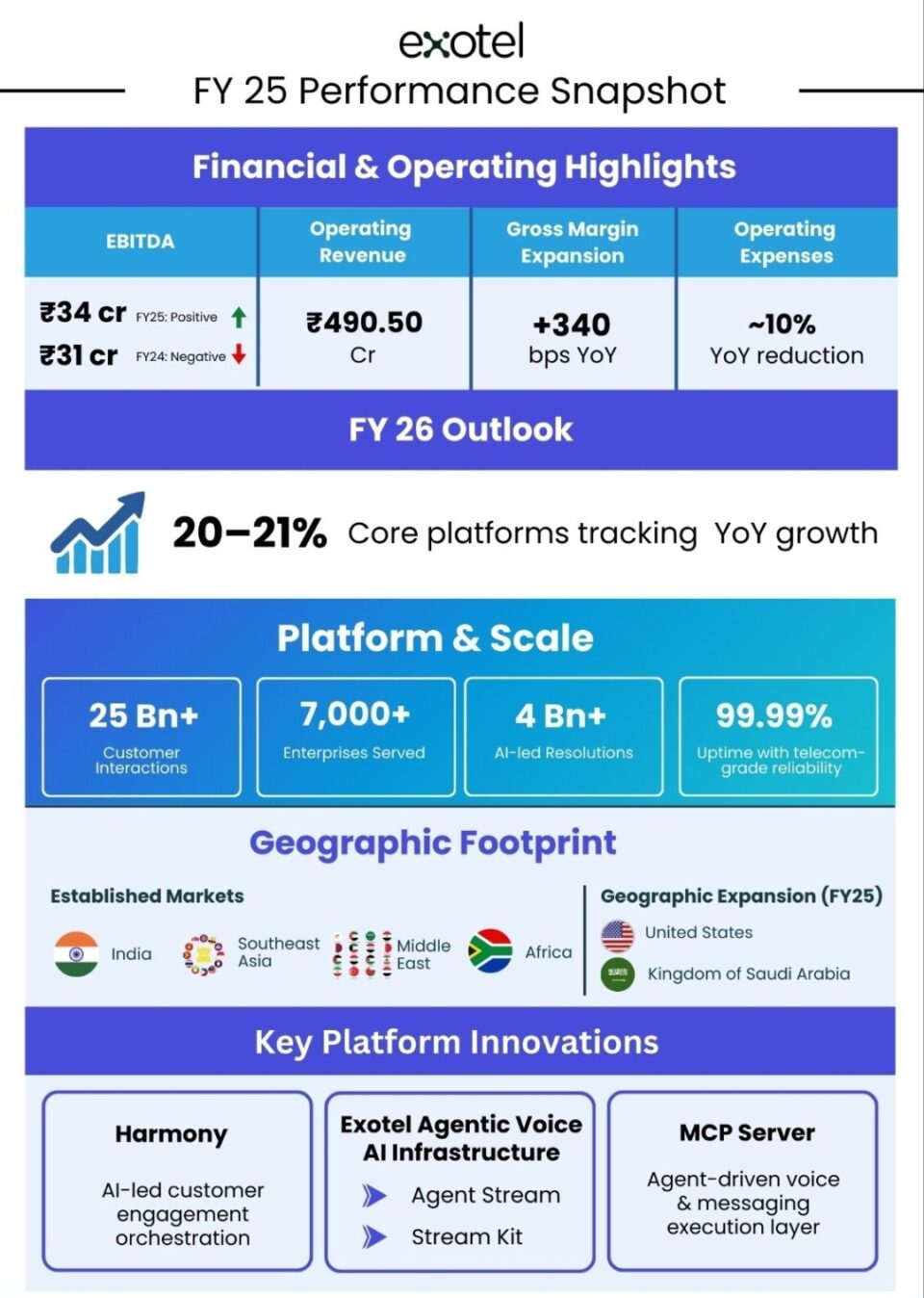
Exotel’s FY25 performance snapshot reads like a boardroom moment every CX leader recognises. The dashboards finally shift from red to green, the CFO stops asking if CX is a cost centre, and the CEO wonders, “If AI can do this for them, what are we missing in our own customer journeys?”
This is more than a good-quarter story. It is a case study in how an AI-first customer engagement platform can turn relentless interaction volume into EBITDA, while raising the bar on customer experience across banking, fintech, e-commerce, and more.
What Does Exotel’s FY25 Snapshot Signal for CX Leaders?
Exotel’s FY25 snapshot signals that AI-led customer engagement is now a proven growth and efficiency engine, not an experimental add-on.
The visual tells a clear story:
- EBITDA swing: From a negative base in FY24 to about ₹34 crore EBITDA in FY25, driven by better gross margins and tighter cost control.
- Solid revenue base: Operating revenue of around ₹490.5 crore, building on FY24 revenue of roughly ₹444–445 crore, shows steady growth rather than a one-off spike.
- Margin and cost discipline: About 340 basis points of gross margin expansion and around 10 percent reduction in operating expenses point to structural shifts, not just pricing tweaks.
- Scaled CX footprint: Over 25 billion customer interactions, 7,000-plus enterprises, more than 4 billion AI-led resolutions, and 99.99 percent uptime demonstrate a mature, high-trust platform.
For CXQuest readers, the key takeaway is that AI plus orchestration plus discipline can move CX from narrative to numbers.
How Is AI Rewiring Customer Experience Economics?
AI is rewiring CX economics by automating complex interactions, orchestrating journeys across channels, and making every interaction more context-aware and measurable.
Exotel’s roadmap illustrates this:
- Harmony platform: Harmony is positioned as an AI-first customer engagement OS that unifies conversations, context, and workflows across voice, messaging, and digital touchpoints. It blends generative voice bots, conversational quality analysis, and intelligent routing into one platform.
- Agentic AI, not just chatbots: Exotel’s AI strategy focuses on agentic AI that can plan, act, and complete tasks, rather than static bots. Harmony and the company’s AI stack enable agents and AI to collaborate in real time, driving hyper-personalized, context-rich interactions at scale.
- From contacts to outcomes: In BFSI, healthcare, and e-commerce, the platform targets outcomes such as faster loan approvals, higher repayment rates, reduced churn, and better first-contact resolution, not just lower handle time.
This shift mirrors what many global CX trend reports highlight: AI agents and orchestration platforms are moving CX from transactional to predictive and proactive.
How Does Exotel’s FY25 Story Link CX Metrics to Financial Outcomes?
Exotel’s FY25 pivot shows how CX metrics like CSAT, NPS, and journey completion can connect directly to EBITDA when AI and orchestration are embedded into the operating model.
Several mechanisms stand out:
- Reduced cost per interaction: Harmony’s automation, generative voice bots, and AI-assisted agents reduce human effort in high-volume queries, lowering cost per resolved interaction while sustaining or improving CSAT.
- Higher quality at scale: Conversational quality analysis and AI-driven coaching ensure that both human agents and AI stay on-brand and compliant, strengthening NPS and reducing error-driven rework.
- Revenue-linked journeys: AI-led campaigns for collections, cross-sell nudges, renewals, and reactivation link CX initiatives to measurable revenue outcomes, which is one reason the EBITDA story shifted so decisively between FY24 and FY25.
Across leading CX programmes, organizations that connect journey metrics to financial KPIs see higher investment support and faster scaling. Exotel’s numbers reinforce that pattern.
What Can CX and Business Leaders Learn from Exotel’s Platform Strategy?
CX and business leaders can, in fact, learn that platform thinking, not isolated tools, is what unlocks sustainable value from AI.
Exotel’s platform strategy highlights three lessons:
- Solve fragmentation first
Harmony’s core promise is to unify disjointed systems and channels so that customers don’t feel like they are starting from scratch in every interaction. This aligns with the broader push toward “customer operating clouds” that sit above channel silos. - Make AI a co-worker, not a project
Harmony encourages human–AI collaboration, where AI handles repetitive tasks and quality checks, while agents solve complex, emotional, or high-value problems. CX programmes that frame AI as a teammate consistently drive higher adoption and better culture outcomes. - Design for reliability and trust
A 99.99 percent uptime claim matters because CX breaks instantly when OTPs, payments, or support lines fail. For regulated industries, reliability and explainability often matter more than raw AI capability.
This is the kind of stack CXQuest has been calling out: AI-native, orchestrated, resilient, and deeply integrated into business outcomes.
Where Do AI, Regulation, and CX Risk Collide?
AI, regulation, and CX risk collide at the point where intelligent systems touch customer journeys that affect money, identity, or trust.
Key pressure points:
- Data protection and consent: Exotel operates across India, Southeast Asia, the Middle East, Africa, and is expanding into the US and Saudi Arabia. Clients must align AI-driven engagement with multiple privacy regimes, consent standards, and sectoral guidelines in BFSI and healthcare.
- Agentic AI accountability: As model-context and orchestration infrastructure let AI agents initiate calls and messages, enterprises must define who is accountable when AI miscommunicates terms or mishandles vulnerable customers.
- Bias, fairness, and explainability: With AI screening, routing, or nudging customers, CX leaders need monitoring to detect bias and ensure decisions can be explained when regulators, boards, or customers ask hard questions.
Winners over the next few years will treat responsible AI as part of CX design, not just risk mitigation.
How Can CX Leaders Operationalise an Exotel-Like Playbook?
CX leaders can operationalise a similar playbook by combining clear journey design, AI orchestration, and strong governance.
A pragmatic framework:
- Map your value journeys
Identify eight to ten journeys where better conversations move financial needles: collections, early delinquency management, onboarding, KYC follow-ups, renewals, claims, and digital adoption. - Choose an orchestration layer, not a stack of tools
Prioritise platforms that behave like Harmony: AI-native, omnichannel, and integrated with your CRM, core systems, and analytics. This prevents the “bot zoo” problem so many enterprises face. - Start with AI-assisted, move to human-assisted AI
Begin with AI helping agents through suggested responses and summaries. As models mature and risk is better understood, move to human oversight over AI-led interactions in low-risk journeys. - Build a CX–finance partnership
Work with finance to track cost per interaction, revenue per journey, and risk outcomes. Link Harmony-like initiatives directly to margin or growth, echoing the EBITDA shift in Exotel’s story. - Establish responsible AI guardrails
Co-create policies on data residency, consent flows, red lines for full automation, and escalation paths when AI fails. Make responsible AI a CX design principle, not an afterthought.

Key CX Insights from Exotel’s FY25 Case
- AI-led CX can flip the P&L narrative when orchestrated properly, turning support and communication from a cost centre into a margin contributor.
- Platform thinking beats point solutions; unifying channels, data, and workflows is a prerequisite for hyper-personalised, reliable experiences.
- Agentic AI is moving from buzzword to baseline, especially as Harmony-like platforms prove that autonomous agents can safely handle large parts of the interaction stack.
- Responsible AI and regulatory awareness will define who wins large, regulated accounts, as privacy, consent, and explainability expectations tighten.
FAQ: Exotel’s FY25 Snapshot and the Future of AI-Led CX
1. How is Exotel different from traditional contact centre or CPaaS vendors now?
Exotel now positions itself as an AI-first CX transformation partner rather than just a telephony or CPaaS provider. Harmony serves as a customer operating layer that unifies voice, messaging, AI agents, and quality analytics, giving enterprises a single fabric for customer conversations.
2. What should CX leaders benchmark when considering a Harmony-like platform?
Leaders should benchmark automation rate, CSAT and NPS improvements, cost per interaction, uptime, integration depth, and governance features such as AI observability and consent management. The goal is to connect CX improvements directly to EBITDA, not just engagement scores.
3. Can smaller banks, NBFCs, or regional players realistically adopt such advanced AI CX?
Yes. Because platforms abstract away telecom, AI infrastructure, and orchestration complexity, smaller institutions can start with targeted journeys like reminders, onboarding nudges, and simple service automation, then scale based on proven value.
4. How does Exotel’s geographic expansion change the CX conversation?
Expansion into markets like Saudi Arabia, and the UAE exposes Exotel to more demanding CX and compliance standards, which pushes the platform toward stronger reliability, security, and governance. This ultimately benefits clients across all regions.
5. What are the biggest culture shifts required to mirror Exotel’s AI-centric CX strategy?
Organizations must reframe agents as problem-solvers supported by AI, encourage cross-functional squads spanning CX, tech, and risk, and build comfort with experimentation and continuous optimisation. Culture often determines whether AI projects stagnate or scale.
6. How does the broader CX market context support Exotel’s trajectory?
Global CX analyses point to rising adoption of AI agents, customer operating clouds, and hyper-personalisation, with many predicting that a majority of customer interactions will involve AI by mid-decade. Exotel’s FY25 numbers sit squarely within this macro movement.
Actionable Takeaways for CX and Business Leaders
- Identify your highest-impact customer journeys and quantify their current financial and experience performance before touching technology.
- Select an AI-native orchestration platform that can centralise channels, context, and workflows, instead of stacking isolated tools.
- Start with AI-assisted agents, then graduate to human-assisted AI in clearly scoped, low-risk journeys as trust and maturity grow.
- Co-create a CX–finance scorecard that links automation, CSAT, NPS, and journey completion directly to cost and revenue metrics.
- Build a responsible AI framework that covers data privacy, consent, fairness, explainability, and incident response across all CX use cases.
- Design resilience into your CX stack with strong SLAs, multi-region redundancy, and contingency plans for critical notifications and support.
- Invest in culture and skills so agents, supervisors, and product teams see AI as a co-worker and innovation partner, not a threat.
- Regularly revisit your CX architecture and governance in light of evolving regulations and CX trends, using case studies like Exotel’s FY25 pivot as benchmarks.
