

How the Azul–Payara Merger Redefines Enterprise CX Agility: Lessons for the Modern CX Leader
Imagine this:
It’s Monday morning in a global bank’s digital office. Customer data sprawls across disconnected CRMs, Java-powered applications operate in silos, and developers scramble to patch performance gaps before a high-stakes client presentation.
Then, the CTO walks in with news: “We’re consolidating our entire app stack under one open-source platform to improve security, agility, and CX speed.”
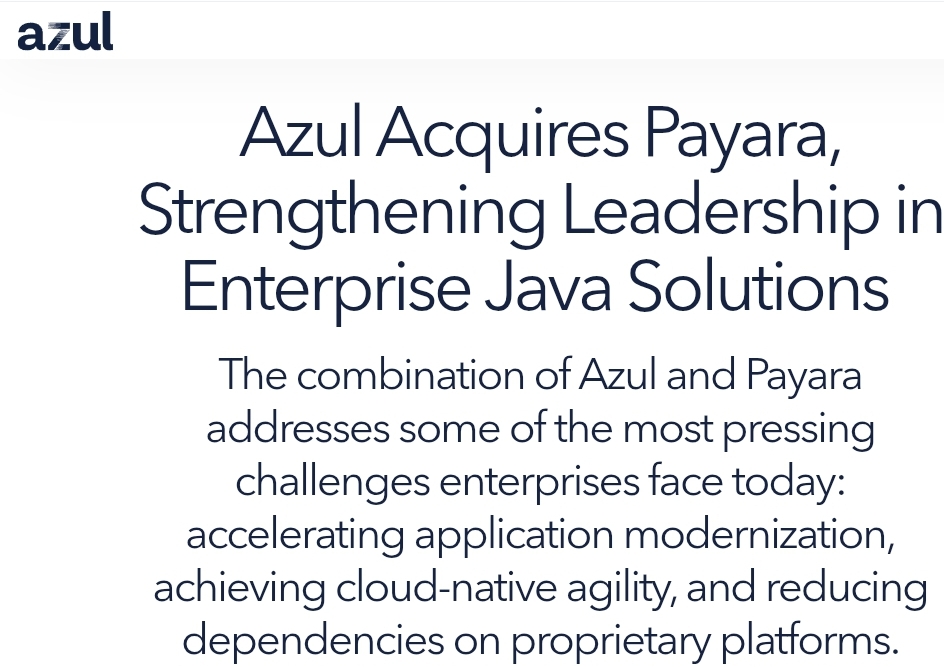
This isn’t fiction. It’s the story unfolding across enterprises modernizing their ecosystems—and Azul’s strategic acquisition of Payara offers a blueprint for how tech precision meets customer innovation.
What Is Driving the Need for CX Agility in Java-Heavy Enterprises?
CX agility means the ability to deliver fast, personalized, and resilient customer experiences in an ever-changing digital environment.
With over 36% of the Fortune 100 relying on Azul, the company’s acquisition of Payara signals more than a business expansion—it’s a response to enterprise pain points: fragmented journeys, legacy dependencies, and rising customer expectations for seamless digital engagement.
Key pressures behind this shift:
- Tech fragmentation: Legacy Java applications slow down customer innovation cycles.
- Security and compliance: Fintechs and healthcare firms need consistent protection across microservices.
- Cloud-native readiness: Hybrid and multi-cloud deployments demand platform unification.
- AI integration: Without data orchestration, AI-driven CX personalization falters.
When systems don’t speak the same language, customer journeys falter—and every second of lag translates to lost trust.
How Does the Azul–Payara Synergy Empower CX Transformation?
By uniting complementary, open-source Java solutions, Azul and Payara enable faster modernization, better cost efficiency, and increased CX innovation.
Azul’s strength lies in performance, scalability, and Java runtime optimization. Payara brings deep experience in Jakarta EE–based applications and microservices. Together, they create a full-stack enterprise Java ecosystem—secure, cloud-native, and aligned for customer-centric agility.
Why this matters for CX leaders:
- Unified application stack: Reduces friction across journeys spanning legacy and modern systems.
- Lower latency: Faster backend translates into real-time personalization on the front end.
- Open-source flexibility: No vendor lock-in means teams can innovate freely across regions.
- Resilient infrastructure: Consistent performance across business-critical applications fosters trust in digital channels.
As Azul CEO Scott Sellers put it, this move is designed to “support global enterprises’ need for modernization and agility.” For CX leaders, that phrase—“modernization and agility”—is the gateway to resilient experiences and scalable innovation.
What Can CX leaders Learn from Azul’s Open-Source Mindset?
Open-source thinking mirrors the core philosophy of great customer experience—transparency, collaboration, and continuous improvement.
When Azul embraced Payara, it wasn’t just adopting technology; it was endorsing a mindset. In CX, the equivalent is building open frameworks—shared data, connected teams, and iterative improvement loops.
Here’s how the parallel applies:
| Open-Source Principle | CX Strategy Parallel |
|---|---|
| Shared innovation | Co-creation with customers |
| Continuous iteration | Agile journey optimization |
| Transparency | Open data and feedback loops |
| Community support | CX ecosystems across partners |
Just as open-source code evolves through contribution, CX ecosystems evolve through collaboration—between IT, marketing, operations, and support. Azul’s playbook reinforces that open collaboration = scalable CX success.
Are Siloed Systems Still the Biggest Obstacle to Unified CX?
Yes. Despite AI advancements, disconnected systems remain the top barrier to cohesive experiences.
A 2024 CXQuest.com study revealed that 67% of CX leaders struggle with journey fragmentation due to platform silos. Tools exist—AIOps, cloud data fabrics, integration middleware—but without common architectures like the unified Java ecosystem Azul and Payara now offer, execution remains patchy.
Common Pitfalls Seen in CX Modernization:
- Data friction: Customer and developer insights trapped in separate silos.
- Tech overreach: Adopting too many unaligned tools.
- AI limitation: Lacking unified data source reduces prediction quality.
- Shadow IT: Departments bypass governance to deliver CX fixes faster.
The learning? Modernization isn’t about adding layers—it’s about removing barriers.
How Can Tech Consolidation Translate into Better EX (Employee Experience)?
When developers, IT, and CX teams work on unified platforms, innovation flows faster and burnout falls.
Azul and Payara’s integration reduces operational complexity for enterprise engineers. For CX pros, that translates into faster iteration, consistent customer data governance, and smoother experimentation.
Key EX benefits of unified architecture:
- Shorter development cycles through shared microservices.
- Consistent SLAs improving reliability.
- Reduced cognitive load on IT teams managing multiple vendor systems.
- Empowered autonomy to innovate within safe, governed environments.
A CX transformation always begins with internal experience transformation. Azul’s strategy proves that empowerment at the core radiates empathy at the edge.
What Framework Can CX Teams Adopt from This Case?
The 4A Framework for CX Modernization, inspired by Azul–Payara’s synergy, helps leaders reimagine their architectures around agility and openness:
| Stage | Focus | CX Outcome |
|---|---|---|
| Align | Map customer and developer journeys to shared outcomes. | Unified vision across teams. |
| Architect | Consolidate technologies using open standards. | Seamless omnichannel foundation. |
| Automate | Use AI and AIOps to monitor performance. | Predictive experience delivery. |
| Amplify | Scale innovation through feedback-driven iteration. | Faster, resilient CX evolution. |
Applied in practice, this framework transforms fragmented ecosystems into adaptive experience networks—just as Azul’s open platform transforms legacy Java fleets.
How Do These Lessons Apply Beyond Java?
The Azul–Payara case teaches universal CX truths: technical agility fuels emotional loyalty.
Whether your infrastructure runs on Java, .NET, or hybrid cloud APIs, the goal remains the same—connect everything that customers touch into a seamless narrative.
When teams align architecture with empathy and automation, CX maturity rises. Every tech integration should serve a single metric: customer lifetime engagement.
Key Insights
- Digital fragmentation is the invisible enemy of CX innovation.
- Open architectures drive trust, transparency, and transformation.
- Unified tech ecosystems reduce total experience friction.
- CX agility requires constant synchronization between IT and design.
- Modernization is culture change as much as it is code change.
FAQ
1. How does Azul’s acquisition benefit enterprise CX teams directly?
It provides a unified, secure Java ecosystem that boosts performance, reliability, and innovation—key enablers of faster CX delivery in complex environments.
2. Can open-source architectures really improve customer experience?
Yes. They encourage transparency, reduce vendor dependency, and enable teams to build exactly what customers need, faster and cheaper.
3. What should CX leaders prioritize when modernizing legacy systems?
Focus on scalability, interoperability, and developer empowerment rather than isolated tool adoption.
4. How do open-source and cloud-native strategies complement each other?
Together, they create flexible, scalable infrastructures where applications grow and adapt to real-time CX demands.
5. What role does AI play in such unified ecosystems?
AI thrives when data and processes are connected. Integrated platforms like Azul–Payara create AI-ready environments for better personalization and predictive CX.
6. How can CX leaders reduce resistance to open innovation?
Start with pilot projects, highlight speed-to-value metrics, and model transparency as a cultural value, not just a technical decision.
Actionable Takeaways for CX Leaders
- Audit your CX architecture—map out silos, duplications, and integration gaps.
- Adopt open standards where possible to reduce vendor lock-in.
- Form CX–IT alignment squads to bridge customer journey design and backend engineering.
- Modernize incrementally—prioritize high-impact journeys before full transformation.
- Leverage AI operationally, not decoratively—use it to predict, prevent, and personalize.
- Measure latency and satisfaction together—speed has become part of experience quality.
- Champion open collaboration internal and external—to spark a culture of shared innovation.
- Draw inspiration from Azul–Payara: unify technology, elevate experience, and accelerate trust.
