

When AI Support Stops Being a Bot and Starts Being a Team Member – By Alix Gallardo, Co-founder of Invent
Support today is already multiplayer: agents, specialists, operations, product managers, plus a tangle of tools and systems. Dropping a single, isolated bot into that ecosystem and calling it “AI transformation” misses the point.
What happens when AI joins the team instead of replacing it?
That’s the shift that actually matters.
The Problem Is Bad Framing
We’ve spent the last few years watching the same pattern:
- A chatbot answers FAQs, does fine on “What’s your refund policy?” and then falls apart on anything with nuance.
- Customers get bounced between bot and human, repeating themselves.
- Agents inherit half‑broken conversations and clean up the mess.
- Leaders quietly turn down the AI dials “for safety.”
- On the other end, there are heavy platforms that promise total control, if you’re willing to redesign your processes around them and maintain flows like they’re legacy codebases.
Both approaches share a hidden assumption:
Support is a one‑to‑one interaction (bot vs. customer) that can be replaced.
But inside most organizations, support doesn’t look like that at all.
Support as It Actually Exists: A Multiplayer System
A single, “simple” request can touch:
- An AI assistant (if one exists)
- A frontline agent
- A specialist or on‑call lead
- Operations people updating macros or docs
- Product or engineering, if the issue is systemic
- CRMs, billing tools, incident trackers, internal dashboards
Roles constantly shift:
- AI starts the conversation, humans finish it.
- Humans solve something today that AI should recognize tomorrow.
- Great human replies become templates, or they die in a private thread no one ever reuses.
Support is a living, multiplayer system where knowledge, responsibility, and context pass between actors all day long.
That’s where most current AI tools fail: they don’t join this system, they sit next to it.
Multiplayer AI: Same Context, Same Workspace, Shared Goals
AI is another participant in the support team, working in the same place, with the same information, toward the same goal: real resolution.
That implies a very different shape of tooling:
- Shared context
AI doesn’t just see a prompt; it sees customer history, preferences, and relevant internal data. - Shared workspace
Agents and AI operate in the same environment. Handoffs don’t feel like restarting the conversation; they feel like tagging in a colleague. - Continuous learning
Every tricky human resolution can become a pattern the system learns from, whether that means full automation next time, or simply a better starting point for the next human.
In practice, multiplayer AI is a collaborative layer that connects people, models, and systems.
Orchestration Is the Real Product, Not a Single Model
The industry often behaves as if the right large language model is the prize. In support work, that’s a distraction.
Different parts of the job need different capabilities:
- Use small, cheap models for quick classification and routing.
- Use search + embeddings to find the right answer in thousands of documents.
- Use stronger, more expensive models for long, emotional, multi‑threaded conversations.
What matters isn’t picking a single winner; it’s orchestrating all of this coherently:
- Route each task to the right tool.
- Fail gracefully when something breaks.
- Balance cost, speed, and accuracy.
- Hide the technical complexity from agents and customers.
For a support lead, the interesting question isn’t “Which model are we using?” It’s:
- Where can we trust automation?
- Where do humans need to stay firmly in the loop?
- How do we design collaboration between Humans and AI?
Human-Led, AI-Amplified Support
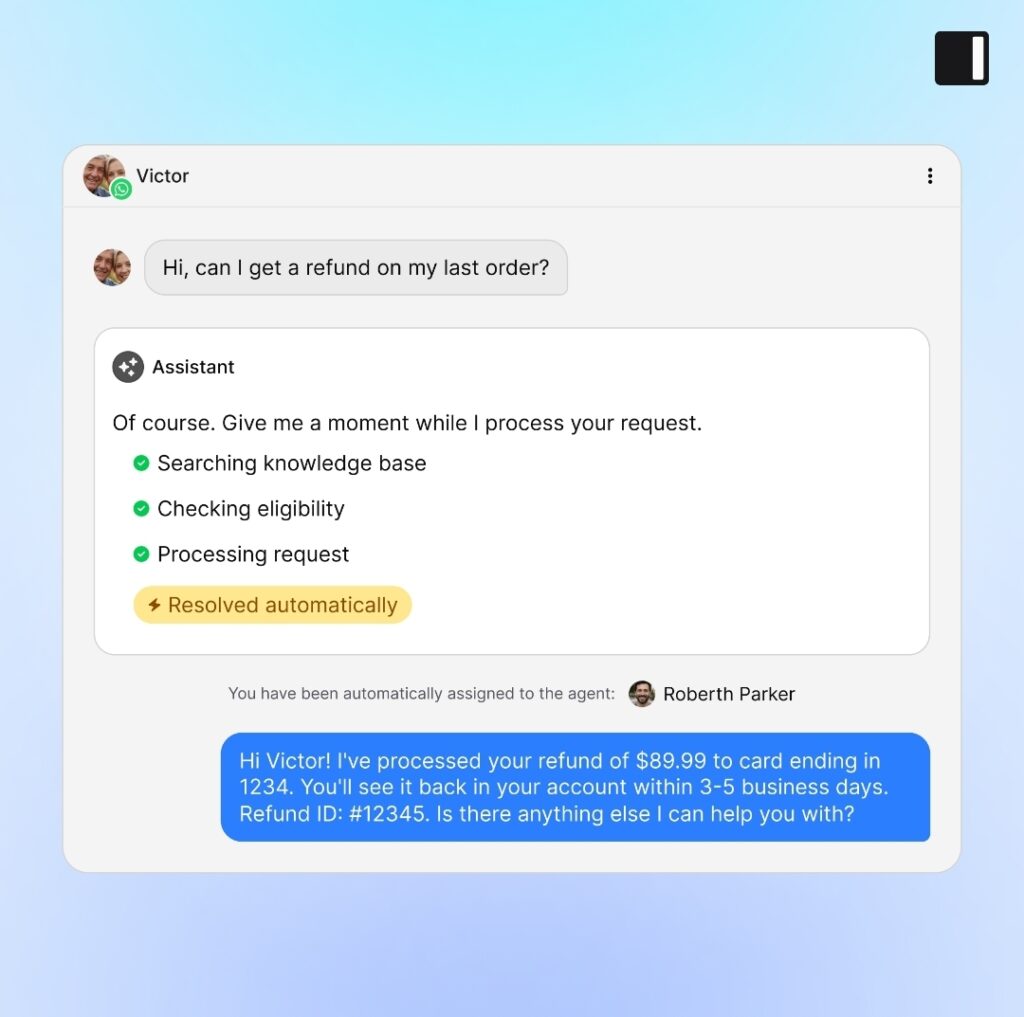
AI handles the repetitive, clearly defined work: password resets, plan details, policy clarifications, and order status checks, across channels and time zones.
Humans handle ambiguous, emotional, high‑stakes cases as escalations, edge cases, relationship‑sensitive situations where trust, creativity, and accountability matter.
The System Itself Becomes the Memory
Each resolved issue, whether by AI or human, makes the next similar issue easier, faster, and less painful.
Ultimately, the value is a support system that learns from the people doing the work instead of fighting them.
Why This Shift Matters Beyond Support Teams
This isn’t just a customer service story. It’s a preview of how human-AI collaboration will look across work in general:
- AI as a peer in shared workspaces, not a hidden black box.
- Human judgment steering when to trust, when to override, and when to teach.
- Organizations treating knowledge as a shared, constantly evolving, not a static knowledge base.
The real future of AI at work is multiplayer: multiple humans, multiple models, one shared context.
Support just happens to be where we’re seeing it first.
Ready for this new vision of Customer Support and AI?
Alix Gallardo
@agnamihira
Co-founder of Invent
Author’s Bio: Alix Gallardo is a product strategist and founder focused on designing human‑centered AI experiences. As Founder & Product Consultant at Zydeer and Co‑founder of Invent, she helps teams transform abstract ideas into scalable digital products, bridging user research, product vision, and AI implementation. With a background in digital innovation and UX, Alix has led initiatives across Latin America and the U.S., collaborating with startups, enterprises, and communities to make emerging technologies more accessible and useful in real life.
