
From Fragmented Silos to Orchestrated Journeys: Breaking the CX Fragmentation Trap
Sarah is the VP of Customer Experience at a mid-market fintech company. On paper, her metrics look stellar—customer satisfaction is at 82%, her support team’s resolution time has dropped 35% since AI implementation, and marketing campaigns are converting at record rates. But there’s a problem nobody’s talking about publicly: customers are leaving anyway. This is nothing but CX fragmentation trap.
Last quarter, a customer complained to support about a duplicate charge. The support team refunded it immediately. Three days later, the same customer received an email from Sarah’s marketing team recommending a premium tier upgrade—completely oblivious to the previous issue. The customer unsubscribed. Sarah didn’t know about it until her churn analysts flagged the pattern two weeks later. By then, five similar incidents had occurred. Another instance of CX fragmentation trap.
Sarah’s department had invested heavily in AI, automated workflows, and sophisticated CRM systems. What she didn’t have was a unified view of the customer across those fragmented silos. Her marketing team, support team, and product team were speaking different languages, optimizing for different KPIs, and delivering experiences that felt coordinated to no one. As a matter of fact, despite heavy investment in automation of workflows, nobody thought about CX fragmentation trap.
If this scenario feels uncomfortably familiar, you’re not alone. In 2025, fragmented customer experience isn’t a technical problem—it’s a organizational architecture problem. And this CX fragmentation trap is silently destroying loyalty faster than any single channel failure ever could.
What Is Journey Fragmentation, and Why Are CX Leaders Losing Sleep Over CX Fragmentation Trap?
Journey fragmentation occurs when customer interactions across touchpoints, channels, and teams operate independently rather than as a unified ecosystem. A customer’s journey should feel like one coherent narrative. Instead, many organizations deliver a patchwork of disconnected experiences: marketing doesn’t know what support promised, product doesn’t reflect what sales sold, and the actual lived experience bears little resemblance to the brand’s intended positioning. The system is deeply affected by CX Fragmentation trap.
The problem isn’t that these functions exist. It’s that they operate in silos—separate teams, separate data systems, separate KPIs, separate budgets. This organizational structure made sense in the pre-digital era when customer touchpoints were limited and sequential. Today, it’s the silent CX killer.
Why it matters: 74% of CX technology investments fail because of silos, not because the tools are bad. Customers don’t experience your brand channel by channel. They experience it as a single relationship. When that relationship is fragmented, every interaction feels transactional, and loyalty erodes faster than engagement metrics suggest.
The Three Root Causes of CX Fragmentation Trap: A Candid Look
1. Data Lives in Disconnected Systems (Not in a Unified Home)
Most organizations operate with customer information scattered across incompatible systems: your CRM handles sales data, your marketing automation tracks engagement differently, your support ticketing system has its own view of the customer, and your analytics platform sees yet another version. Each system speaks a different language and maintains its own version of truth.
The result? When your email system recommends products to a customer who just complained to support about precisely those products, nobody is surprised anymore. Without a unified customer profile, AI recommendations actively undermine trust.
The infrastructure truth: 70% of organizations report persistent headaches in data governance, system integration, and training data quality—even among AI high-performers. Building that single customer view requires significant investment in data infrastructure that most CX leaders don’t control.
2. Organizational Structures That Reward Individual Channel Optimization
Marketing optimizes for acquisition and engagement metrics. Support optimizes for resolution speed and ticket deflection. Product optimizes for feature adoption and retention within the app. Each team wins locally by their metrics while the customer loses globally.
When a fintech company’s marketing team celebrates a 35% increase in support ticket volume (because campaigns drove more sign-ups), while the support team panics about capacity, nobody asks: “Is this good for the customer?” The answer often isn’t.
The governance gap: One-third of enterprise AI leaders identify skills gaps as their biggest roadblock, while 28% can’t figure out how to integrate AI into existing systems. Cross-functional alignment requires not just tools but shared ownership, shared budgets, and shared KPIs—organizational changes that most companies struggle to implement.
3. Technology Decisions Made in a Vacuum
Organizations typically buy point solutions to solve immediate pain points: a chatbot for support volume, a CDP for personalization, a sentiment analysis tool for insights. Each tool is sophisticated on its own. Combined, they create integration nightmares and siloed data architectures.
The cost reality: 63% of enterprises report delayed AI deployments due to legacy integration challenges, with 41% experiencing project cost increases of 30–50%. The true cost of fragmentation isn’t just misaligned experiences—it’s the exponentially increasing complexity and cost of trying to stitch systems together post-hoc.
The Business Impact: What Fragmentation Actually Costs
The metrics that make executives pay attention: improving retention by just 5% can increase profits by 25% to 95%. Small frustrations pile up. A customer navigates a confusing website, encounters a script-bound chatbot that can’t escalate, finally reaches a human agent with no context of previous interactions, and receives a follow-up email from marketing promoting the exact service they just complained about.
That customer doesn’t complain. They just quietly leave.
The silent damage: Departments celebrate their wins (marketing’s engagement is up, support’s deflection is up, product’s adoption is up), while churn creeps upward. Leadership doesn’t connect the dots until the churn analysts flag a pattern six weeks later.
Why AI and Automation Make CX Fragmentation Trap Worse (Not Better)
Here’s the uncomfortable truth: poorly implemented AI in fragmented organizations doesn’t fix fragmentation—it amplifies it. When you activate AI without a unified data foundation, you get expensive personalization engines that recommend the wrong products, chatbots that frustrate customers, and predictive models trained on incomplete data that miss obvious churn signals.
88% of consumers prefer live agents for sensitive issues, citing frustration with AI’s inability to interpret emotional context.[8] Yet many organizations, eager to reduce costs, deploy aggressive deflection strategies that push customers toward automated systems precisely when human judgment and empathy matter most.
Organizations using hybrid models (AI handling routine tasks, humans handling complex/emotional issues) see 22% higher CSAT scores compared to fully automated systems.[9] But building that balance requires coordinated decisions across channels—which fragmented organizations struggle to make.
From Fragmentation to Orchestration: The Five-Stage Maturity Journey
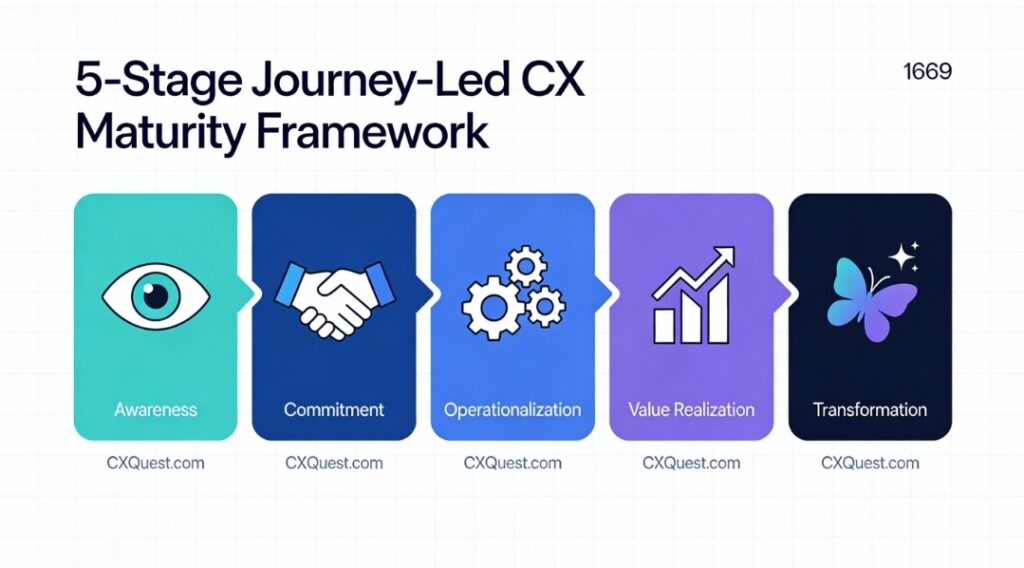
Breaking fragmentation isn’t a technology project. It’s an organizational transformation. Research identifies five maturity stages organizations must navigate:
Stage 1: Awareness — Leaders recognize that despite strong departmental metrics, customers are dissatisfied. This requires courage to admit that the current structure isn’t serving customers well.
Stage 2: Commitment — The organization secures resources, assigns clear ownership, and creates governance structures that span silos. This is where most organizations stall because it requires visible budget reallocation from existing departments.
Stage 3: Operationalization — Teams redesign workflows around journeys, not channels. Marketing and support create shared response protocols. Product and CX align on design priorities. Technology investments prioritize integration over point solutions.
Stage 4: Value Realization — Metrics shift from departmental KPIs to journey-level metrics. Customer satisfaction and retention improve demonstrably. Leadership sees CX as a business engine, not a cost center.
Stage 5: Transformation — CX becomes organizational DNA. Teams organize around customer journeys. Innovation starts with customer pain points. The company doesn’t do journey management—it is journey-led.
Most organizations are stuck in Stages 1–2, where awareness exists but structural change hasn’t scaled.
The Unified Profile: The Foundation Every Organization Needs
The antidote to data fragmentation is a Customer Data Platform (CDP) that creates unified customer profiles. Not a CRM. Not a CDP that lives in a silo. A true unified profile that integrates data from every touchpoint—CRM, support systems, website analytics, social channels, purchase history, support transcripts, behavioral signals.
This unified profile serves as a single source of truth. When a customer emails support, the agent sees their complete history. When marketing sends a follow-up, it reflects what just happened in support. And, when product teams design features, they prioritize based on patterns across all customer interactions.
Real-world impact: Sephora saw a 25% increase in sales by leveraging unified customer profiles to deliver truly personalized experiences. This isn’t theoretical—it’s operational.
Building a unified profile requires solving identity resolution (matching records across systems), data governance (ensuring quality and compliance), and real-time activation (ensuring data flows to every system that needs it).
The Three Metrics That Actually Matter: NPS, CSAT, and CES
Fragmented organizations measure fragmented metrics. To break fragmentation, measure the journey.
- CSAT (Customer Satisfaction Score): Measures satisfaction with specific interactions. Use immediately after purchase or support contact. Shows if individual touchpoints are delivering.
- NPS (Net Promoter Score): Measures willingness to recommend. Track quarterly or annually. Shows if the overall relationship is strong enough to drive advocacy.
- CES (Customer Effort Score): Measures effort required to complete a task. Use immediately after transaction or resolution. Identifies friction points that make customers work too hard.
Organizations using all three metrics together outperform competitors in retention and revenue growth. Why? Because they see the customer’s reality holistically: individual interactions (CSAT), overall relationship (NPS), and process friction (CES).
Most fragmented organizations use only CSAT (reactively, after issues) or only NPS (annually, without actionable specificity). They’re flying blind.
How to Build Omnichannel Customer Journey Maps That Actually Get Used
Journey mapping is the practical tool that turns strategic commitment into operational reality. A strong omnichannel journey map includes five elements:
- Customer Personas: Based on real behavioral, demographic, and psychographic data (not assumptions). Who are you serving? What problems are they solving?
- Lifecycle Stages: Awareness → Consideration → Purchase → Retention → Advocacy. What does the customer need at each stage? What messages resonate?
- Touchpoints: Every interaction, digital or physical. Where is the customer interacting? Is the experience consistent?
- Emotions and Pain Points: Not just actions, but feelings. Where do customers feel frustrated, confused, or delighted? These emotional moments drive loyalty or churn.
- Data-Driven Insights: Which channels drive engagement for which personas? Where do customers drop off? What patterns emerge from real behavior?
The output isn’t a pretty PowerPoint slide. It’s an operational asset that guides prioritization, informs cross-functional decisions, and serves as a communication tool that helps fragmented teams see the customer’s reality.
Common Pitfalls to Avoid
Pitfall 1: Building maps based on assumptions, not data. The best maps are built on interviews, surveys, CRM records, analytics, and support transcripts. If your map surprises your support team, it’s probably wrong.
Pitfall 2: Creating maps in marketing silos. Journey maps must involve product, support, sales, and operations. Each function owns a different part of the journey. Leave anyone out, and the map becomes a marketing artifact instead of an operational tool.
Pitfall 3: Treating the map as a finished deliverable. Customer behavior changes constantly. New channels emerge. Expectations shift. Maps should be quarterly living documents, not annual projects.
Pitfall 4: Over-complicating the map. If your map includes every possible interaction, it becomes overwhelming and useless. Prioritize the touchpoints that matter most to customer satisfaction and business outcomes.
Building Your Cross-Functional Journey Team (The Practical Model)
Breaking silos requires structural change. The emerging best practice is the journey team—a cross-functional group responsible for designing and optimizing a specific journey.
Typical composition: CX strategist (owns customer insights and journey strategy), UX practitioner (owns interaction design), product owner (provides product perspective), marketing stakeholder (ensures brand consistency), support representative (ensures operationalization), technology resource (addresses integration feasibility).
This team meets regularly, uses shared KPIs, works from a shared budget, and has the authority to make decisions that span departments. They organize around the customer’s journey, not around departmental silos.
This structure works because it doesn’t eliminate silos (which provide necessary specialization). Instead, it creates connectivity and collaboration across silos. Product teams still operate independently. Marketing still optimizes campaigns. Support still manages tickets. But they all report to a journey-level strategy that ensures their work coheres.
Key Insights: What Separates Leaders from Laggards
Organizations breaking fragmentation share these characteristics:
- Executive sponsorship. Transformation requires visible support from C-level leadership because it involves resource reallocation across departments.
- Clear ownership. Someone (not a committee) owns the journey. They have authority to make trade-offs and ensure alignment.
- Shared KPIs and budgets. When teams share budgets and metrics, incentives align. Product doesn’t over-optimize for engagement when it damages retention.
- Investment in data infrastructure. Unified profiles don’t happen by accident. They require deliberate investment in CDPs, APIs, and data governance.
- Balanced automation. AI augments humans; it doesn’t replace them, especially for complex or emotional interactions.
- Regular measurement and iteration. Journey metrics (NPS, CSAT, CES) guide ongoing optimization. Changes are tested before scaling.
FAQ: What CX Leaders Are Asking
Q: How do we get started if our organization has deep silos?
A: Start small. Pick one high-impact journey (onboarding, renewal, churn recovery). Form a journey team. Build a unified customer profile for that journey. Prove value. Use success as proof-of-concept for organizational expansion.
Q: Should CX and UX be in the same department?
A: Research shows it helps significantly. Shared strategy and shared budgets prevent the conflicting priorities that derail journey-level design. If organizational structures don’t allow it, create explicit governance that forces alignment.
Q: How long does fragmentation fix take?
A: Organizations typically spend 18–24 months moving from awareness to operationalization. Value Realization takes another 12–18 months. Transformation is continuous. Quick wins appear within 3–6 months if you start with focused journeys.
Q: What’s the ROI of breaking fragmentation?
A: Link metrics to business outcomes. Retention improvements directly impact CLV. Reduced support costs from better upfront onboarding. Increased upsell from personalization. Reduced churn from proactive interventions. Conservative estimates show 2–3x ROI within 18 months.
Q: How do we handle the skills gap? We don’t have AI translators who speak both business and technology.
A: This is real. Build hybrid teams that pair domain experts (who understand CX deeply) with technical specialists (who understand data architecture). Invest in upskilling existing teams rather than hiring. Partner with external advisors to accelerate learning.
Actionable Takeaways: Your 90-Day Roadmap
A. Week 1–2: Diagnosis
- Audit your current data infrastructure. Where does customer information live? How fragmented is it?
- Interview customers. Ask about their experience across channels. Where do they feel friction?
- Map current departmental KPIs. Where are teams incentivized differently?
B. Week 3–4: Vision & Sponsorship
- Identify executive sponsor committed to journey-level thinking.
- Define your first high-impact journey (customer onboarding, renewal, or churn recovery).
- Build business case: How does fixing this journey improve retention, satisfaction, and revenue?
C. Week 5–6: Foundation
- Select CDP or customer data platform to create unified profiles (this is non-negotiable).
- Begin API integrations connecting your CRM, support, analytics, and marketing systems.
- Establish data governance protocols ensuring quality and compliance.
D. Week 7–8: Journey Mapping
- Form journey team (CX, product, UX, marketing, support, tech stakeholder).
- Collect real data from customers and teams.
- Map current state with emotions, pain points, and friction.
- Identify quick wins (3–4 low-cost changes likely to improve satisfaction).
E. Week 9–12: Testing & Iteration
- Pilot quick wins with subset of customers.
- Measure impact on CSAT, CES, and behavior.
- Celebrate wins internally. Use momentum to secure resources for next phase.
- Document learnings for expansion to other journeys.
The Invitation: Shift from Isolated Optimization to Orchestrated Excellence
Fragmentation feels normal because silos have been organizational reality for decades. Departmental metrics feel legitimate because they’re easier to measure than journey metrics. But customers don’t experience your brand departmentally. They experience it journeys.
Breaking fragmentation requires courage—to admit current structures aren’t serving customers, to reallocate resources, to organize teams differently. It requires investment in data infrastructure and operational changes that span traditionally separate functions.
But the payoff is profound: customers who feel understood rather than transacted, retention that improves because experiences cohere rather than conflict, and competitive differentiation that’s genuinely difficult to replicate because it requires organizational alignment that competitors struggle to achieve.
The question isn’t whether you can afford to break fragmentation. It’s whether you can afford not to.
About CXQuest: CXQuest helps CX leaders design orchestrated customer journeys that drive loyalty, retention, and growth. Our framework combines journey mapping, unified customer profiles, and cross-functional governance to transform fragmented efforts into coordinated experiences.
