
India’s AI Adoption Boom and Customer Lifetime Value: Why Your CX Still Feels Broken (And How to Fix It)
Customer Lifetime Value: The Paradox That’s Costing You Revenue
Imagine this: A customer in Bengaluru opens her bank’s mobile app and receives an AI-powered loan recommendation based on her transaction history. Impressed, she clicks through to apply. The form loads, but it’s asking for information the app already captured. She switches to live chat for help. A different system. Different context. Different agent handling. Her frustration escalates. She abandons the application.
What she doesn’t know: That bank is in the top quartile of India’s AI-adopting enterprises.
India doesn’t have an artificial intelligence problem. It has an integration problem. While the country celebrates becoming the world’s third-ranked AI power—ahead of the UK, South Korea, and nearly every developed economy—its enterprises are buying AI solutions faster than they can wire them together. The result? Customers experience fragmented journeys powered by disconnected algorithms.
This is the CX paradox of India’s AI moment: We’ve conquered adoption. We haven’t conquered orchestration. Where’s the Customer Lifetime Value.
Why India’s AI Leadership Numbers Tell Only Half the Story
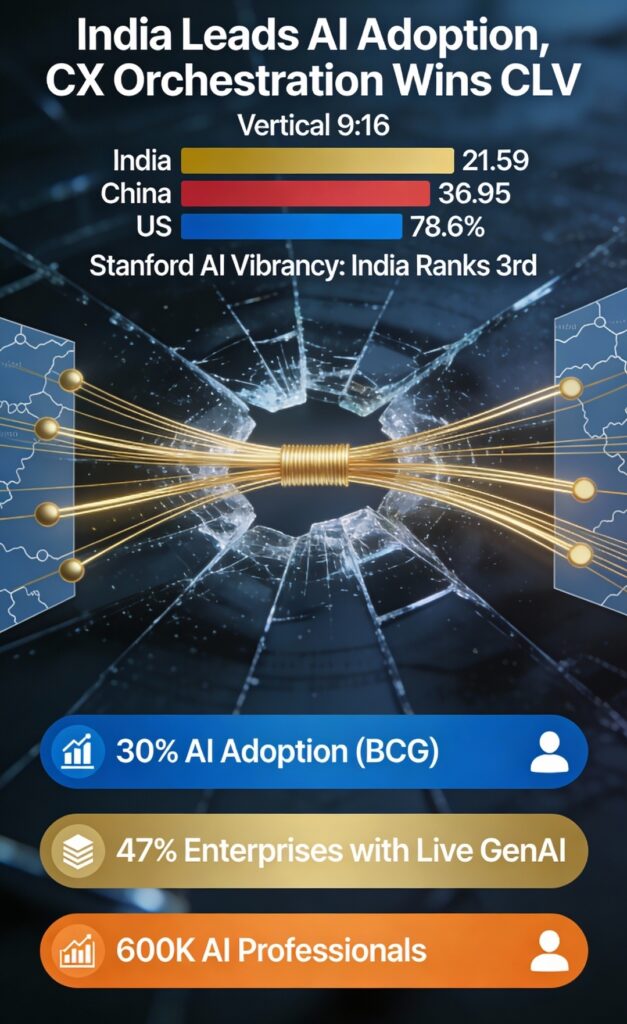
The headlines are undeniable. According to the Boston Consulting Group, India leads global enterprise AI adoption at 30%, outpacing the global average of 26%. Stanford University’s 2025 Global AI Vibrancy Tool ranks India an impressive third globally—jumping from seventh place just one year prior—behind only the US and China. Indian enterprises now have 600,000 AI professionals, the second-largest GitHub contributor base for AI projects globally, and government backing through the IndiaAI Mission (Rs. 10,300 crore budget). Nearly 47% of Indian enterprises have shifted beyond experimentation into live production with multiple GenAI use cases running simultaneously. The momentum is real, and it’s unprecedented for an emerging economy.
But here’s what the adoption metrics obscure: Nearly half of Indian enterprises still operate with fragmented CX architectures. Limited cross-department alignment ranks as the #1 CX challenge for 43% of organizations. Siloed systems create integration headaches for 38%. While 81% of Indian consumers expect brands to adopt AI for hyper-personalization and seamless support, their actual experiences tell a different story. Only 24% of customers report that their needs are truly met—despite leaders’ 80% confidence in their CX strategies.
The disconnect isn’t accidental. It’s structural.
Three Silos That Are Silently Damaging Your CX (And Revenue)
When AI adoption happens in isolation, it reinforces the very fragmentation it’s meant to solve. CX leaders face three recurring failures that transform promising AI pilots into siloed efficiency gains.
1. The Technology-First Trap: Buying AI Before Defining Purpose
The typical scenario: An IT director hears about enterprise ChatGPT. She runs a quick business case, identifies a use case (customer service automation), and deploys a solution within weeks. It works beautifully—ticket resolution time drops 35%, deflection improves. The team is celebrated.
Simultaneously, the marketing department independently procures a different GenAI platform for campaign personalization. The finance team licenses another tool for document processing. The product team implements yet another for insight mining. Each deployment optimizes its own KPIs. None talk to one another.
This is the technology-first trap, and it’s rampant across Indian enterprises. When departments select and deploy AI tools before establishing shared business outcomes, they create what Harvard Business Review calls “siloed AI implementations.” Each function improves individual operations while the organization becomes less able to deliver on corporate strategy.
Why this matters for CX: A customer’s journey spans multiple departments. Marketing promises personalization; service delivers generic responses. Sales makes a commitment; operations can’t fulfill it. Billing contradicts marketing. Each handoff forces the customer to repeat details, re-authenticate, and start over. When these systems don’t share context, the customer doesn’t experience a unified company—she experiences five separate, barely coordinated entities.
2. Duplication and Contradiction: When AI Models Disagree
Picture this real scenario (names changed): A major Indian bank’s risk management AI flags a specific customer segment as high-risk based on traditional credit scores and historical loan performance. Simultaneously, the marketing team’s customer acquisition AI—analyzing digital behavior and social media signals—identifies the exact same segment as prime acquisition targets.
The conflict is expensive. Should the bank aggressively market to these customers, as marketing advocates, or avoid them, as risk management advises? The data science teams are using different datasets, different models, different definitions of risk. Nobody has a shared truth.
This scenario repeats across Indian enterprises because individual departments often:
- Operate with separate data ecosystems (fragmented sources of truth)
- Optimize for contradictory metrics (efficiency vs. customer lifetime value)
- Make decisions in isolation without cross-functional visibility
Result: Customers experience contradictory messages. Personalization feels random. Recommendations seem tone-deaf. Trust erodes.
3. Fragmented Customer Journeys: The $136.8 Billion Problem
India loses hundreds of millions annually to preventable churn. The root cause isn’t bad service. It’s broken handoffs.
Here’s what a typical fragmented journey looks like in Indian financial services:
- Digital Channel: Customer starts exploring a loan on the app, fills out initial details, abandons due to complexity.
- Phone: She calls to ask questions. The agent has zero visibility into her app session, doesn’t know she’s already filled in half the form, and starts from scratch.
- Branch: She visits a branch. The branch system shows a different profile. Different balance. Different customer status. Is she active or dormant? Are these separate applications or one customer?
- Email: She receives a marketing email for a completely different product, suggesting she’s not engaged with her current application status.
At every boundary, the customer becomes a stranger. She repeats information. She clarifies misunderstandings. Above all, she gradually loses confidence that anyone actually understands her situation. By interaction four, she switches to a competitor.
This isn’t just a service problem. It’s a data and systems problem. And when CX leaders bolt AI onto these fragmented foundations, the fragmentation accelerates.
What’s Really Driving India’s Enterprise AI Shift?
To fix these silos, CX leaders must understand why adoption is accelerating in the first place—then redirect that momentum toward integration instead.
What India’s CX leaders are actually prioritizing (in order): customer service automation (54%), operational efficiency (63%), and marketing personalization (33%). Each is a high-ROI use case. Each makes sense in isolation.
What’s changing the game: Speed has become the competitive metric. 91% of business leaders now cite rapid deployment as the biggest factor influencing their “buy vs. build” decisions. In other words, enterprises are choosing speed over architectural coherence.
Additionally, the skill base is expanding. India has 600,000 AI professionals and produced the world’s highest year-on-year growth in AI hiring. No-code platforms have democratized GenAI adoption, allowing teams to experiment without waiting for data science support. Accessibility is driving adoption—and fragmentation.
The five-dimensional ROI model is also shifting thinking. Rather than measuring AI purely through cost savings and productivity gains, enterprises now evaluate:
- Time saved
- Efficiency improvements
- Business upside (revenue, retention)
- Strategic differentiation
- Organizational resilience
This broader view creates both opportunity and risk. Opportunity because leaders now see AI’s potential beyond automation. Risk because they’re not waiting for integrated infrastructure before they pursue these opportunities.
From Fragmentation to Orchestration: The Framework CX Leaders Need.
Breaking down organizational silos while scaling AI requires moving from a “process-first” to a “purpose-first” approach. Here’s how leading companies are doing it:
Step 1: Define Your Shared Purpose, Not Processes
Instead of letting individual departments optimize their processes, start with a single overarching business outcome. A major Indian e-commerce retailer provides a powerful example: Rather than letting departments pursue separate goals (customer service improving response times, inventory reducing stockouts, marketing driving conversions), the company declared a unified purpose: improve customer lifetime value across every interaction.
This single purpose became the north star. It forced departments to make tradeoffs. Should we chat-automate a question the customer could learn from (higher CLV), or deflect it for speed (lower CLV)? The answer became clear. Suddenly departments aligned.
For CX teams: Don’t ask “How do we automate this?” Ask “How does this interaction contribute to customer lifetime value, retention, or advocacy?” Let that answer determine which AI tool you choose and how you implement it.
Step 2: Build a Hub-and-Spoke Model
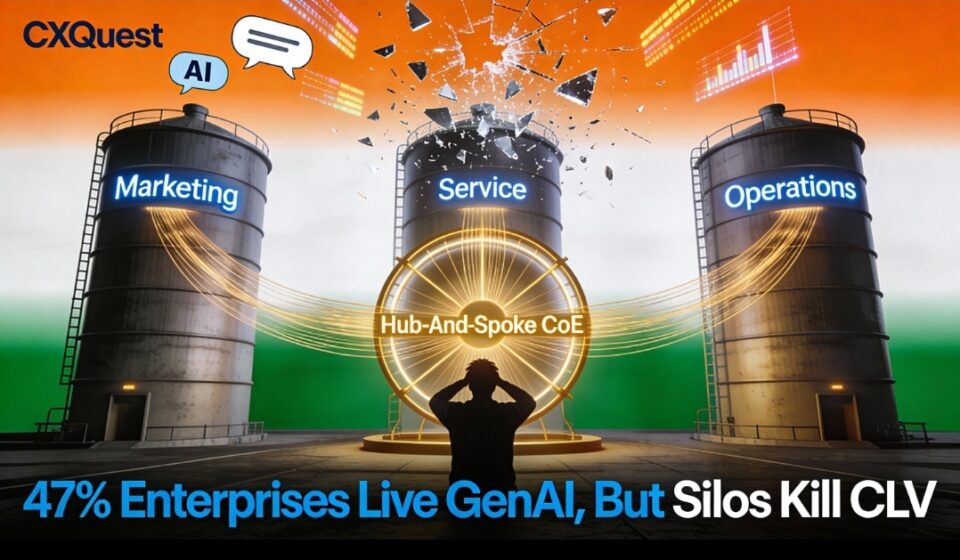
The AI Center of Excellence (CoE) model is proving effective across Indian enterprises. The hub houses your organization’s top AI experts, governance frameworks, and shared infrastructure. The spokes are embedded teams within business functions (customer service, marketing, operations) that leverage the hub’s resources and standards while applying deep domain knowledge.
This structure solves three problems simultaneously:
- Alignment: The hub ensures all AI initiatives serve corporate strategy, not departmental KPIs.
- Speed: Spokes don’t wait for central approval on every decision; they follow shared guardrails.
- Data coherence: Shared infrastructure means single sources of truth for customer data, reducing contradictions.
A major Australian insurance company’s CoE identified an opportunity to integrate sales and underwriting processes using AI. Spokes within both departments worked from the CoE’s shared platform, governance framework, and data standards. Result: Real-time policy pre-approval and instant piping to the sales team. The departments felt ownership while the organization moved toward unified customer experience.
Step 3: Measure Cross-Functional Outcomes, Not Siloed Metrics
Siloed measurement ensures siloed execution. When sales chases revenue, HR tracks engagement, and operations pursues efficiency, there’s no incentive to collaborate. Design shared KPIs that reflect collective outcomes:
- Customer Effort Score (CES) across all channels (not individual channel satisfaction)
- End-to-end journey time from discovery through resolution
- Customer recovery rate (how many customers do we bring back after a poor interaction?)
- Net Promoter Score by journey, not by department
- Cross-channel consistency metrics (are customers getting the same information and experience regardless of touchpoint?)
An agricultural company in Australia initially measured research teams on trial accuracy, sales on client acquisition, and operations on cost efficiency. This siloed incentive structure created friction—sales promised rapid timelines, operations struggled to deliver, research felt rushed, and customer satisfaction suffered. When they introduced shared metrics (client satisfaction from trial setup through final reporting, trial turnaround time, data quality consistency), collaboration became rational. Incentives aligned with customer outcomes.
What India’s CX Leaders Are Getting Right (And What They’re Missing)
Wins Worth Celebrating
Multilingual AI: India’s linguistic diversity forced a competitive advantage. 75% of AI customer service systems in India support regional languages (Hindi, Tamil, Telugu, Bengali), creating access and trust that English-only systems can’t match.
Speed to deployment: Over 50% of Indian SMEs deployed AI customer service solutions in under a week. This velocity is powerful—if directed toward integrated architectures rather than isolated point solutions.
Enterprise-scale AI confidence: 76% of Indian business leaders believe GenAI will significantly impact their firms, and 63% say they’re ready to leverage it effectively. Mindset is shifting from skepticism to action.
Real financial impact: Early AI adopters in customer service reported 25% sales uplift and 30% operational cost reduction. These aren’t theoretical benefits; companies are proving value.
Critical Gaps CX Leaders Must Address
Modest AI investments: 95% of Indian firms allocate less than 20% of IT budgets to AI. Only 4% exceed that threshold. This gap between conviction and financial commitment is the real limiting factor in how quickly enterprises can unlock integrated value from AI.
Skills and governance: 30% of IT professionals cite limited AI skills as the biggest barrier. 57% lack an AI strategy. 55% lack company guidelines. Without these foundations, every department solves problems independently.
Data readiness: Many Indian enterprises haven’t unified their customer data yet. Multiple versions of the same customer exist in different systems. Siloed data creates siloed AI models.
Change management: Leaders underestimate the cultural and organizational change required. Technology is the easy part. Rewiring how departments interact, share accountability, and measure success is where most transformations stumble.
Common Pitfalls: What NOT to Do (Even When It Feels Fast)
Pitfall 1: Deploying AI Before Fixing Data Architecture
Temptation: “Our AI tool will work with messy data. Let’s implement now and clean it later.”
Reality: AI trained on fragmented, inconsistent data produces fragmented, inconsistent outputs. A customer relationship management system showing one view of “active customers” and a marketing platform showing a different definition will create contradictory personalization. The AI doesn’t fix this; it amplifies it.
Right approach: Audit your data sources first. Identify the single source of truth for critical customer attributes (status, preferences, purchase history, support interactions). Only then deploy AI on that foundation.
Pitfall 2: Measuring Individual AI Performance, Not Customer Impact
Temptation: “Our chatbot is handling 40% of inquiries. Deployment is successful.”
Reality: Those inquiries might be the ones that didn’t need a chatbot. Meanwhile, customers with complex needs get frustrated by bots and escalate to agents who now have less context. Overall customer satisfaction might drop despite the high deflection rate.
Right approach: Measure things that matter to customers. Did resolution time improve overall? Did customers handle fewer handoffs? Moreover, did satisfaction increase? Did they recommend you to others? Individual tool performance is secondary.
Pitfall 3: “BYOAI” (Bring Your Own AI) Culture
Temptation: “Let teams choose their own tools. We’ll save money on licensing, and they’ll adopt faster.”
Reality: This creates an integration nightmare. The CRM vendor’s AI chatbot doesn’t talk to the marketing team’s personalization AI. Nobody owns the customer data flow. Shadow IT sprawls. Security and compliance become nightmares. You save money on licensing and spend it fighting integration tax.
Right approach: Establish a small set of approved platforms (typically 2–3 AI vendors) that can integrate with your core systems. Let teams configure these platforms rather than procure new ones.
Key Insights: Why Integration Beats Adoption
Organizations with integrated AI and CX strategies outperform their fragmented counterparts by 3–4x on customer outcomes. The difference isn’t intelligence; it’s orchestration.
Integration lifts every metric: When customer data flows across systems, personalization improves. When departments share outcomes (rather than compete for internal credit), handoffs become smoother. When AI models are trained on consistent data, recommendations feel less random. In fact, when customer journeys are measured end-to-end, departments naturally align.
Speed becomes a feature, not a risk: Integrated systems allow rapid deployment without creating debt. A new AI initiative can inherit your data architecture, security frameworks, and governance standards rather than reinvent them.
India’s growth trajectory depends on this: India’s AI market is expected to grow from USD 7.8 billion in 2025 to over USD 17 billion by 2027. That growth will create the jobs, innovations, and global influence that India’s tech sector is known for—but only if enterprises move from consuming AI tools to orchestrating AI systems.
FAQ: What CX Leaders Are Actually Asking
Q: We’re running multiple AI pilots. Should we kill some to consolidate?
A: Don’t kill pilots arbitrarily. Instead, categorize them by their contribution to shared business outcomes (customer lifetime value, retention, satisfaction, operational efficiency). Keep pilots that clearly ladder to strategy. Consolidate those that duplicate efforts. This prevents the “kill everything” response while avoiding fragmentation.
Q: Our departments are resistant to shared KPIs. How do we move past this?
A: Start with a visible win. Pick one high-impact journey (e.g., customer acquisition to onboarding) and measure it end-to-end. Show leaders how their individual metrics were hiding larger truths. Make the business case for collaboration, then extend it. Resistance usually softens when incentives align.
Q: We don’t have a Center of Excellence yet. Is it too late to build one?
A: It’s never too late, but the cost of delay compounds. The more pilots you run independently, the more technical debt you accumulate and the harder integration becomes. If you’re already running 5+ AI initiatives, building a CoE should be a top priority. If you’re running 1–2, a lighter governance structure (working group with cross-functional leads) might suffice initially.
Q: What’s the single highest-ROI thing we can do in the next 90 days?
A: Audit your customer journeys. Map where departments hand off to one another. Identify the touchpoints causing friction, rework, or data loss. Then pick one handoff and integrate it. Fix the data flows. Ensure context travels with the customer. This often delivers more customer satisfaction improvement than any new AI tool.
Q: How do we measure whether our AI integration is working?
A: Track five metrics: (1) customer effort across all channels (declining is good), (2) customer satisfaction by journey (not by channel), (3) first-contact resolution rate, (4) customer recovery rate (percentage of dissatisfied customers you win back), and (5) cross-channel consistency (are customers getting consistent information and experience?). If these improve, your architecture is working.
Q: Which sectors are leading this transformation in India?
A: BFSI (banking, financial services, insurance) is ahead of retail and e-commerce, which are ahead of healthcare and manufacturing. BFSI leaders like DBS Bank India are proving that hyper-personalization at scale requires integrated data, consistent models, and orchestrated journeys. Retail is catching up fast, particularly in quick commerce and marketplace models where customer velocity is high. Emulate BFSI playbooks until your industry develops its own patterns.
Actionable Takeaways: Your 90-Day Roadmap
For Your Next Executive Meeting
Audit siloed AI: Catalog every AI tool and initiative underway. Map how they connect to one another. Be honest about whether they share data, serve common outcomes, or operate in isolation.
Define a unifying customer outcome: Don’t default to “improve CX.” Specify: “Increase customer lifetime value by 15%” or “Reduce customer effort by 20%” or “Achieve 50% first-contact resolution.” Let this become your single north star.
Establish a lightweight governance structure: If you don’t have a CoE, form a working group with leaders from customer service, marketing, operations, and product. Meet biweekly. Their job: Ensure new AI initiatives serve the shared outcome and integrate with existing systems.
Migrate from departmental KPIs to journey-based KPIs:
This is uncomfortable but necessary. Stop measuring “customer service response time” and “marketing conversion rate” independently. Measure “time to resolution across all channels” and “likelihood to purchase given interaction quality.” This reframing alone will shift behaviors.
Fix your top three data problems: Identify the three customer data attributes that are most fragmented across systems (e.g., “customer status,” “purchase history,” “support history”). Build connectors or ETL pipelines to create a unified view. This is table-stakes for integrated AI.
Pick one high-impact journey and re-architect it: Choose a journey that touches multiple departments and currently frustrates customers. Map the ideal experience. Identify where data gets lost, where handoffs fail, where customers repeat information. Then fix it with integrated technology and process redesign.
Design an AI integration checklist: Before approving any new AI tool, require it to answer these questions:
- Which business outcome does this serve?
- Which other departments does this affect?
- What customer data does it need? Where does that data live?
- How will this tool share insights with other systems?
- Who owns the success metric?
Measure what matters in 30, 60, and 90 days: Track customer effort, satisfaction, and recovery metrics before and after integration work. Show quick wins to build momentum and executive buy-in. Scale what works.
Customer Lifetime Value: The Moment Is Now (But Not How You Think)
India’s moment as a global AI power isn’t in adoption rates or vendor reports. It’s in orchestration—turning disconnected AI tools into coherent systems that deliver the seamless, empowering customer experiences that drive lifetime value and loyalty.
Your competitors are buying the same AI tools you are. They’re hiring from the same talent pool. They’re deploying at similar speeds. The companies that win will be those that wire these tools together in ways that serve customers, not silos.
Start tomorrow. Audit your current state. Define your shared purpose. Then begin the harder work of breaking down silos and orchestrating AI as a unified, customer-centric system. The enterprises that do this first—before the fragmentation calcifies into technical debt—will own their category.
India leads the world in AI adoption. It’s time for Indian enterprises to lead the world in AI orchestration by building Customer Lifetime Value.
