
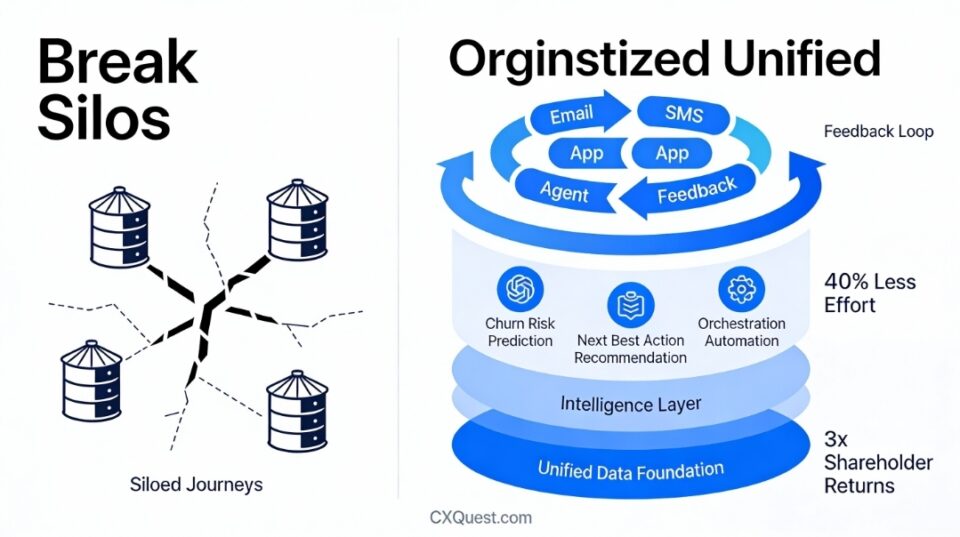
Customers are not waking up thinking, “I hope your martech stack finally integrates today.” They just want their issue resolved, in one try, without repeating themselves, on the channel they prefer. And that simple expectation is exactly where most CX programs still fail.This article explores how AI-powered journey orchestration can help CX leaders break silos, fix fragmented journeys, and turn AI from buzzword to business outcome.
What Is AI Journey Orchestration and Why CX Teams Need It?
AI journey orchestration uses real-time data and intelligence to decide the next best action across channels, so customers move smoothly from problem to resolution. It connects silos, personalizes at scale, and reduces effort in one unified motion.
Instead of thinking in terms of channels or departments, orchestration treats the customer journey as a living system. It listens, predicts, and responds in real time using shared data, automation, and human support where it matters most.
What Is Breaking Your Journeys Today?
Most CX breakdowns do not start with bad intentions but with fragmented decisions made in different corners of the organization. The result is a journey that feels stitched together rather than designed.
Common structural problems include:
- Siloed data and systems
- 71% of companies use six or more tools or systems just to manage service.
- Data silos stop teams from seeing a single customer truth, which directly hurts personalization and loyalty.
- Channel- and function-first design
- Marketing, sales, service, and product design journeys in isolation.
- Customers experience inconsistent answers, repeated verification, and contradictory offers across touchpoints.
- Point AI without a journey spine
- Chatbots, analytics, and personalization engines run as disconnected pilots.
- Without orchestration, AI becomes another silo, not a force multiplier.
These issues are not just operational annoyances. Organizations with fewer silos can outperform peers by nearly three times in total shareholder returns, showing a direct growth impact.
How Does AI Journey Orchestration Actually Work?
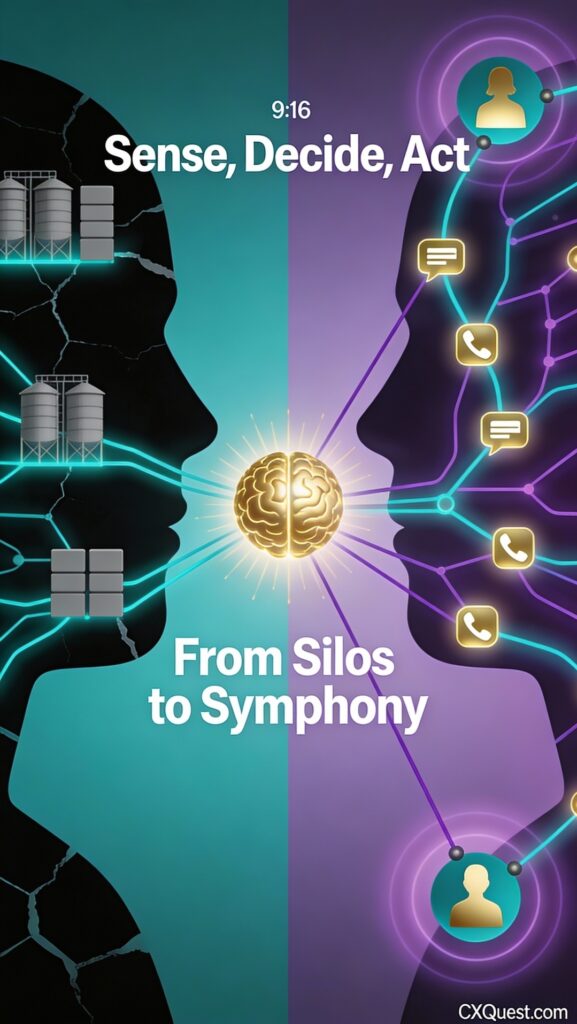
AI journey orchestration connects data, intelligence, and actions so every interaction can adapt in real time. Think of it as a “customer nervous system” that senses, decides, and acts continuously.
At a high level, most mature setups share four layers:
- Data foundation
- Unified profiles from CRM, contact center, web, app, billing, and product usage.
- Cleaned and governed to support real-time decisioning, not just reporting.
- Intelligence and decisioning
- Predictive models score churn risk, intent, and next best actions.
- AI and machine learning turn streaming behavior into recommendations, alerts, and proactive outreach.
- Orchestration and automation
- Visual journey designers create rules, triggers, and paths across email, SMS, apps, IVR, and agents.
- Workflows push tasks into contact center, field service, operations, and back-office systems.
- Experience and feedback
- Experiences run across CCaaS, marketing hubs, digital experience platforms, and self-service portals.
- Continuous analytics loop performance back into the models and journey design.
Leading vendors are already merging these capabilities into broader CX ecosystems, bringing journey analytics, AI routing, and real-time decisioning together in single platforms.
What Outcomes Can CX Leaders Realistically Expect?
When journey orchestration moves from pilot to operating model, results appear in both customer and cost metrics.
Evidence from recent research and implementations shows:
- Lower effort, higher resolution
- Early adopters of journey-first design report 40% lower customer effort and 25% more first-contact resolutions.
- Better routing and guidance reduce channel switching and repeated contacts.
- Revenue uplift and cross-sell
- The same journey-first programs see around 30% higher cross-sell rates due to more relevant offers at the right moment.
- Hyper-personalization through predictive AI drives engagement and loyalty across channels.
- Cost and complexity reduction
- Breaking tech silos can cut long-term integration costs by up to 50%.
- Service automation and AI deflection reduce manual workloads while maintaining or improving customer satisfaction.
- Stronger trust and emotional resonance
- CX research shows a shift from transactional measures to dynamic, emotional, and co-created experiences, with trust and personalization as central drivers.
- Human-AI collaboration lets agents focus on empathy while AI handles repetitive tasks and insights.
These outcomes are achievable, but only when orchestration is treated as an enterprise capability, not another tool.
What Does a Practical Orchestration Blueprint Look Like?
Here is a simple, CX-leader-friendly blueprint that moves from theory to implementation.
1. Define journeys that matter most
Focus on three to five journeys that drive disproportionate value or pain.
- Examples: onboarding, billing issues, plan changes, churn save, claims, or service disruption.
- For each journey, map stages, channels, handoffs, systems, and emotions.
2. Build a minimum viable data foundation
You do not need perfect data everywhere; you need the right data for the target journeys.
- Start with identity, interaction history, product holdings, and recent behaviors.
- Establish one integration layer that feeds your orchestration platform in near real time.
3. Introduce AI where it moves the needle
Use AI to predict, not just to report.
- Use predictive models for churn risk, intent, and likely next steps on each journey.
- Combine models with business rules to generate next best actions that are understandable and controllable by CX teams.
4. Design journeys as “decision flows,” not campaigns
Shift from static campaigns to adaptive flows.
- In visual journey builders, define entry criteria, triggers, and guardrails such as frequency caps and quiet hours.
- Ensure journeys can switch channels seamlessly if a customer does not respond or exhibits high-friction signals.
5. Close the loop with measurement and ops
Measurement turns orchestration into a learning system.
- Track not just CSAT and NPS, but also effort scores, resolution rates, and time to value per journey.
- Use “integration health” metrics like data-flow success rate and interoperability score to keep the engine stable.
Which Roles and Operating Model Do You Need?
Technology alone will not break silos. The operating model must change.
Critical roles and practices include:
- Journey owners
- Senior leaders accountable for an end-to-end journey across functions, budget, and KPIs.
- They align teams on shared objectives such as reducing effort, improving loyalty, or increasing lifetime value.
- CX analytics and insights partners
- Specialists who translate journey data into insights and model requirements.
- They enable self-service analytics for CX, marketing, and product teams to reduce dependence on IT.
- Human-AI collaboration designers
- Teams that design when AI acts alone, when it augments agents, and when humans take full control.
- This design is critical to maintain trust, explainability, and ethical boundaries.
Organizations that reimagine front-office leadership with shared goals and cross-functional models see more coherent experiences and faster transformation.
Common Pitfalls CX Leaders Should Avoid
Many orchestration programs fail for predictable reasons. Avoid these traps:
- Tech-first, journey-second
- Buying a platform before defining target journeys and outcomes leads to low adoption.
- Over-automation without empathy
- Excessive deflection or impersonal bots damage trust, especially in high-stakes scenarios.
- Ignoring governance and ethics
- Weak consent management, opaque AI decisions, and poor explainability can trigger backlash and regulatory risk.
- No change management for front-line teams
- Agents stuck with old KPIs and tools cannot realize the value of orchestrated journeys.
Building a clear governance framework and communication plan from day one can prevent these issues and sustain momentum.
Example Table: From Siloed CX to Orchestrated CX
| Dimension | Siloed CX Reality | Orchestrated CX Reality |
|---|---|---|
| Data | Fragmented across tools and teams; hard to reconcile | Unified profiles and streaming events feeding one decisioning layer |
| Decision-making | Local, channel-based, often manual | Centralized logic with AI-driven next best actions |
| Journeys | Static campaigns and ad-hoc fixes | Dynamic, real-time flows across channels |
| Metrics | Channel KPIs, lagging reports | Journey KPIs, effort, and predictive signals |
| Customer perception | Repetition, inconsistency, frustration | Seamless, proactive, and personalized support |
| Business impact | Higher costs, lost loyalty, stalled growth | Increased loyalty, revenue, and lower integration costs |
FAQ: AI Journey Orchestration for CX Leaders
1. How is journey orchestration different from traditional marketing automation?
Journey orchestration uses real-time data and AI to coordinate experiences across service, sales, and product, not just campaigns. It responds to live customer behavior instead of pushing pre-set sequences.
2. Do we need a full data lake before starting orchestration?
No. You can start with a minimum viable data layer focused on priority journeys, then expand. Many organizations see strong results by unifying only a few critical data sources first.
3. Where should AI show up first in our journeys?
Begin where prediction directly changes an outcome, such as churn save offers, proactive outreach for at-risk orders, or intelligent routing to the right agent or channel.
4. How do we protect privacy and trust while personalizing?
Use transparent consent practices, clear value exchanges, explainable AI decisions, and configurable guardrails that respect frequency, sensitivity, and regulatory constraints.
5. What KPIs best prove orchestration value to the C-suite?
Track effort reduction, first-contact resolution, conversion or save rates on target journeys, and cost-to-serve changes alongside traditional CSAT and NPS.
6. How do we align siloed teams around journey orchestration?
Appoint journey owners, define shared journey-level goals, create cross-functional squads, and measure success on joint outcomes rather than channel KPIs alone.
Actionable Takeaways for CX Leaders
- Identify your top three high-impact journeys and map them end-to-end, including emotions, handoffs, and systems.
- Build a minimal unified data set for those journeys by integrating just the most critical sources into one decisioning layer.
- Select or extend an orchestration platform that can connect to your contact center, CRM, and digital channels in real time.
- Define clear next best actions per journey stage, combining business rules with simple predictive models to start.
- Pilot one orchestrated journey, instrument it with journey-specific KPIs, and compare outcomes against a control group.
- Enable front-line teams with new insights, playbooks, and feedback loops so they can co-create better journeys with AI.
- Establish governance covering data quality, consent, AI ethics, and cross-functional ownership for each orchestrated journey.
- Scale only after one or two journeys consistently deliver measurable improvements in effort, resolution, and revenue.
CXQuest.com Articles Featuring Real Journeys
- Customer Lifetime Value: India’s AI CX Orchestration Secret
Focuses on how Indian enterprises use AI-led orchestration to reduce CX fragmentation, improve CLV, and operationalize journey audits with 90-day roadmaps. - AI Orchestration in CX is Revolutionizing Contact Centers
Examines an Avaya-led study on how AI orchestration transforms contact centers, driving hyper-personalization and efficiency with real-time routing and automation. - Real-Time Customer Experience: United Airlines’ Success Story
Case study of how United Airlines consolidates real-time data, empowers staff, and uses its app ecosystem to lift NPS, revenue, and operational efficiency. - DataQuark Transforms CX with AI-Driven Customer Insights
Shows how LS Digital’s DataQuark unit unifies marketing, finance, sales, and operations data to enable real-time insights and seamless omnichannel journeys. - Mahalaxmi Metro Station: HDFC Life’s Journey of Trust and Transformation
Explores how HDFC Life integrates physical and digital touchpoints at Mahalaxmi Metro to create a cohesive, emotionally resonant customer journey. - AI-Native UX: Transforming Marketing with Unified AI Decisioning & Insights
Discusses how unified AI decisioning, content, and insights reshape marketing and CX, enabling smarter, intuitive AI-powered workflows. - AI-Led, Platform-Driven Services Elevate Persistent’s Customer-Centric Growth
Highlights Persistent Systems’ platform-driven, AI-led services that anticipate customer needs and deliver personalized solutions at scale.
Delve into some more articles:
- CX Strategy: Building Customer Experience That Delivers
Provides strategy and examples of companies redesigning journeys end-to-end, such as a bank compressing onboarding from days to minutes. - Mastering Customer Experience for Business Success
Uses examples like streaming and ecommerce brands to show how personalization and omnichannel journeys drive loyalty and growth. - Unlocking Hyper-Personalized Customer Experiences with AI
Explores how brands use AI to power hyper-personalized omnichannel journeys that build trust and connected experiences. - 10 Most Common Customer Experience Mistakes Leaders Make
Includes a retailer example where journey mapping exposes root causes of contact volume and unlocks significant CX and financial gains. - Xperience 2025: Future of AI-Powered Customer Experience
Covers Genesys Xperience insights on agentic AI and CX orchestration, showing how enterprises re-architect journeys around AI and data. - Customer Experience in 2026: 4 AI Shifts Every Leader Must Know
Analyzes how accessible AI changes CX operating models, including journey-level orchestration and democratized decisioning. - Journey Orchestration Tag Archive
Central hub aggregating CXQuest pieces on journey orchestration, AI-human gaps, and orchestration-centric CX evolution.
