How Zendesk’s Acquisition of Unleash Signals the Next Frontier in AI-First Employee Experience
Imagine this: an employee in a growing fintech startup begins her day with ten unresolved IT tickets, half-written product documentation, and crucial data scattered across SharePoint, Slack, and Confluence. She tries searching for policy updates, only to find outdated results and delayed responses from support. Frustration brews, productivity drops, and her trust in internal systems weakens.
Now, envision the same scenario where AI delivers a precise, permission-secure answer directly within Slack — accurate, contextual, and instant. That’s the promise Zendesk just made real with its acquisition of Unleash.
This move isn’t merely a product expansion. It’s a signal that employee experience is becoming the new competitive battlefield in AI-driven organizations.
What Is Unleash and Why Does It Matter for EX Leaders?
Unleash is an AI-powered enterprise search platform that connects data across 70+ tools — from Google Drive to SharePoint. It ensures employees get permission-based, context-rich answers instantly, transforming fragmented internal service into unified experience delivery.
At its core, Unleash addresses a silent CX killer: internal friction. When employees can’t find the right information, customer outcomes suffer downstream — a truth every CX leader now recognizes.
By integrating Unleash, Zendesk accelerates a new model of AI-first employee support — where contextual knowledge is the currency of speed and service quality.
How Does This Acquisition Reshape AI-First Employee Experience?
Zendesk’s integration of Unleash goes beyond feature expansion; it represents a strategic shift toward integrated intelligence across enterprise ecosystems.
Key enhancements include:
- Permission-based Retrieval-Augmented Generation (RAG): AI respects security barriers while fetching contextual insights.
- Native knowledge agents built directly into Slack and Microsoft Teams, bridging silos where employees already collaborate.
- End-to-end context modeling: Every response embeds an understanding of company language, processes, and priorities.
- Unified governance: Consistent compliance, privacy, and accuracy across knowledge channels.
In simple terms, Zendesk is weaving AI into the fabric of employee workflows, making organizational knowledge usable at scale.
Why Should CX Leaders Care About Internal Service Automation?
Because customer experience starts with employee experience. If your internal teams waste hours locating answers, verifying policies, or escalating simple queries, your customer-facing agility erodes.
According to recent enterprise benchmarks, organizations with robust internal support automation report:
- 30–40% faster issue resolution rates
- 25% higher employee satisfaction scores
- Significant reduction in redundant support tickets
Zendesk’s Unleash integration will likely extend these gains — converting invisible operational time into measurable service outcomes.
What Are the Broader Implications for the AI-Powered Enterprise?
The acquisition spotlights three major shifts defining 2026-ready CX/EX strategies:
- From Generative to Goverened AI: Enterprises demand not just smart answers, but auditable intelligence. Zendesk’s permission-aware architecture ensures that every AI interaction meets compliance requirements.
- From Fragmented Tools to Unified Context: Connecting enterprise systems under a single semantic layer removes the most persistent bottleneck: disconnected knowledge.
- From Reactive to Predictive Service: AI agents won’t just answer questions — they’ll anticipate needs by understanding behavioral patterns across communication channels.
This sets the foundation for proactive EX ecosystems, where employees spend less time searching and more time solving.
How Can Enterprises Implement an AI-First EX Framework?
Implementation shouldn’t begin with technology — it starts with designing trustable, context-rich knowledge flows. Here’s a simple adoption roadmap:
- Audit internal knowledge silos. Identify where information fragmentation hurts service continuity.
- Map high-friction employee journeys. Pinpoint top repeat queries or bottlenecks where AI intervention adds measurable value.
- Apply permission frameworks. Align data governance rules before automation deployment.
- Embed AI directly in workplace tools. Integrate trusted platforms like Zendesk’s AI Agents within Slack or Teams.
- Monitor, learn, and iterate. Use analytics to refine knowledge accuracy and identify new automation opportunities.
The shift to an AI-first EX isn’t about replacing human support; it’s about augmenting employee intelligence with enterprise context.
What Does This Mean for CX & EX Alignment?
In mature organizations, the line between CX (Customer Experience) and EX (Employee Experience) is fading. Zendesk’s strategy embodies this convergence:
- Shared platforms streamline both external and internal support.
- Consistent governance ensures compliance across all data flows.
- Knowledge reuse between customer and employee channels reduces operational duplication.
A CX leader’s new role is to orchestrate value chains where internal speed equals external satisfaction.
Key Insights from the Zendesk–Unleash Integration
- AI belongs in the workflow, not on the periphery. Knowledge should reach employees where they work — in chat, tickets, or collaboration apps.
- Governance-first AI builds confidence. Adoption thrives when privacy, permissions, and accuracy are non-negotiable.
- Unified knowledge boosts customer velocity. Better internal answers create faster, more consistent customer resolutions.
- The future of CX excellence is full-context AI. Zendesk is setting a precedent for how contextual intelligence shapes service experience — both inside and outside the enterprise.
Common Pitfalls to Avoid in AI-EX Transformation
- Over-automating without governance: AI that ignores access rules introduces compliance risk.
- Deploying tools without change management: Employees bypass systems they don’t trust or understand.
- Ignoring content hygiene: Poorly tagged or outdated internal data undermines AI accuracy.
- Measuring outputs, not outcomes: Tracking response volume instead of employee productivity misses true impact.
CX/EX transformation leaders must integrate cultural readiness with technical rollout for sustained adoption.
How Is Zendesk Redefining “AI + Human” Collaboration?
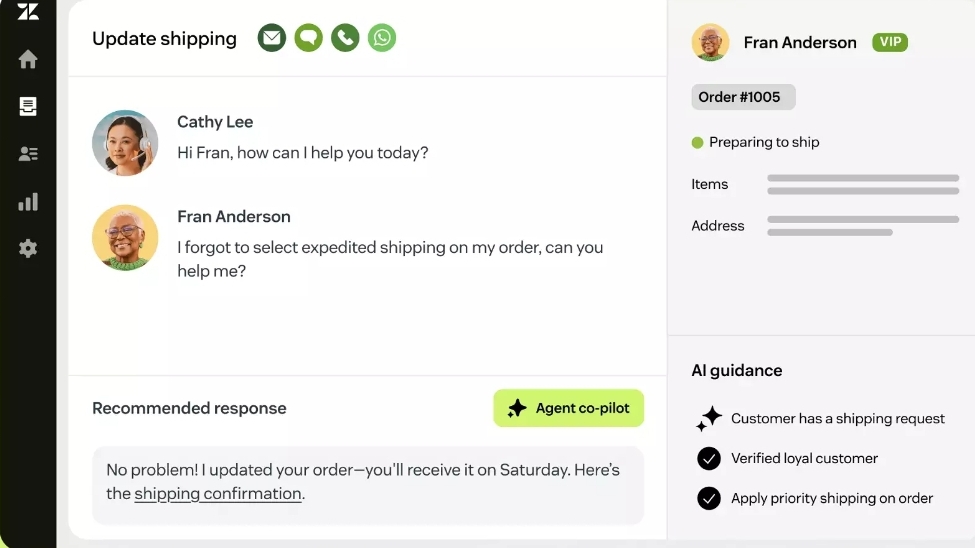
Zendesk isn’t discarding the human element—it’s enhancing it. With AI-driven handoffs and escalation workflows, agents receive context-rich case data before interaction even begins.
That translates to:
- Less time spent gathering redundant details.
- Higher first-contact resolution rates.
- Improved emotional experience for both employee and requester.
This “AI-assisted empathy” model is what’s fast becoming the gold standard for support ecosystems.
FAQ: Understanding AI-Driven Employee Support
1. How does AI enterprise search differ from traditional search tools?
Traditional search retrieves documents; AI enterprise search retrieves answers, contextualized by permissions, recency, and relevance.
2. Is permission-based RAG essential for enterprise AI deployment?
Yes. It ensures AI only accesses data authorized for each user, maintaining security and compliance integrity.
3. Can generative AI replace human support teams?
Not entirely. It automates routine queries but enhances humans’ ability to resolve complex, emotional, or ambiguous requests faster.
4. How does unified knowledge improve customer experience?
When employees resolve internal queries faster, they deliver faster customer responses — closing the gap between internal efficiency and external satisfaction.
5. What challenges should CX leaders anticipate in AI-first transformations?
Data silos, resistance to change, and governance complexity are major hurdles. A phased, transparent rollout strategy mitigates these challenges.
Zendesk Unleash: Actionable Takeaways for CX/EX Leaders
- Launch an “Internal Support Maturity Audit.” Evaluate how easily your employees access critical data.
- Adopt permission-based AI frameworks. Prioritize systems that respect enterprise security norms from the start.
- Embed AI where employees already work. Integrate intelligent assistants in Teams, Slack, and Zendesk portals.
- Train teams on AI-human collaboration. Elevate the human role to decision and empathy layers, not basic retrieval.
- Build a unified knowledge graph. Connect documents, policies, and conversations into a single searchable network.
- Create an EX governance council. Include HR, IT, Legal, and CX to unify AI, privacy, and usability goals.
- Monitor value through analytics. Track time-to-resolution, satisfaction uplift, and automation coverage monthly.
- Prototype, measure, and iterate. Treat EX-AI rollout as a living program, not a one-time implementation.
Zendesk’s acquisition of Unleash is more than a corporate move—it’s a strategic blueprint for the future of service intelligence. As AI becomes the bridge between people, knowledge, and context, the enterprises that master this harmony will define the next era of CX and EX excellence.
How Zendesk Unleash Move Transforms EX for CX Leaders
Picture a CX director in Delhi’s bustling fintech hub. Her team chases customer queries while IT tickets pile up across silos. Employees hunt for policies in Drive, Confluence, SharePoint—wasting hours. Customer journeys fragment as internal delays mount.
Zendesk’s acquisition of Unleash ends this chaos. It delivers AI answers in Slack or Teams, permission-secure and instant. CXQuest analysis shows this unifies EX, fueling CX speed.
This strategy piece equips intermediate CX/EX leaders with frameworks, outcomes, and implementation steps.
What Is Unleash and Why CX Teams Need It Now?
Unleash powers AI enterprise search across 70+ sources like Google Drive, Confluence, SharePoint. It uses permission-based RAG for compliant, contextual answers right in collaboration tools.
CX leaders need it because EX friction kills customer outcomes. Zendesk data reveals 30-40% faster resolutions in automated EX setups. Internal speed directly lifts CX satisfaction.
Adoption surged in 2025. Trendsetters triple AI use, per Zendesk’s CX Trends Report, hitting 80% autonomous resolutions.
How Does Unleash Reshape AI-EX Workflows?
Unleash embeds native AI agents in Slack and Teams with seamless human handoffs. Secure connectors apply access controls at query time.
Zendesk integrates this into Resolution Platform for end-to-end context. Employees get insights without leaving workflows. Analytics track automation gains.
Outcomes match 2025 benchmarks: 25% EX satisfaction uplift, fewer tickets. CXQuest sees this as CX/EX convergence blueprint.
| Feature | Benefit | CX Impact |
|---|---|---|
| Permission RAG | Compliant answers | Zero data breaches |
| Channel Agents | Workflow-native AI | 40% faster resolutions |
| 70+ Connectors | Silo unification | Unified knowledge graph |
| Escalation Handoffs | AI + Human | Higher first-contact wins |
Why Prioritize EX Automation Amid CX Fragmentation?
EX automation cuts internal query time by 30%, per enterprise benchmarks. Siloed teams delay customer responses—Unleash fixes this.
Shashi Upadhyay, Zendesk President, notes AI must flow in workstreams for mission-critical support. Itay Itzhaki, Unleash CEO, stresses accessible knowledge with security.
2025 CX Trends confirm: Human-centric AI drives loyalty. Assistant-first models handle 67% interactions seamlessly.
What Frameworks Guide AI-First EX Implementation?
Start with a 5-step EX Maturity Framework: Audit, Map, Govern, Embed, Iterate. Tailor to silos, AI gaps, journey breaks.
- Audit Silos: Scan 70+ sources for fragmentation.
- Map Journeys: ID top queries via Zendesk analytics.
- Govern Data: Set RAG permissions pre-launch.
- Embed Agents: Deploy in Teams/Slack first.
- Iterate: Measure ROI monthly.
CXQuest hub recommends this for intermediate leaders facing real challenges. Voice AI agents resolve speech issues autonomously.
Key Insights from Zendesk Unleash Strategic Play
AI shifts from generative to governed intelligence. Unleash ensures auditable, secure responses across ecosystems.
Context unifies CX/EX. Shared platforms reuse knowledge, slashing duplication. Employees resolve faster; customers feel it.
Proactive service emerges. Agents predict needs via patterns, per Zendesk Summit updates. Trendsetters lead with 3x AI adoption.
Human role elevates. AI handles routine; experts focus on empathy, complexity.
Common Pitfalls in AI-EX Rollouts
Skip governance, risk breaches. Always apply permissions at query.
Neglect change management. Train for AI-human trust. Employees bypass untrusted tools.
Overlook data hygiene. Tag content or AI fails.
Chase metrics wrongly. Track outcomes like resolution time, not just volume. CXQuest warns: Poor EX erodes CX velocity.
How Does Zendesk Unleash Align CX and EX for 2026?
Unified platforms bridge CX/EX. Zendesk extends employee AI to customer service seamlessly.
Governance consistency builds trust. Knowledge graphs span internal-external flows. CX leaders orchestrate this for agility.
Outcomes: 20,000+ customers hit $200M AI ARR. Efficiency soars; loyalty follows.
FAQ: Zendesk Unleash for CX/EX Leaders
How does permission-based RAG secure enterprise AI?
It checks user access at query time across 70+ sources, blocking unauthorized data while delivering context-rich answers.
What ROI can CX teams expect from Unleash integration?
30-40% faster resolutions, 25% EX uplift, ticket reductions—mirroring Zendesk’s 5B annual issues benchmark.
Can Unleash agents handle complex, emotional EX queries?
Routine yes; they handoff context to humans for empathy-driven resolutions, boosting first-contact rates.
How does EX AI impact customer journey fragmentation?
Faster internal answers speed CX delivery, unifying silos for consistent outcomes.
What’s the rollout timeline for AI-first EX?
Audit-map phase: 2 weeks. Pilot in Teams: 4 weeks. Full scale: 3 months with iteration.
Does Unleash compete with Glean or internal tools?
No—focuses on service workflows, permission RAG, Zendesk-native escalation.
Actionable Takeaways for CX Pros
- Audit silos today. List top 10 query sources and gaps.
- Build governance first. Define RAG rules with IT/Legal.
- Pilot in Slack/Teams. Deploy agents for one department; measure time savings.
- Map CX/EX links. Trace internal delays to customer impacts.
- Train on handoffs. Role-play AI-to-human escalations weekly.
- Unify knowledge graph. Connect Drive/Confluence via connectors.
- Track KPIs monthly. Resolution time, satisfaction, automation %.
- Scale with insights. Use Zendesk analytics for predictive tweaks.
